

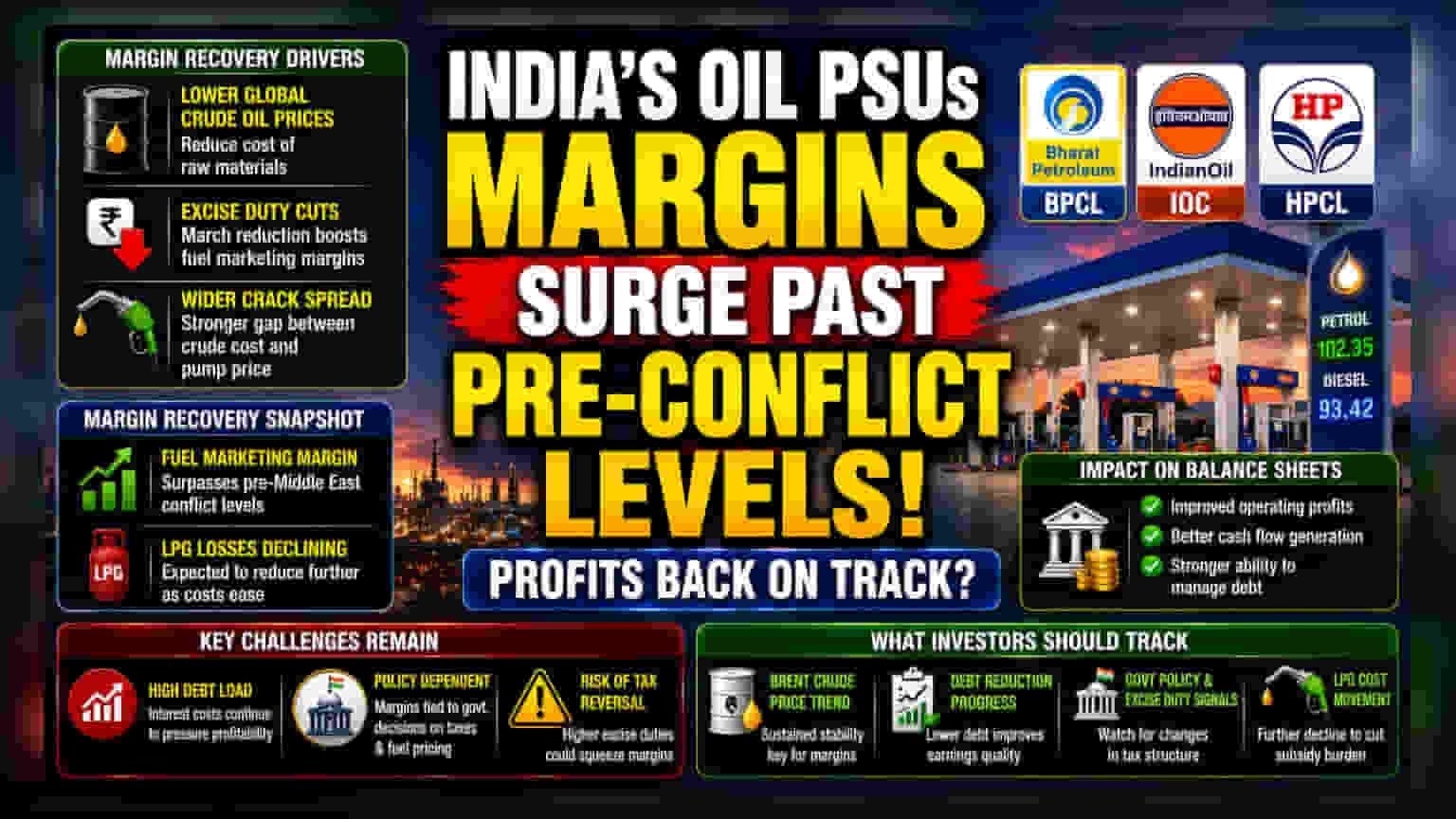
Indian state-run oil marketing companies are witnessing a rebound in fuel marketing margins due to lower crude prices and previous excise duty cuts. While this supports short-term profits for BPCL, IOC, and HPCL, investors are monitoring high debt levels and the uncertainty surrounding potential changes in government tax policies.
What Happened
State-run oil marketing companies (OMCs) in India are seeing a recovery in their core profitability. Companies including Bharat Petroleum Corporation Limited (BPCL), Indian Oil Corporation (IOC), and Hindustan Petroleum Corporation Limited (HPCL) have seen their fuel marketing margins—the profit earned on every liter of petrol and diesel sold—surpass levels seen before the recent geopolitical conflicts in the Middle East. This turnaround is largely attributed to a decrease in global crude oil prices, which lowers the cost of raw materials, and the central government's earlier decision to reduce excise duties on fuel.
The Margin Recovery Story
Fuel marketing margins are crucial for OMCs because they represent the profit companies make after accounting for the price at which they buy oil and sell it at retail petrol pumps. When global oil prices spike, these companies often hold retail prices steady to protect consumers, which squeezes their profit margins. As global prices have softened, the gap between the cost of crude oil and the pump price has widened, leading to an improvement in the companies' financial health. While losses on the sale of Liquefied Petroleum Gas (LPG) are still significant, they are also expected to decline as the cost benefits flow through the system.
The Debt and Regulatory Challenge
Despite the improved environment, the sector faces structural challenges that impact long-term outlooks. Many OMCs took on significant debt to fund operations during periods when global oil prices were high and retail prices remained fixed. This debt acts as a drag on the companies' ability to improve their balance sheets.
Furthermore, the profitability of OMCs is deeply tied to government policy. A large part of the current margin recovery stems from the reduction in excise duties implemented in March. There is ongoing uncertainty about whether the government might restore these taxes to manage its own spending commitments. Any increase in taxes or sudden policy shifts could put pressure on the margins of these companies again, regardless of global price trends.
What Investors Should Track
Investors typically view the OMC sector as a tactical play, meaning it is often traded based on short-term market cycles rather than long-term growth. The primary factor to monitor is the movement of Brent crude oil prices, as sustained volatility directly impacts operating costs. Additionally, keeping an eye on the companies' debt reduction efforts is important, as high interest payments can offset gains from improved fuel margins. Finally, government communications regarding excise duties and fuel pricing policy will be the most significant indicator of future earnings stability for BPCL, IOC, and HPCL.