

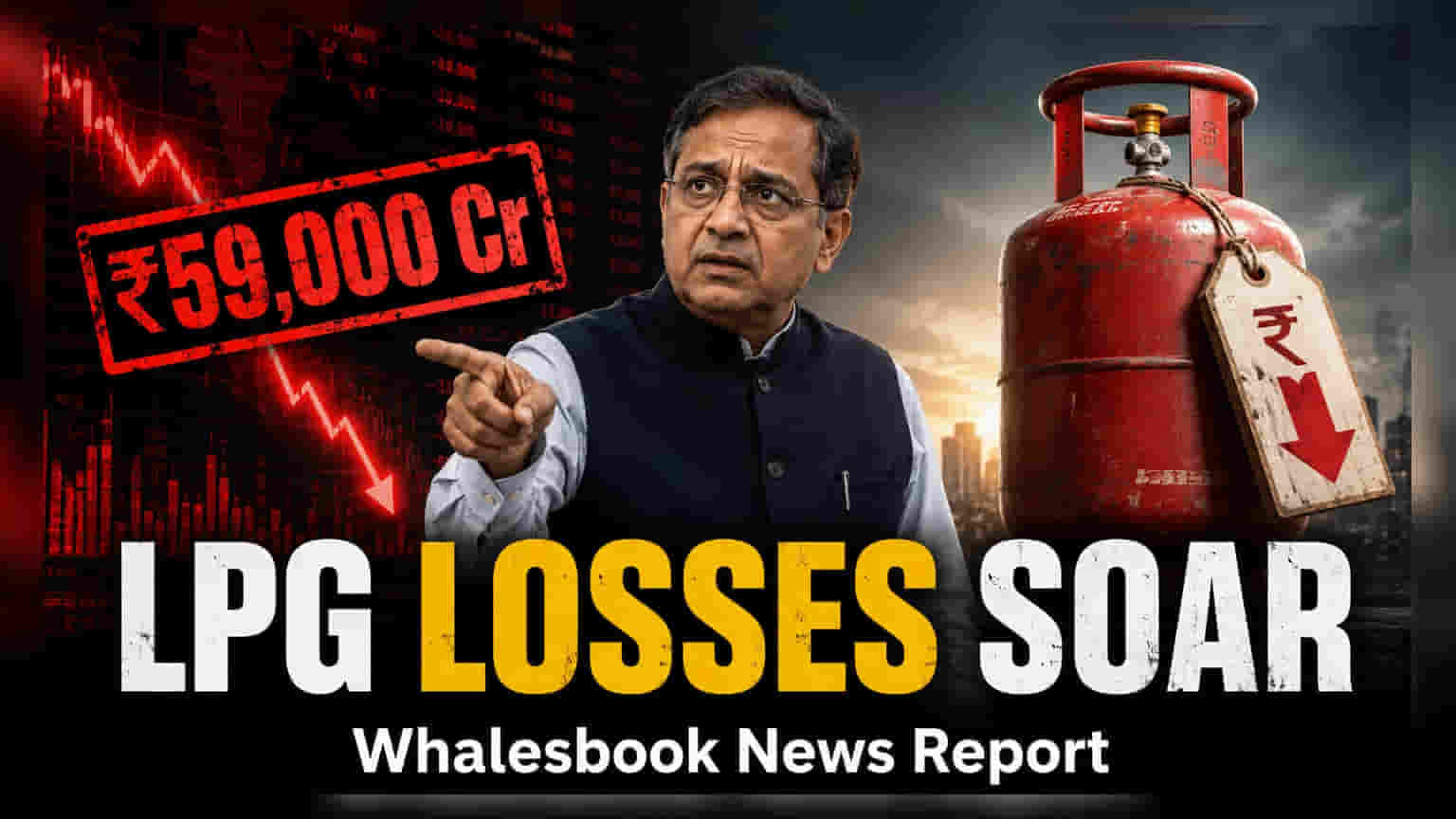
State-run oil marketing companies are grappling with over ₹59,000 crore in losses from selling LPG below market rates. High global prices, driven by Middle East tensions, have squeezed margins for Indian Oil, BPCL, and HPCL despite government compensation. Investors are monitoring how this financial burden impacts the balance sheets and debt levels of these public sector companies.
State-run oil marketing companies (OMCs) in India are currently managing a cumulative financial deficit, or "under-recovery," of over ₹59,000 crore on domestic cooking gas (LPG) sales as of the end of July 2026. This financial gap arises when these companies sell fuel to households at prices lower than the actual cost of procurement and distribution. While the government has stepped in with significant financial aid, the scale of the deficit continues to place pressure on the financials of major public sector players, including Indian Oil Corporation (IOCL), Bharat Petroleum Corporation (BPCL), and Hindustan Petroleum Corporation (HPCL).
Impact on Oil Marketing Companies
The necessity to maintain stable retail prices for consumers has forced these companies to absorb the cost of price surges in international markets. This strategy has led to significant margin compression in the marketing segment, contributing to reported losses for companies like BPCL and HPCL during the first quarter of the 2026-27 financial year. For investors, the primary concern is how this sustained under-recovery impacts cash flow and debt accumulation. When the government compensation does not fully match the losses incurred, these companies often rely on borrowing, which can increase interest costs and weaken balance sheets over time. In Delhi, the retail price for a 14.2 kg domestic LPG cylinder has been steady at ₹942 since June 2026, even while global costs fluctuated.
Geopolitical Drivers of Cost
The rising costs are largely tied to international market volatility following geopolitical conflicts in West Asia. Disruption in key supply routes, including the Strait of Hormuz, has kept global prices for energy products elevated throughout 2026. The Saudi Contract Price, which serves as a global benchmark for LPG, saw a sharp increase earlier this year. When international prices remain high, the gap between the cost of the gas and the fixed retail price widens, increasing the per-cylinder loss for OMCs. While the government provides a targeted subsidy of ₹300 per cylinder for Ujjwala scheme beneficiaries, the broader retail market requires these companies to manage the remaining price difference.
Government Support and Future Monitoring
To help mitigate this strain, the government has provided substantial fiscal support, including ₹22,000 crore in the 2022-23 financial year and a commitment of ₹30,000 crore across the 2025-27 period. While this ₹52,000 crore in total compensation helps, the accumulated deficit of ₹59,000 crore indicates that losses are still outpacing current payout levels. Moving forward, investors will be closely tracking international crude and LPG price trends, as well as management commentary regarding debt levels and working capital requirements. Any further escalation in global prices or a delay in additional government support could remain a key monitorable for the profitability of these oil marketing firms.