 Whalesbook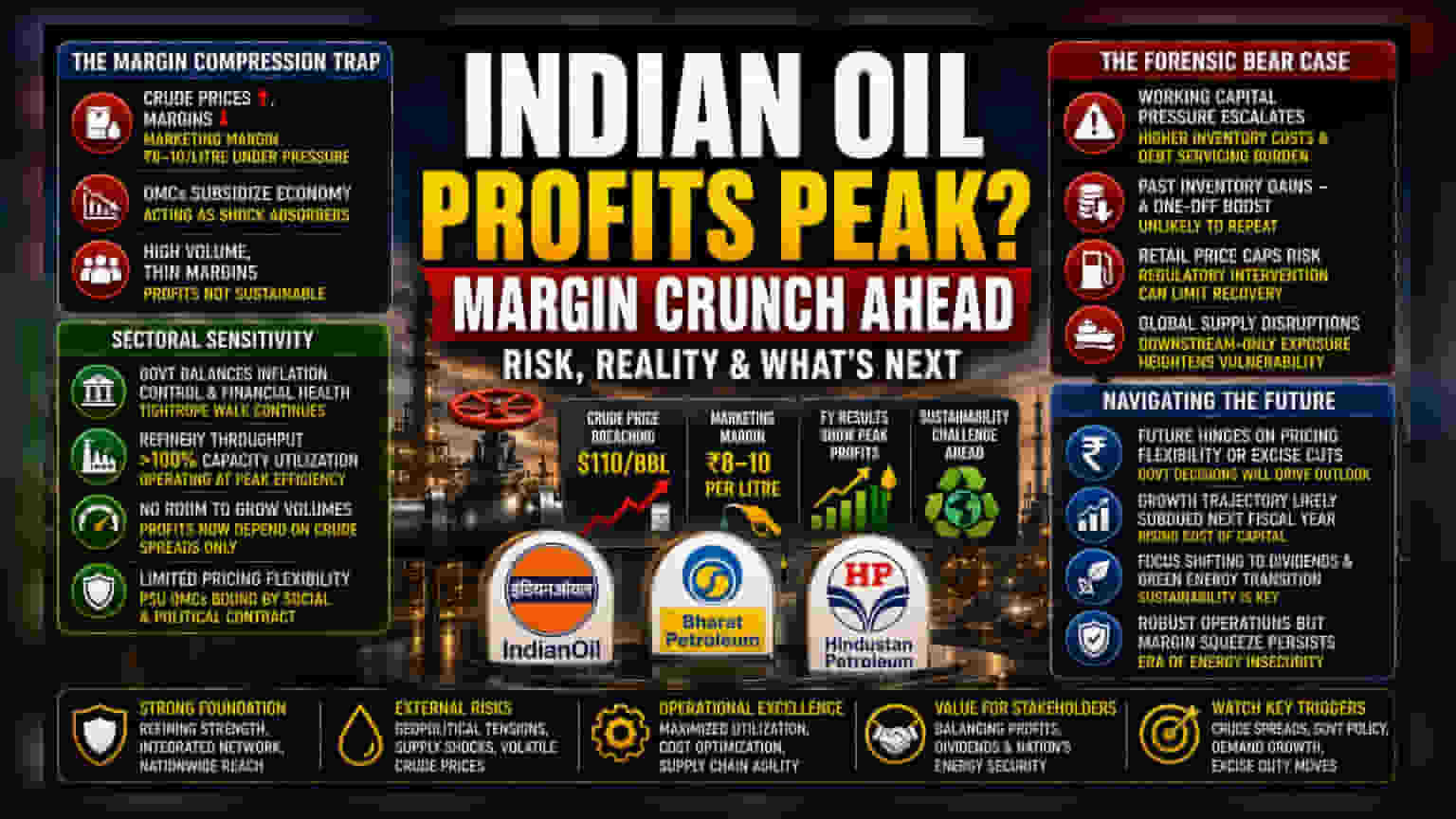


The Margin Compression Trap
While the fiscal year results paint a picture of unprecedented profitability for Indian Oil Corporation, Bharat Petroleum, and Hindustan Petroleum, these figures represent a rearview mirror perspective. The underlying reality is defined by the high-volume, thin-margin nature of the downstream sector. As crude prices breach critical thresholds, the marketing margins—typically stabilized between ₹8 and ₹10 per litre—are being rapidly liquidated to subsidize consumer retail prices. This effectively turns these entities into shock absorbers for the broader economy, a role that becomes increasingly untenable when the cost of imported feedstock climbs toward the $110 per barrel mark.
Sectoral Sensitivity and Macro Pressure
The financial stability of these state retailers is tethered directly to the government's delicate balancing act between managing retail inflation and ensuring the financial health of national energy assets. Unlike private sector peers who possess greater agility in adjusting to supply chain costs, public-sector undertakings operate under a tacit social contract that limits aggressive pricing maneuvers. Recent performance metrics, characterized by refinery throughputs exceeding 100% of installed capacity, indicate that the OMCs have been operating at maximum efficiency to compensate for margin slippage. However, capacity utilization has hit a ceiling, meaning further profit growth cannot be engineered through production volume alone; it is now entirely dependent on the volatile spread between crude input costs and retail realization prices.
The Forensic Bear Case
The primary risk factor currently facing these firms is the silent escalation of working capital requirements. As crude prices rise, the liquidity trapped in inventory and credit cycles expands, necessitating higher debt servicing costs. From a risk-averse standpoint, the heavy reliance on past inventory gains—profits generated by purchasing crude before recent price spikes—is a non-recurring benefit that will likely not repeat in the coming quarters. Furthermore, the persistent threat of regulatory intervention to cap retail prices, should inflation indicators tick upward, places a ceiling on how much these companies can recover from the market. Unlike international oil majors, which often have upstream assets to hedge against downstream losses, Indian state retailers remain heavily exposed to the downstream marketing cycle, leaving them vulnerable to any sustained disruption in global supply lines.
Navigating the Future Outlook
Market sentiment currently hinges on whether the government allows a more flexible retail pricing mechanism or opts for further excise duty adjustments to keep fuel prices muted. Brokerage analysis suggests that while the operational foundation remains robust, the growth trajectory for the next fiscal year will likely be subdued as the cost of capital climbs. Investors are shifting focus toward the sustainability of dividends and the ability of these firms to fund green energy transitions without diluting shareholder value, particularly as the margin squeeze persists in an era of persistent energy insecurity.