

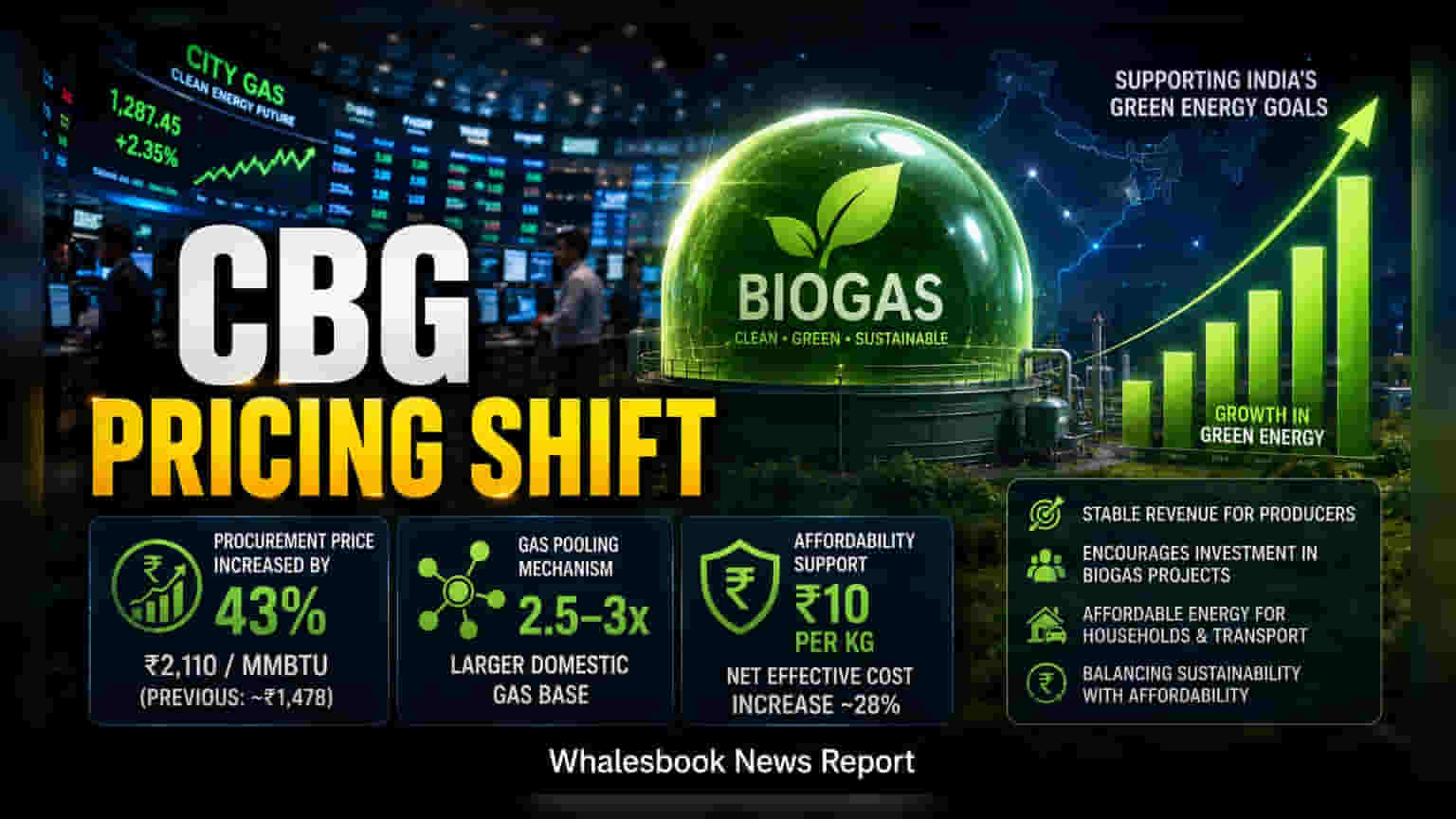
The Ministry of Petroleum and Natural Gas has clarified that a 43% increase in biogas procurement prices will not significantly burden retail consumers. By leveraging a broader gas pool and providing Rs 10 per kg in affordability support, the government aims to balance producer viability with retail price stability. Investors should track whether this pooling mechanism effectively shields margins for city gas distributors without creating long-term fiscal strain.
The Ministry of Petroleum and Natural Gas has clarified the financial mechanics behind the revised Compressed Biogas (CBG) pricing structure, aiming to address market concerns regarding potential retail price spikes. Under the new policy, the procurement price for biogas producers has been increased by 43%, rising to Rs 2,110 per million British thermal units (MMBtu) from the previous level of approximately Rs 1,478.
This adjustment is part of a broader strategy under the GOBARdhan Scheme, designed to provide more predictable and sustainable revenue for biogas producers. Historically, CBG pricing was linked to CNG retail rates, which created volatility and made it difficult for operators to plan long-term facility investments. By moving to a fixed procurement rate, the ministry intends to incentivize greater participation in the green energy space.
To prevent the full weight of this procurement hike from falling on households and transport users, the government is utilizing a gas pooling mechanism. Instead of passing the cost directly to retail consumers, the ministry is spreading the acquisition costs across a domestic gas base that is estimated to be 2.5 to 3 times larger than the previous scope. By expanding this footprint, the government believes it can effectively dilute the volatility of the price increase.
In addition to the pooling strategy, the government has introduced direct affordability support set at Rs 10 per kilogram. This buffer is designed to lower the effective cost recovery from end-users. According to the ministry, the net effective cost increase to be recovered through the consumer base is estimated at roughly 28%, significantly lower than the headline 43% increase paid to producers.
For investors, the policy represents a trade-off between supporting renewable energy production and managing retail fuel costs. While the new framework provides better price certainty for biogas producers, the reliance on government-funded affordability support introduces a degree of fiscal dependency. The long-term sustainability of this model will depend on whether the gas pooling mechanism can consistently absorb the costs without requiring future retail price adjustments for CNG and household PNG.
The key monitorable for market participants will be the stability of margins for city gas distribution companies that rely on this pooled gas. Investors may track whether the current cost-recovery strategy remains effective during periods of high energy price volatility or if the government faces pressure to adjust subsidy levels in the coming quarters.