

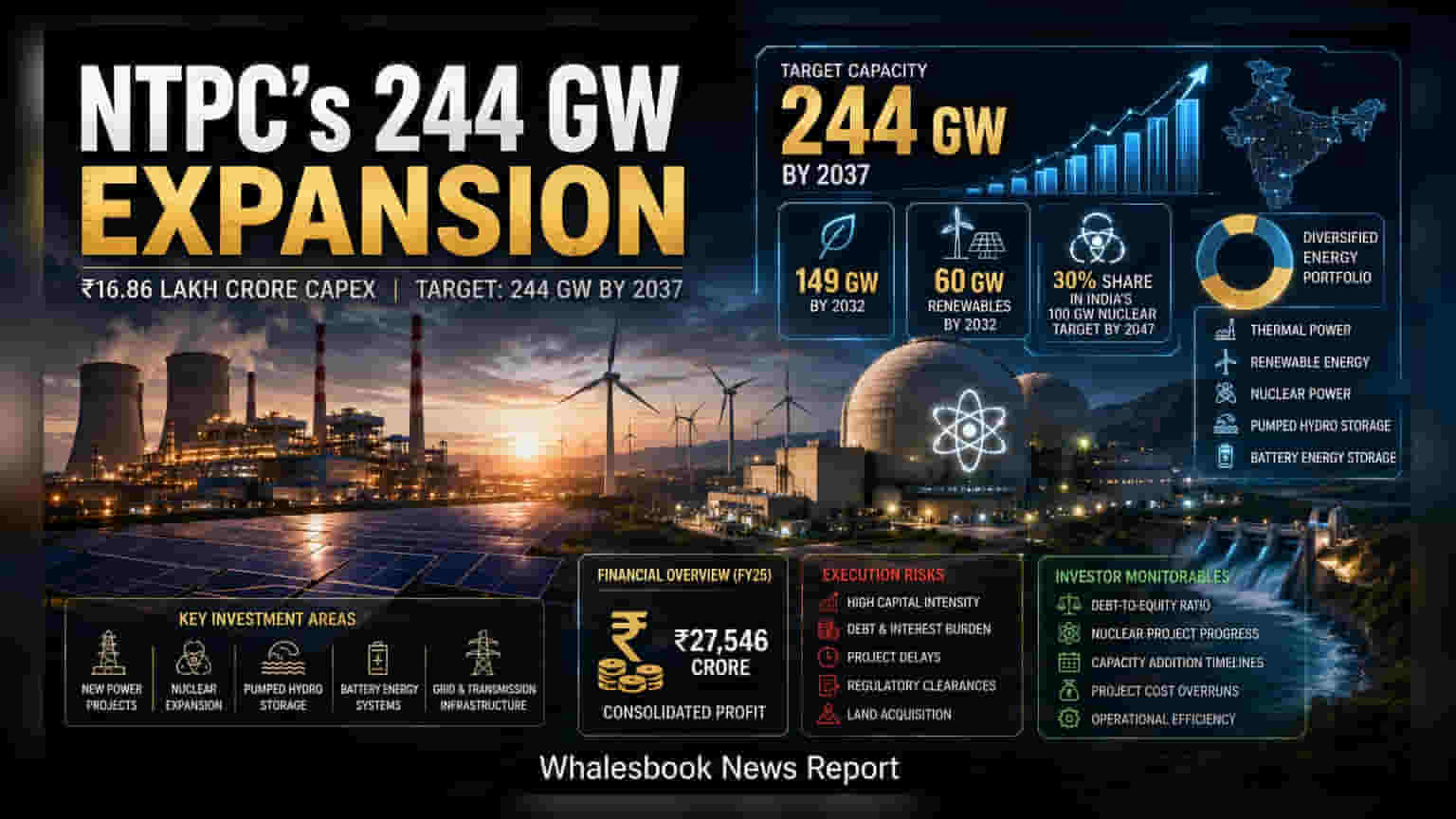
NTPC Limited has announced an ambitious long-term roadmap to reach 244 GW of power generation capacity by 2037, backed by a massive ₹16.86 lakh crore capital expenditure plan. The state-run utility aims to diversify into nuclear and green energy to meet rising national demand. Investors should note that such large-scale projects bring significant execution and debt-related challenges.
NTPC Limited has announced a major shift in its long-term growth strategy, committing to a massive capital expenditure (capex) plan of ₹16.86 lakh crore to reach a total generation capacity of 244 gigawatts (GW) by 2037. This expansion is designed to address the steady increase in India's power consumption by diversifying into new energy sectors while strengthening existing capabilities.
Scaling for Future Demand
The company’s roadmap includes an intermediate milestone of 149 GW capacity by 2032, with 60 GW specifically coming from renewable energy sources. This is a significant jump from the utility's current operational capacity of approximately 91 GW. The massive investment amount covers the entire energy chain, moving beyond traditional thermal power to include pumped hydro storage, battery energy systems, and, notably, a major focus on nuclear energy.
The Pivot Toward Nuclear Power
A key part of the new strategy is NTPC’s entry into nuclear power. The management has stated its ambition to capture a 30% share of India's government-set target of 100 GW in nuclear capacity by 2047. Beyond the existing joint venture project in Rajasthan, the company is evaluating 34 potential sites across 13 states. This shift is strategic, as nuclear energy provides stable, round-the-clock power, which helps balance the intermittent nature of solar and wind energy.
Financial and Execution Risks
While the expansion signals growth, it also carries substantial financial and operational weight. A capital expenditure of ₹16.86 lakh crore is a large commitment. For investors, the primary concern with such massive projects is the impact on the balance sheet. High spending often requires significant borrowing, which can increase interest costs and put pressure on profit margins if not managed efficiently.
Furthermore, the execution of projects of this scale—particularly in nuclear and large infrastructure—involves complex challenges. These include the difficulty of land acquisition, obtaining regulatory clearances, and the risk of delays, which can lead to cost overruns. The company reported a consolidated profit of ₹27,546 crore for the previous fiscal year, and maintaining healthy financial ratios while funding this expansion will be a critical task for the management.
What Investors Should Monitor
The success of this 15-year roadmap will depend on how the company manages its debt levels and maintains its operational efficiency. Going forward, the market will likely track the company's debt-to-equity ratio, the progress of feasibility studies for new nuclear sites, and the actual commissioning timelines for the announced capacity additions. The ability to balance this aggressive expansion with stable shareholder returns will be the central theme for the coming years.