

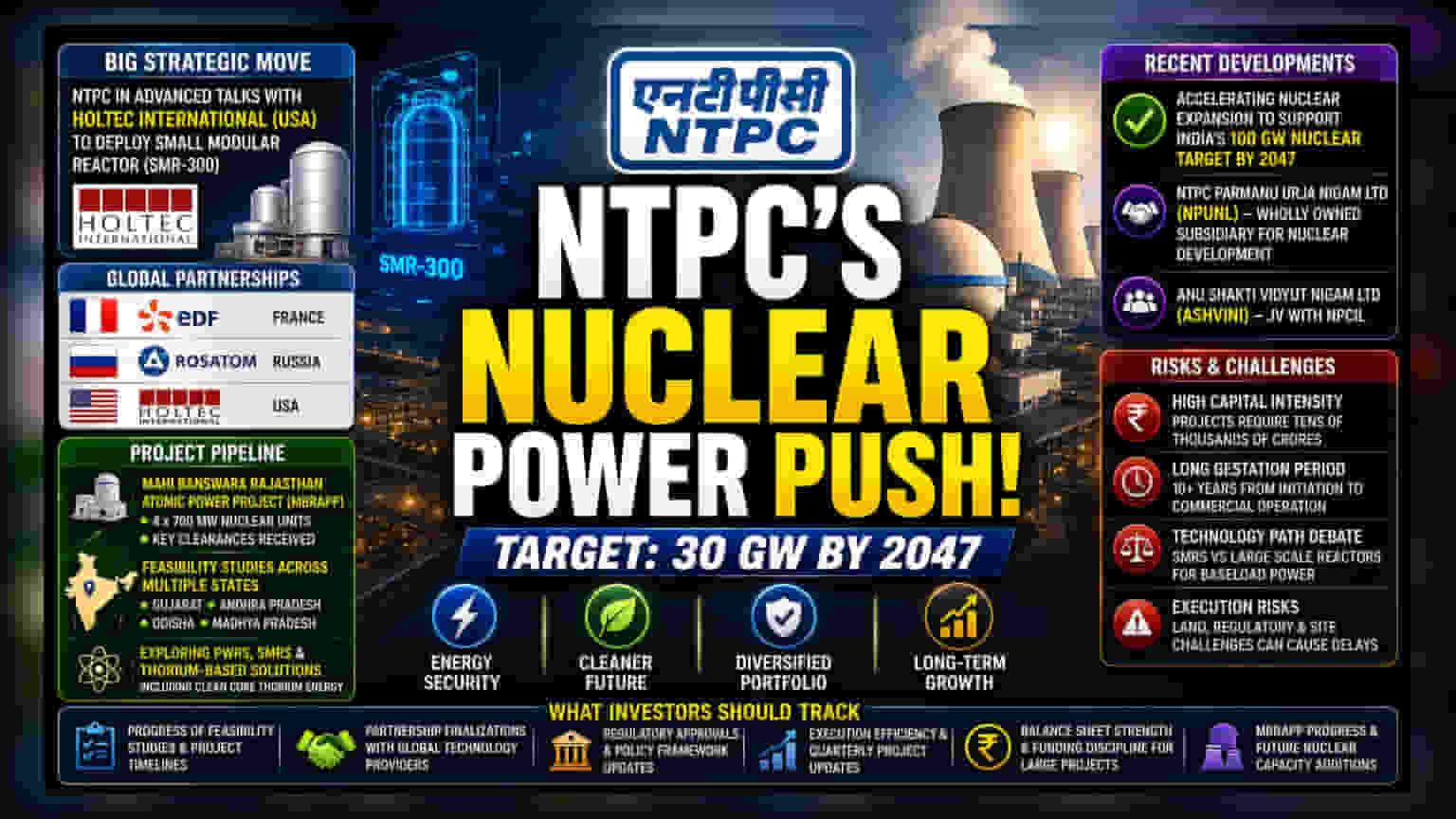
NTPC is advancing its goal to build 30 GW of nuclear capacity by 2047, forging partnerships with international firms like Holtec International, EDF, and Rosatom. This strategic pivot from thermal power to a diversified energy portfolio faces challenges, including high capital requirements, long project timelines, and the complexity of integrating advanced reactor technologies.
What Happened
NTPC Ltd, India's largest integrated power producer, is accelerating its push into the nuclear energy sector. The company is in advanced discussions with U.S.-based Holtec International to explore the deployment of small modular reactors (SMRs), specifically the SMR-300 model. This effort is part of a broader strategy to secure partnerships with global nuclear technology providers, following similar collaborations already initiated with France's Électricité de France (EDF) and Russia's Rosatom. NTPC aims to achieve a nuclear power capacity of 30 GW by 2047, aligning with the Indian government's overarching target of reaching 100 GW of nuclear energy by the same year.
Strategic Shift Toward Nuclear
For decades, NTPC has been the backbone of India's thermal power generation. However, the company is now rapidly diversifying its portfolio to reduce its reliance on fossil fuels. Beyond its massive coal and thermal assets, NTPC is investing heavily in renewable sources and, more recently, nuclear energy. This shift is being operationalized through dedicated entities, such as the wholly owned subsidiary NTPC Parmanu Urja Nigam Ltd (NPUNL) and the joint venture Anu Shakti Vidyut Nigam Ltd (ASHVINI), which works alongside the Nuclear Power Corporation of India Ltd (NPCIL).
The Project Pipeline
A cornerstone of this expansion is the Mahi Banswara Rajasthan Atomic Power Project (MBRAPP) in Rajasthan, which involves the construction of four 700 MW nuclear units. The project has already received key clearances, including excavation consent for the initial units. NTPC is also actively conducting feasibility studies across multiple states, including Gujarat, Andhra Pradesh, Odisha, and Madhya Pradesh, to identify suitable locations for future nuclear plants. The company is exploring a mix of technologies, ranging from traditional large-scale Pressurized Water Reactors (PWRs) to innovative small modular reactors and thorium-based fuel solutions, such as its potential investment in Clean Core Thorium Energy.
Risks and Execution Challenges
While the expansion aligns with India's energy security goals, it carries significant financial and operational risks. Nuclear energy projects are notoriously capital-intensive, often requiring tens of thousands of crores in upfront investment per project. These initiatives are also known for long gestation periods, meaning it can take over a decade from project initiation to the first unit's commercial operation.
Additionally, there is a strategic debate within the sector regarding the best technology path. While some global providers push for small modular reactors due to their flexibility, some NTPC leadership have expressed a preference for large-scale reactor sets to ensure steady, high-volume baseload power. Balancing these technology choices while managing debt levels will be a critical test for the company's financial discipline.
What Investors Should Track
Investors should monitor the progress of feasibility studies and project timelines, as delays are common in the nuclear sector. Key monitorables include the finalization of partnerships with international technology providers, the clarity on regulatory approvals for new sites, and the company's ability to fund these massive projects without excessive strain on its balance sheet. Further updates on the MBRAPP project and the government's progress on evolving the policy framework for private and joint-venture participation will also be important signals for the company's long-term growth trajectory.