 Whalesbook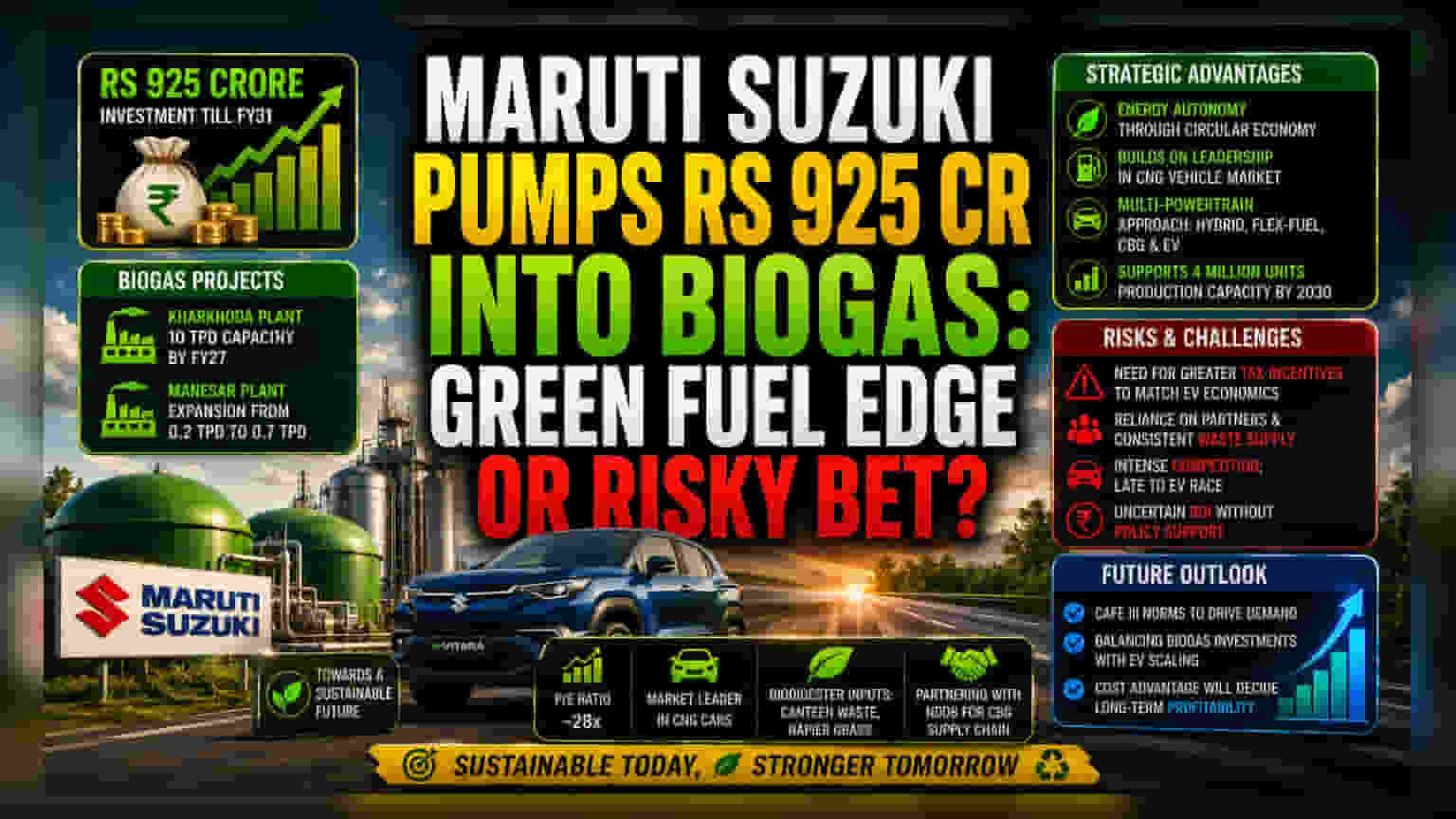


The Capital Allocation Strategy
Maruti Suzuki’s decision to commit Rs 925 crore toward biogas projects through fiscal year 2030-31 serves as a calculated maneuver to secure energy autonomy. This investment is not an isolated initiative; it integrates directly into the company's broader objective of expanding annual production capacity to 4 million units by the end of the decade. By commissioning a 10 Tonnes Per Day (TPD) facility at Kharkhoda by FY27 and scaling up the existing Manesar plant from 0.2 TPD to 0.7 TPD, the company is effectively utilizing circular economy principles—converting canteen waste and local agricultural inputs like Napier grass into viable manufacturing fuel.
The Analytical Deep Dive
This capital outlay reflects a departure from a singular focus on battery-electric vehicles (BEVs). Maruti Suzuki, which maintains a dominant share in the Indian CNG vehicle market, is arguably leveraging its existing infrastructure to bridge the gap between traditional combustion and full electrification. While competitors like Tata Motors have aggressively prioritized a pure-play EV narrative, Maruti Suzuki’s multi-powertrain approach—encompassing hybrids, flex-fuel vehicles, and now expanded CBG capacity—suggests a strategy tailored to India’s unique energy ecosystem. Industry data shows the company currently trades at a price-to-earnings (P/E) ratio of approximately 28x, a valuation that suggests investors are pricing in steady, albeit cautious, growth amidst the transition to newer powertrain technologies.
The Forensic Bear Case
Despite the strategic merits, the path forward is not without structural risk. Management, led by Chairman R.C. Bhargava, has been vocal about the need for greater government tax incentives to make biogas as economically viable as EVs. Should these policy shifts fail to materialize, the return on investment for biogas plants could face significant compression compared to high-margin EV segments. Furthermore, the company faces mounting competitive pressure. While Maruti Suzuki has recently entered the EV market with the e-Vitara, it remains a late entrant relative to domestic peers. Dependence on collaborative biogas models, such as the partnership with the National Dairy Development Board (NDDB), introduces execution risks where the company must rely on third-party supply chain efficiency and consistent availability of organic waste, which remains an unproven scale factor for a large-scale automotive manufacturer.
The Future Outlook
As the company moves toward FY31, its success will likely depend on balancing these green energy investments with the rapid scaling of its electric portfolio. Brokerage consensus continues to watch the impact of upcoming CAFE III emission regulations, which will serve as the true catalyst for demand. Maruti Suzuki’s future profitability rests on whether this diversified energy strategy provides a genuine competitive cost advantage or merely an expensive, albeit environmentally responsible, offset to its core fossil-fuel dependent operations.