 Whalesbook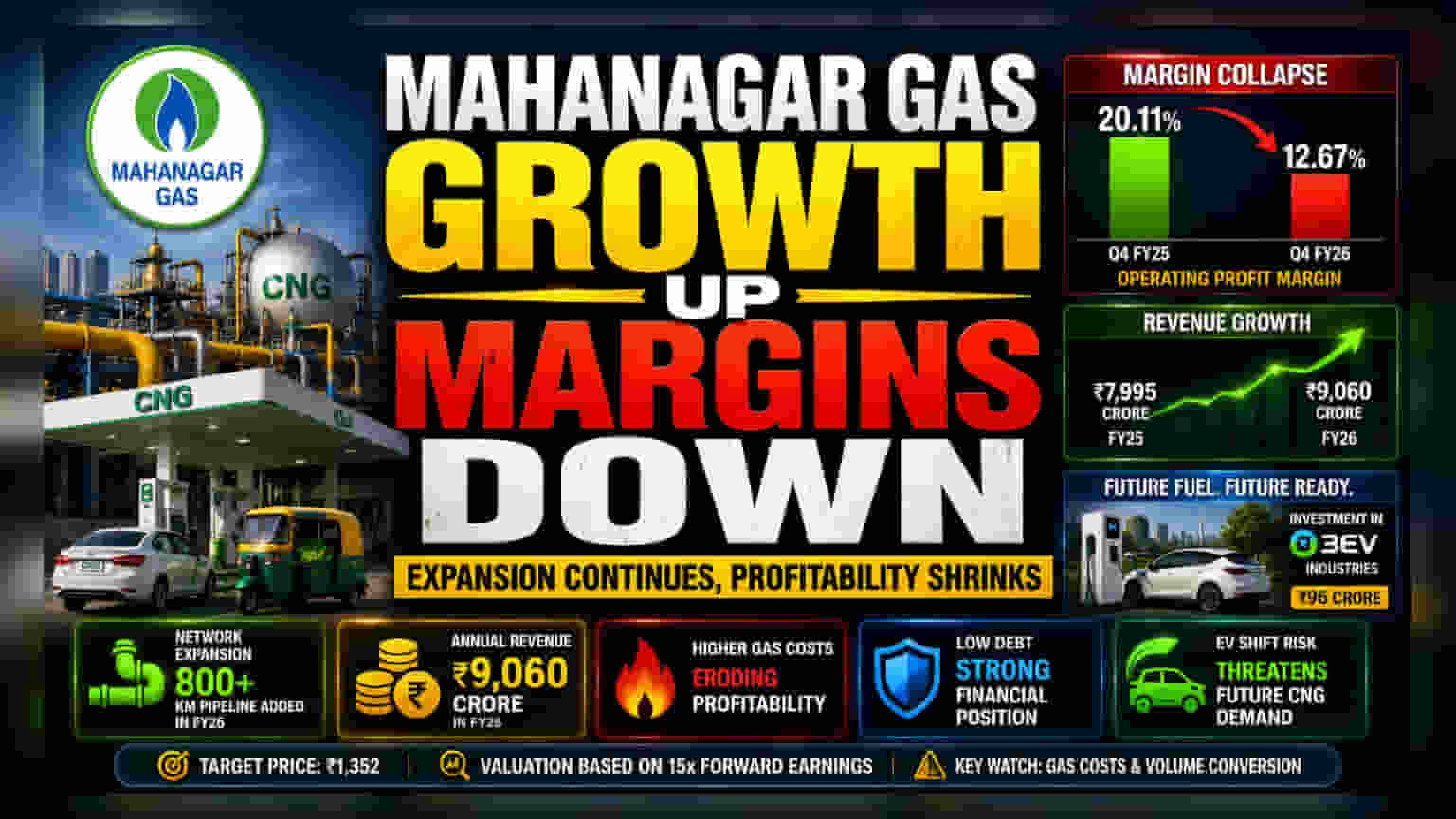


The Margin Erosion Reality
While Mahanagar Gas continues to bolster its physical footprint—adding over 800 kilometers of pipeline in FY26—the financial results tell a more sobering story. Despite a double-digit increase in annual revenue to approximately ₹9,060 crore, the company’s profitability has been significantly hampered. Operating profit margins collapsed to 12.67% in the final quarter of the fiscal year, a sharp retreat from the 20.11% seen in the corresponding period a year prior. This deterioration effectively wiped out significant operating gains, as higher sales volumes failed to compensate for the escalating costs of sourcing natural gas in an increasingly volatile global energy market.
Competitive Positioning and Structural Risks
Unlike peers such as Gujarat Gas, which maintains a high dependency on the industrial segment and thus faces greater exposure to gas curtailment risks, MGL maintains a more balanced portfolio with significant retail exposure. However, this does not grant the company immunity. The sector is currently navigating a period of uncertainty regarding fuel transition. While CNG remains a vital bridge fuel, the rapid shift toward electric vehicles (EVs) in India’s two- and three-wheeler segments threatens to cannibalize future demand growth. MGL’s recent strategic pivot—including a ₹96 crore investment in 3ev Industries—suggests that management is acutely aware of this long-term threat and is actively seeking to diversify its revenue streams beyond traditional city gas distribution.
The Forensic Bear Case
The investment narrative for MGL is currently pinned on the expectation that increased infrastructure spending will yield long-term demand. However, the bear case is fueled by two primary factors: persistent margin volatility and the reality of rising competitive pressure. Management has struggled to pass on the full impact of fluctuating input costs to consumers, leading to the observed margin compression. Furthermore, the company’s capital-intensive nature necessitates sustained high expenditure, which, when coupled with the cooling of profitability, puts pressure on return ratios. While the company remains nearly debt-free, the narrowing gap between revenue growth and profitability suggests that the "growth" phase is becoming significantly more expensive and less efficient than historical trends might have suggested.
Future Outlook
Analyst sentiment remains divided. While some brokerage houses maintain a bullish outlook based on an target price of ₹1,352, this is predicated on 15 times forward earnings—a valuation that assumes the company can successfully navigate the current cost environment. Investors are closely watching for signs that input cost stabilization will allow for a recovery in margins. For now, the consensus remains cautious, with the stock’s performance likely to be dictated by quarterly commentary on gas sourcing costs and the speed at which MGL can convert its expanded pipeline network into meaningful, margin-accretive volume growth.