

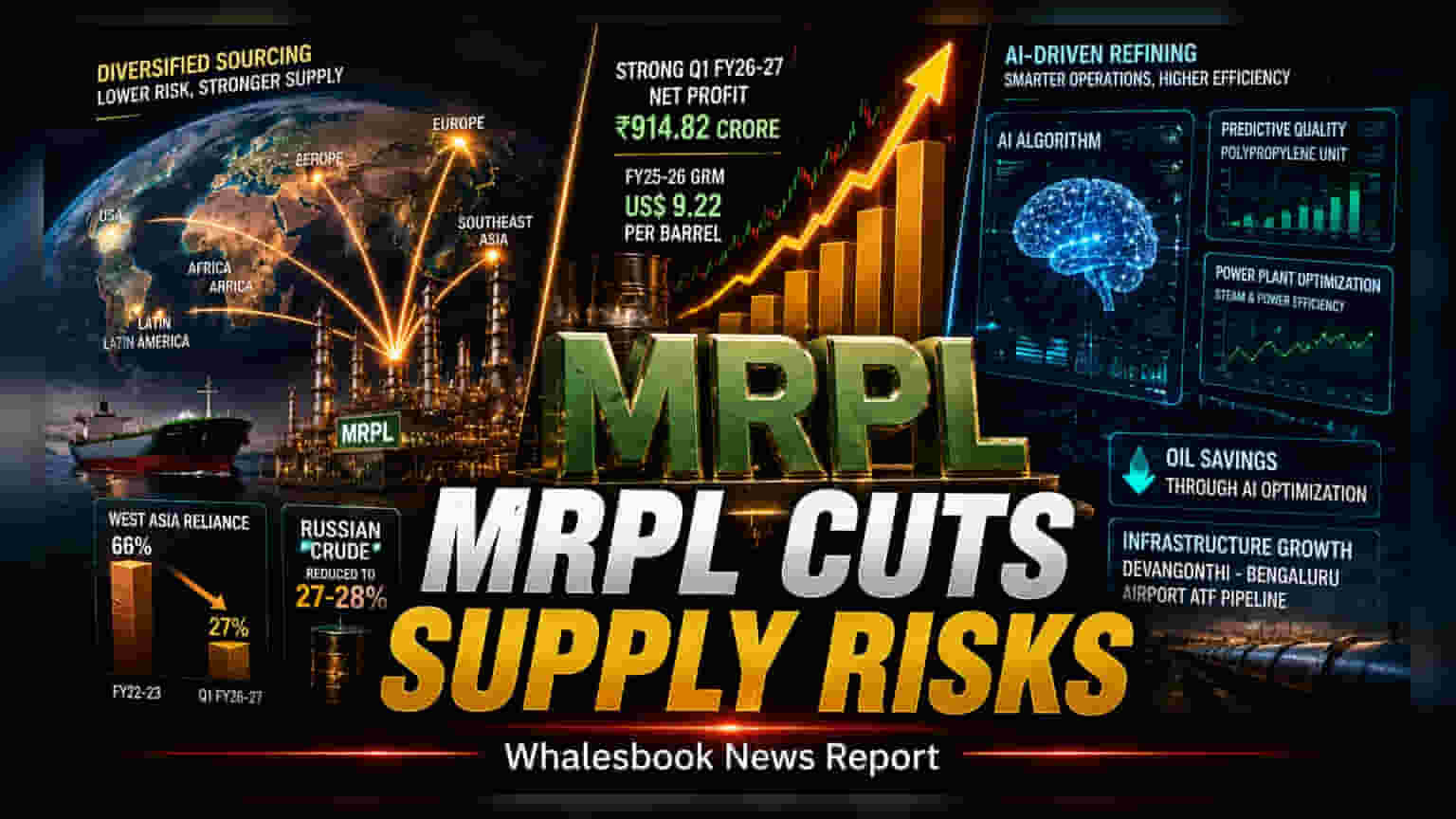
Mangalore Refinery and Petrochemicals Limited (MRPL) has sharply reduced its dependence on West Asian crude from 66% in FY23 to 27% in Q1 FY27 to insulate itself from global supply disruptions. This update follows a strong Q1 FY27 financial performance, with a standalone net profit of ₹914.82 crore. Investors are tracking how this diversification, along with new AI initiatives, affects the company’s ability to manage volatile global oil prices and refining margins.
Mangalore Refinery and Petrochemicals Limited (MRPL) is shifting its crude oil sourcing strategy to protect itself from geopolitical instability. During the company’s 38th annual general meeting held on August 24, 2026, management explained that the refinery no longer relies on any single region or shipping route for its oil supplies. This move is designed to ensure stable operations even if conflicts disrupt traditional trade channels.
The scale of this change is clear in the company's data. Reliance on crude oil from West Asia has dropped significantly, falling from approximately 66% in the 2022-23 financial year to roughly 27% in the first quarter of the 2026-27 financial year. The company has also reduced its procurement of Russian crude, which currently stands at about 27-28%. By spreading its supply sources across different regions, MRPL aims to avoid the risks associated with depending on a single supplier or geographic area.
Financial Performance and Operational Efficiency
This strategic shift in procurement coincides with a period of strong financial results for the company. In the first quarter of the 2026-27 financial year, MRPL reported a standalone net profit of ₹914.82 crore. For the full 2025-26 financial year, the company recorded a Gross Refining Margin (GRM) of US$ 9.22 per barrel, which is a key metric for understanding how much profit a refinery makes from processing crude oil.
Beyond supply chain management, MRPL is investing in technology to improve its efficiency. The company is now using artificial intelligence (AI) models across its refining operations. For example, AI is being used in its polypropylene unit to predict quality metrics, such as melt flow index, more quickly than traditional lab methods. Additionally, an AI-based system in the power plant is helping optimize the use of steam and power, which the company says has led to notable oil savings.
Investor Monitorables and Risks
While the company is diversifying its supply chain and adopting new technology, investors continue to watch several key factors. The refining sector is highly sensitive to the global price of crude oil and the margins achieved on finished products like petrol and diesel. These margins, known as crack spreads, can change quickly due to global demand or supply shifts.
Furthermore, the stock has experienced notable activity recently. On August 12, 2026, the Bombay Stock Exchange (BSE) sought clarification from the company regarding a sudden increase in trading volumes. For investors, the next important updates to track will be the sustainability of refining margins in a changing global energy market and the company’s progress on ongoing infrastructure projects, such as the Devangonthi-Bengaluru Airport ATF pipeline, which are aimed at long-term operational growth.