

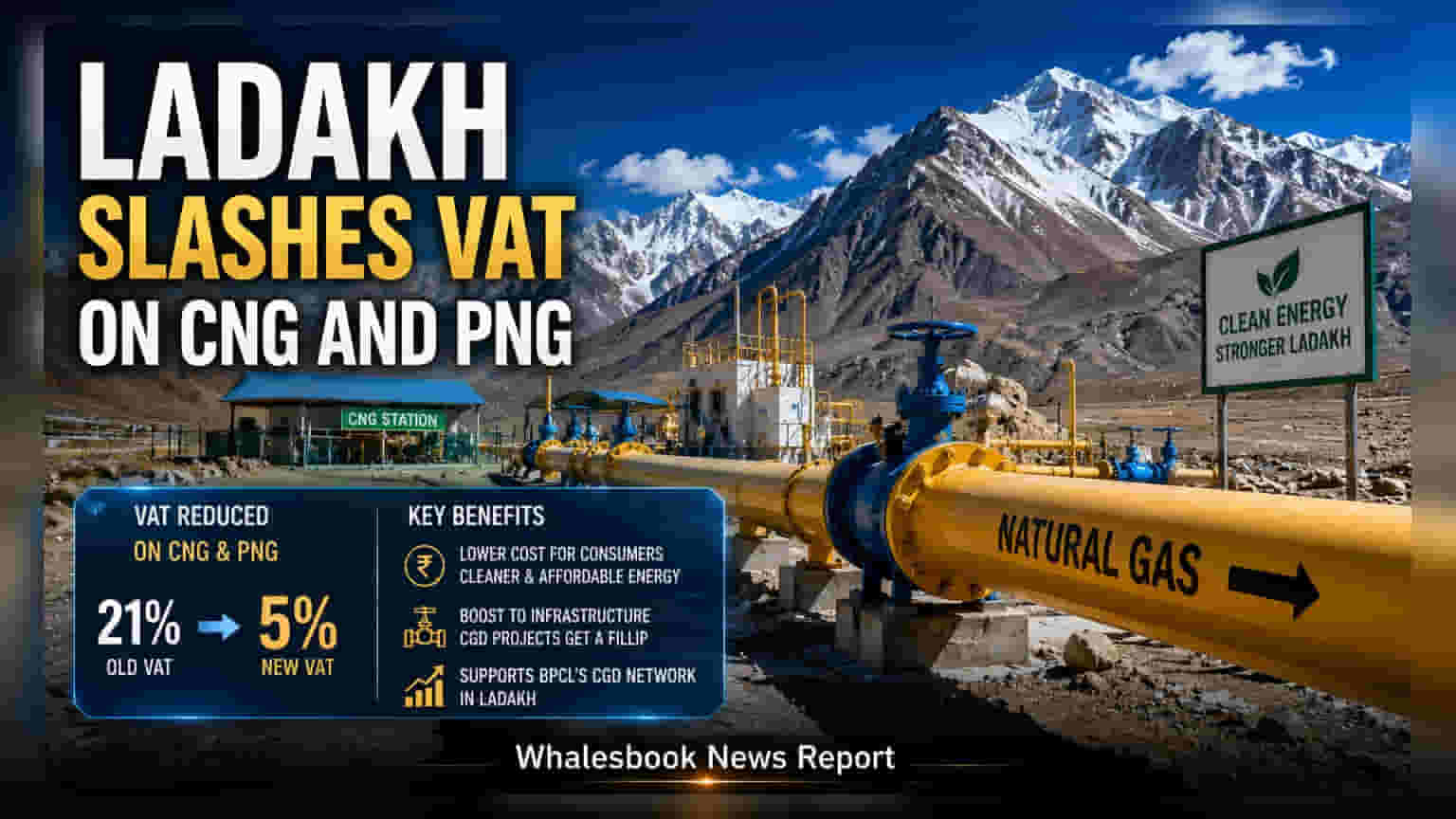
The Ladakh administration has reduced the Value Added Tax (VAT) on CNG and PNG from 21% to 5%, effective August 27, 2026. This tax relief aims to lower energy costs for residents and improve the financial viability of the City Gas Distribution (CGD) network, which is being developed by Bharat Petroleum Corporation Limited (BPCL).
The Union Territory of Ladakh has announced a significant reduction in Value Added Tax (VAT) on Compressed Natural Gas (CNG) and Piped Natural Gas (PNG), bringing the levy down from 21% to 5%. The decision, announced by the Lieutenant Governor of Ladakh on August 27, 2026, aims to make clean energy more affordable for the local population while supporting the deployment of gas infrastructure in the region.
This fiscal policy shift follows a recommendation from the Petroleum and Natural Gas Regulatory Board (PNGRB) issued on June 22, 2026. The regulator had advised a concessional tax framework to account for the unique logistical and economic challenges of operating in high-altitude, mountainous terrain. Because natural gas currently remains outside the GST regime, individual states and Union Territories retain the authority to set their own VAT rates, allowing Ladakh to implement this targeted concession.
For investors and the broader energy sector, the move is a direct boost to the viability of City Gas Distribution (CGD) projects in the region. Bharat Petroleum Corporation Limited (BPCL) is currently the authorized entity tasked with building and operating the gas distribution network in Ladakh. High transportation costs, extreme weather, and the difficult landscape have historically made such projects capital-intensive and economically challenging to scale. By significantly lowering the tax burden, the administration intends to improve the operating margins and long-term financial stability of these infrastructure projects.
While the reduction in VAT is a positive step for infrastructure development, the project continues to face inherent risks. The economic success of the CGD network remains tied to the region’s challenging climate and logistical constraints. Building and maintaining infrastructure in high-altitude areas requires higher capital spending and constant maintenance, which can pressure project timelines. Furthermore, the region’s reliance on transported natural gas means that energy pricing and availability will continue to be sensitive to broader supply chain stability and potential transportation bottlenecks.
Moving forward, the primary monitoring points for stakeholders will be the pace of pipeline laying, the adoption rate of CNG and PNG among households and transport fleets, and whether this tax relief is sufficient to offset the high operational costs associated with the region's unique geography.