

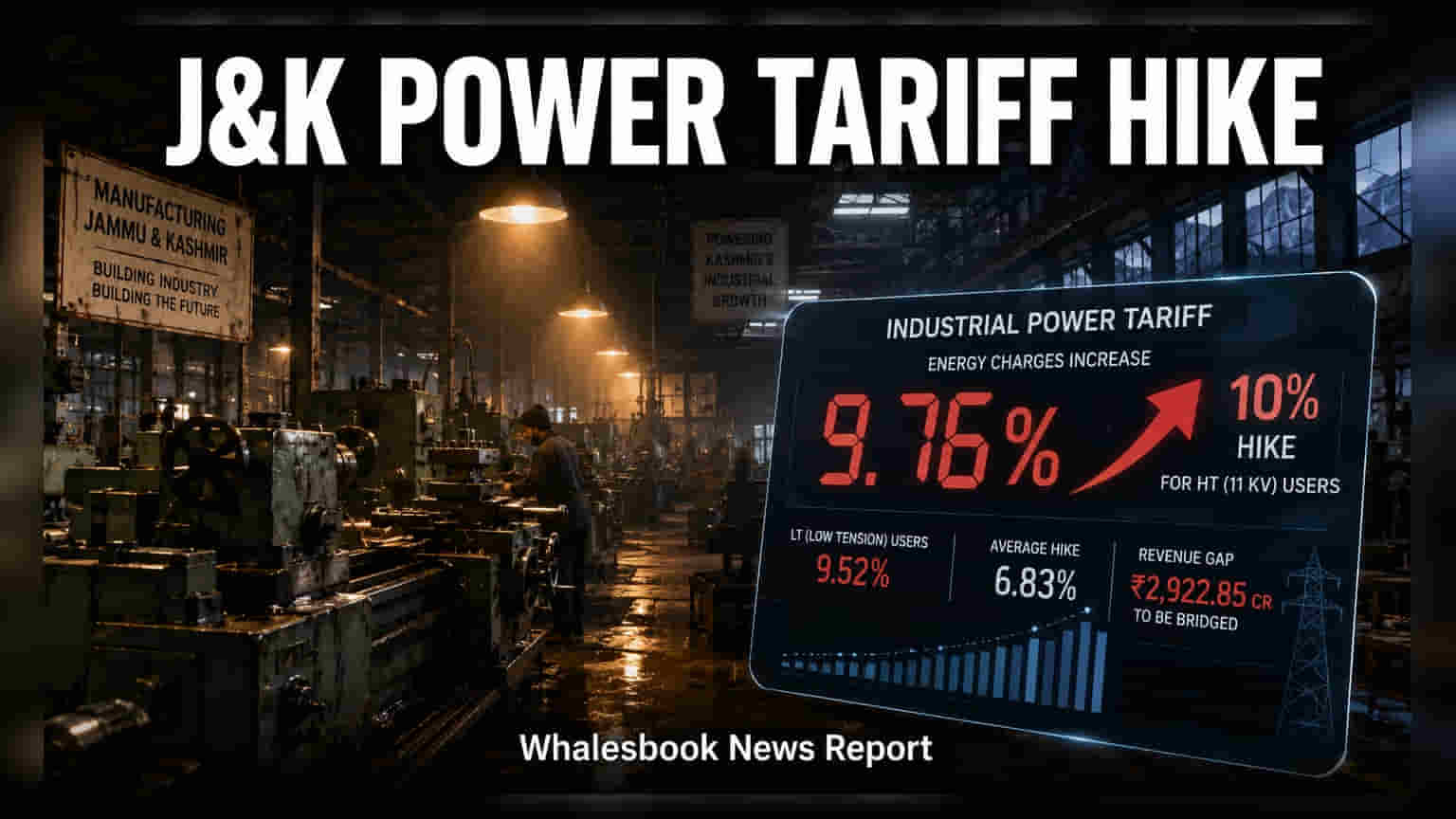
Manufacturing units in Jammu and Kashmir face a sharper-than-expected electricity tariff hike beginning September 1. The regulator approved increases of up to 9.76% for industrial consumers to address the power corporation's revenue gap, raising concerns among local business associations about operational competitiveness.
Starting September 1, 2026, manufacturing businesses across Jammu and Kashmir will face a significant increase in operational costs due to a new electricity tariff order. The Joint Electricity Regulatory Commission (JERC) has mandated a rise in energy charges that exceeds the hike originally requested by local power distribution corporations.
Under the new order, industrial consumers will see energy charges rise by approximately 9.52% for low-tension (LT) industrial users and 9.76% for high-tension (HT) users operating at 11 kV. These specific adjustments are part of a broader tariff revision that includes an average hike of 6.83% across all consumer categories in the Union Territory. The final approved increase for industrial users is notably higher than the 5% hike previously proposed by the Jammu Power Distribution Corporation Ltd (JPDCL) and the Kashmir Power Distribution Corporation Ltd (KPDCL).
Revenue Gap and Financial Context
The regulatory decision comes as the authorities aim to bridge a substantial annual revenue requirement gap of approximately ₹2,922.85 crore for the region’s power distribution corporations. By increasing tariffs, the regulator intends to improve the financial health of the state-owned distribution entities. However, the steeper-than-anticipated hike has created immediate friction with the local industrial sector.
Impact on Regional Competitiveness
For many manufacturers in the region, electricity is a significant component of their variable production costs. Industrial associations, including the Federation of Chambers of Industries Kashmir (FCIK), have expressed concern that these higher utility bills will add to existing operational challenges. Businesses in the region already contend with high logistics expenses due to geographical factors and volatile raw material prices.
Industry leaders argue that a double-digit percentage increase in energy costs could make it difficult for local products to compete in broader markets where producers may not face similar cost pressure. The concern is that this could dampen the appetite for capacity expansion and discourage new industrial investment in the region.
It is important to note that this electricity tariff revision is a regulatory policy change affecting the entire industrial sector of the Union Territory. It is not an event specific to any single publicly traded company. Investors should be aware that Jammu and Kashmir Industries Limited is a state-owned, unlisted public entity and is not traded on national stock exchanges like the NSE or BSE.