

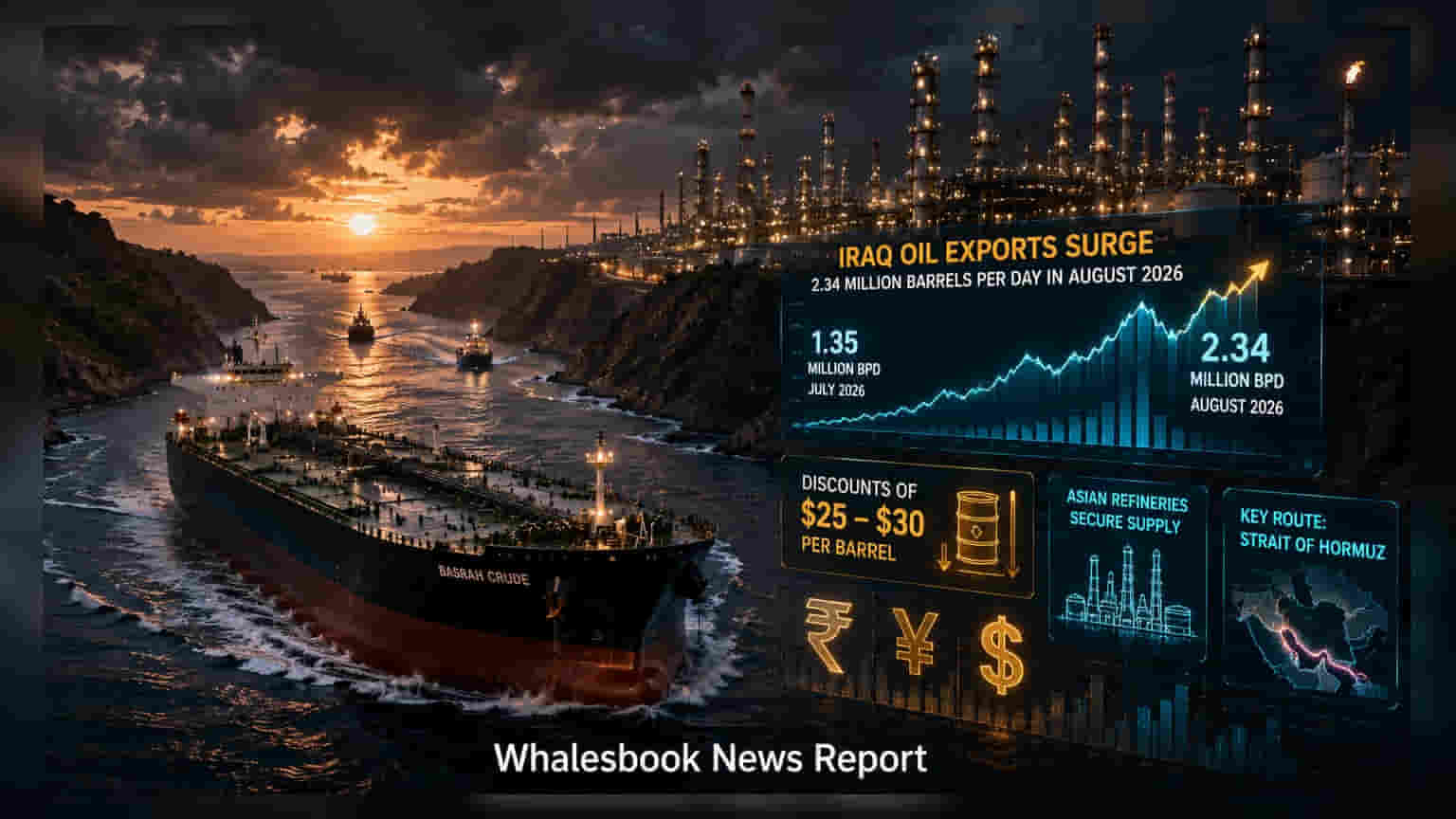
Iraq's crude exports recovered to 2.34 million barrels per day in August as Iran eased restrictions on tanker transit through the Strait of Hormuz. This shift has allowed major Indian refiners, including Reliance Industries and BPCL, to secure supplies at a discount. However, export levels remain below pre-conflict highs, and investors should track regional stability to gauge supply sustainability.
Iraq has successfully increased its oil shipments, providing relief to Asian refineries that rely on Middle Eastern crude. In August 2026, Iraqi exports climbed to 2.34 million barrels per day, a significant rebound from the 1.35 million barrels per day recorded in July. This increase follows Tehran’s decision to allow specific Iraqi tankers to pass through the Strait of Hormuz, a critical maritime waterway that had faced near-closure since the start of the conflict in February 2026.
The key driver behind this export recovery is aggressive pricing. Iraq’s State Oil Marketing Organization has been offering substantial discounts of $25 to $30 per barrel on free-on-board terms. These price cuts are intended to attract buyers and help them offset the high shipping and insurance premiums—currently costing around $17 per barrel—associated with moving crude through the region. This financial incentive has successfully drawn interest from major refiners in India and China looking to stabilize their feedstock costs despite geopolitical volatility.
For Indian energy companies, the resumption of these flows is a practical step for managing refining operations. Reliance Industries, for example, imported 4 million barrels of Basrah crude in August, signaling a return to more normalized procurement. Additionally, Bharat Petroleum Corporation is securing its first Iraqi shipment of the current fiscal year via a ship-to-ship transfer near Fujairah. While these imports help secure supply chains, they highlight a strategic effort by refiners to capitalize on lower-priced heavy crude when available.
Despite this operational improvement, the energy supply chain remains fragile. Current export volumes are still well below the 3.3 to 3.7 million barrels per day seen before the conflict began in February 2026. Because Iraq remains dependent on discretionary approval from Tehran for tanker transit, there is long-term uncertainty regarding supply reliability. Any escalation in the regional conflict or new security threats could quickly disrupt these maritime routes again.
Looking ahead, the stability of this supply will remain tied to the geopolitical situation in the Strait of Hormuz. Investors should monitor whether these transit permissions continue and how global oil prices interact with Iraq's discount strategy. The primary monitorable for the energy sector will be the consistency of crude arrivals and whether export volumes can continue to recover toward pre-war levels without further interruption.