 Whalesbook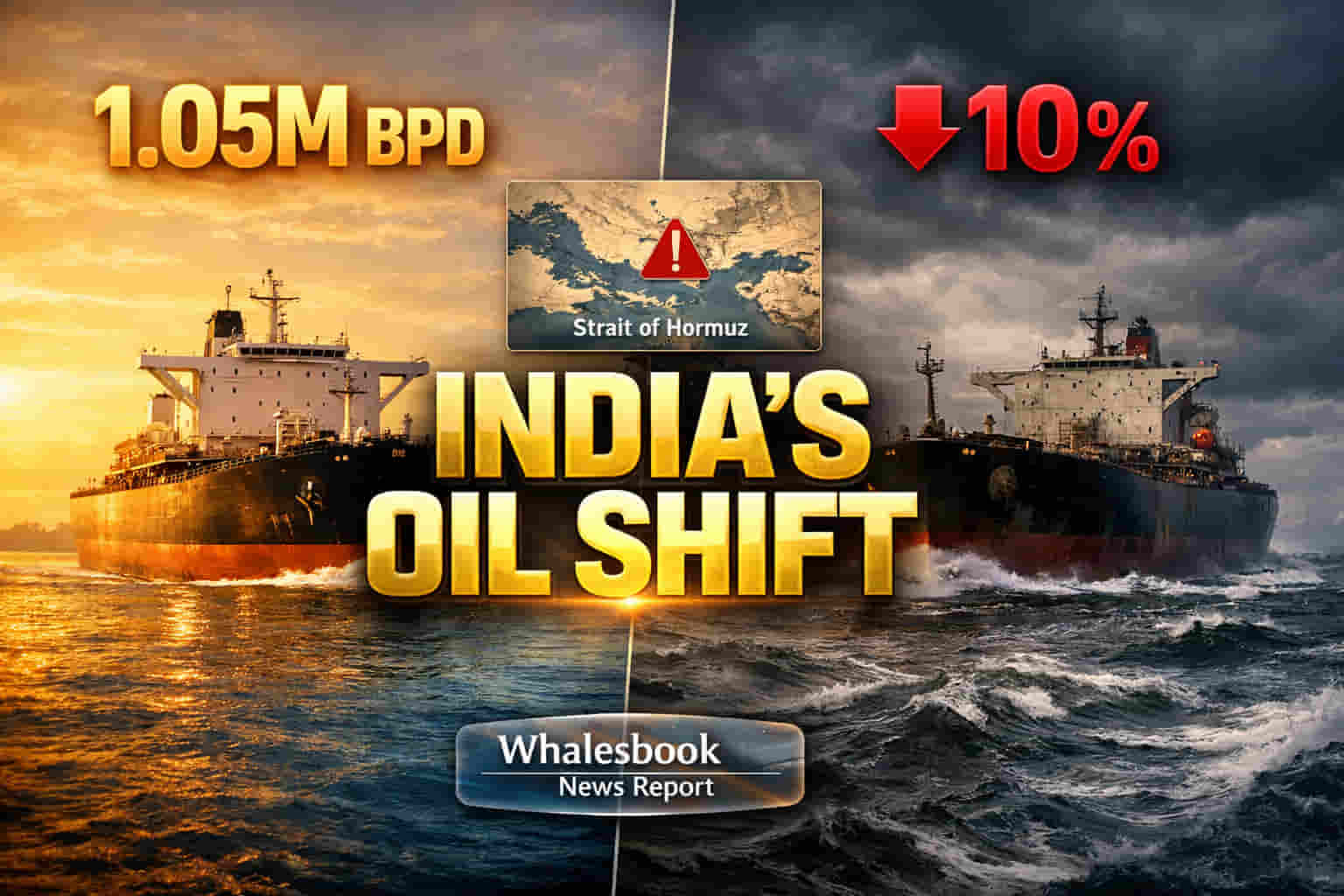


THE SEAMLESS LINK
This shift in sourcing underscores a precarious balancing act for India's energy security, as the nation navigates a volatile global energy market.
THE STRUCTURE (The 'Smart Investor' Analysis)
The Core Catalyst
India's February crude oil intake from Saudi Arabia surged to an all-time high of 1.05 million barrels per day (bpd), marking a significant departure from its traditional supply mix. This record volume arrives as the nation continues to scale back purchases from Russia, a trend accelerated by geopolitical pressures and Western sanctions. Simultaneously, escalating conflict in the Middle East, particularly between the U.S. and Iran, has triggered a sharp rise in global oil prices. Benchmark Brent crude breached $79 per barrel, with WTI futures trading above $72 per barrel as of March 2, 2026. The attack on Saudi Aramco's Ras Tanura refinery, a critical energy hub, on March 2, 2026, further amplified these concerns, leading to a precautionary shutdown and underscoring the fragility of regional energy infrastructure.
The Analytical Deep Dive
India's enhanced reliance on Middle Eastern crude, particularly from Saudi Arabia and the UAE, places it at the nexus of growing geopolitical risks. Approximately 2.5-2.7 million bpd of India's crude imports, sourced largely from Saudi Arabia, Iraq, Kuwait, and the UAE, transit the Strait of Hormuz, a vital chokepoint for roughly 20% of global oil supply. The effective de facto closure of this strait, driven by heightened tensions and warnings issued by Iran, has caused maritime traffic to stall and initiated significant price volatility. Historically, India's import basket underwent a dramatic transformation post-2022, with Russian oil volumes soaring to meet demand amidst discounted pricing. In 2024, Russia supplied 37% of India's crude, compared to Saudi Arabia's 10%. This February's shift represents a reversal, increasing India's exposure to potential supply chain disruptions originating from the Persian Gulf, a region historically prone to instability. Analysts like those at Nomura highlight India's extreme vulnerability to oil price shocks, estimating that a 10% increase typically worsens its current account balance. The country imports nearly 90% of its crude oil requirements, making energy security a paramount concern.
⚠️ THE FORENSIC BEAR CASE
India's strategic pivot towards Saudi Arabian supply, while mitigating immediate Russian volume reduction, significantly elevates its exposure to the volatile Middle East. The Strait of Hormuz's critical role in channeling approximately one-fifth of global oil trade and a substantial portion of India's own imports presents a perennial risk. The recent drone strike on Saudi Aramco's Ras Tanura refinery, even if the damage was contained, serves as a stark reminder of the physical threats to energy infrastructure in the region. While India maintains oil reserves equivalent to about 10-15 days of refinery inventories and 7-10 days of fuel stocks, these buffers are insufficient to mitigate prolonged, severe supply disruptions emanating from the Strait of Hormuz. Every $10 increase in crude oil prices is estimated to widen India's annual import bill by $13-14 billion, potentially pressuring its current account deficit and weakening the rupee. Furthermore, the increased freight costs and insurance premiums associated with rerouting or navigating higher-risk transit corridors add further economic strain. Competitors like China, with substantial strategic reserves and the flexibility to absorb discounted Russian barrels, may possess greater resilience to sustained Middle Eastern supply interruptions.
The Future Outlook
Market projections anticipate continued volatility in oil prices, with Brent crude expected to trade around $80.77 per barrel by the end of the current quarter and potentially reach $88.47 in 12 months, according to Trading Economics. While J.P. Morgan Global Research forecasts an average of $60/bbl for Brent in 2026, they acknowledge geopolitical risks as a significant wild card. For India, maintaining diversified energy sources remains a strategic imperative. The nation's energy security and economic stability are intrinsically linked to global supply chain resilience and the ongoing geopolitical situation in the Middle East. The rapid deployment of renewables and clean technologies is increasingly viewed as a strategic necessity, not merely an environmental goal.