 Whalesbook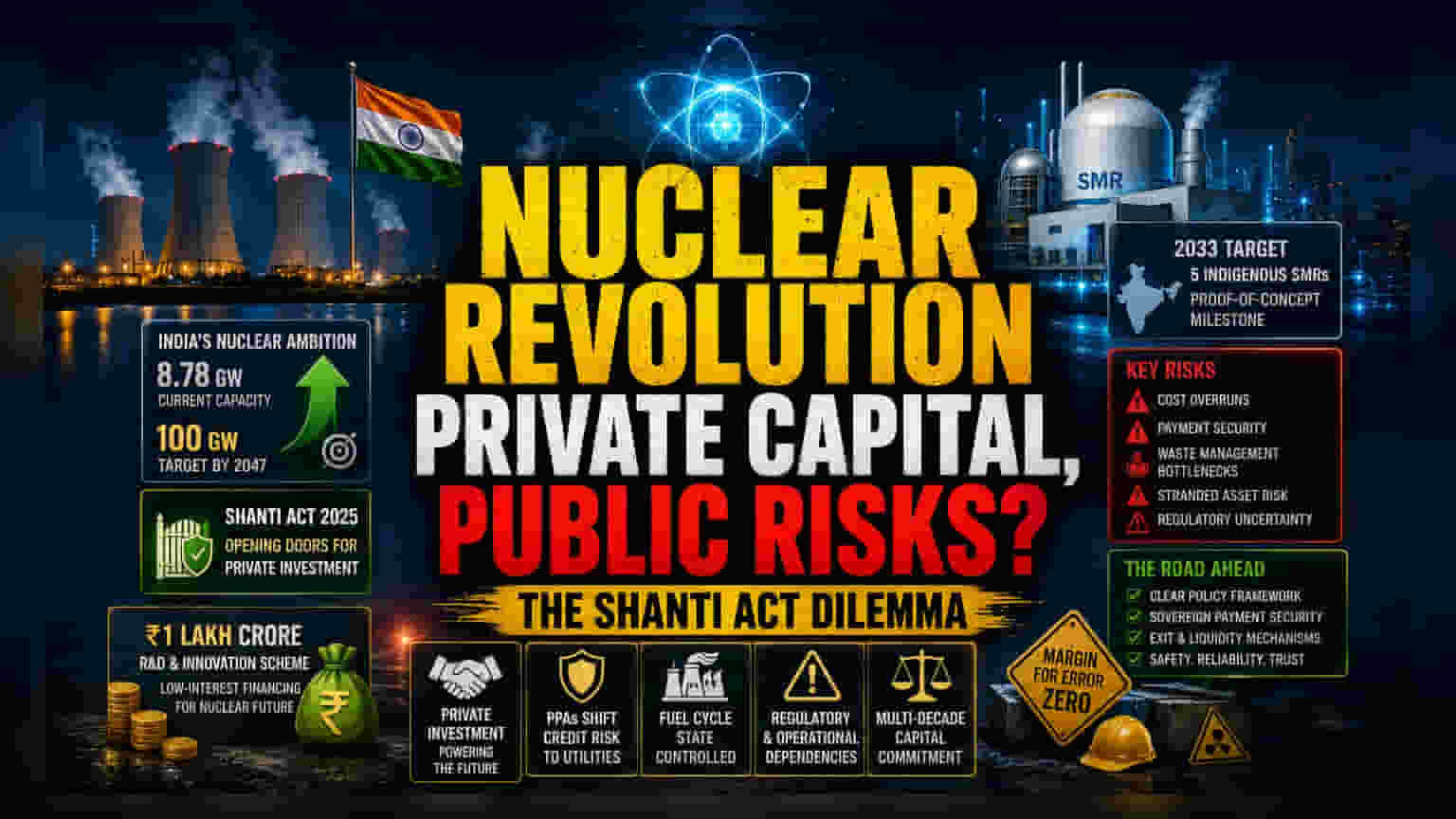


The Capital Expenditure Dilemma
The push to invite private capital into India’s nuclear sector is driven by the stark reality that state-led expansion alone cannot bridge the gap between current 8.78 GW capacity and the 100 GW ambition for 2047. By utilizing the framework of the SHANTI Act 2025, the government is attempting to decouple high-stakes power generation from its balance sheet. However, the reliance on Power Purchase Agreements (PPAs) shifts the credit risk profile directly onto the utility buyers. Given the historical fiscal struggles of many regional distribution companies, investors are likely to demand sovereign-backed payment security before committing to projects that require multi-decade capital lock-ups.
Comparing Peer Execution and Technology
Unlike the solar and wind sectors, where private participation is mature and capital turnover is rapid, nuclear energy remains a laggard in terms of private ROI. Global precedents, particularly the cost overruns seen in Western SMR (Small Modular Reactor) deployment, serve as a cautionary tale for Indian industrial houses. While India’s Rs 1 lakh crore Research Development and Innovation scheme offers a buffer through low-interest financing, it fails to address the inherent complexity of navigating fuel cycle regulations. Private players will find themselves operating in a hybrid environment where they manage generation, yet remain beholden to state-controlled entities for critical fuel cycle services like enrichment and waste disposal.
The Structural Weakness in the SHANTI Framework
From a risk-management perspective, the SHANTI Act creates a bifurcated operational model. Private firms are permitted to participate in equipment manufacturing and generation, but the state retains a monopoly over sensitive areas such as spent fuel reprocessing and high-level waste management. This division of labor introduces significant operational dependency. A private plant operator could theoretically face stranded asset risk if government-managed waste disposal infrastructure fails to keep pace with operational output. Furthermore, because nuclear projects carry a unique 'regulatory risk' regarding safety standards, any shift in global best practices could force mid-cycle modifications, drastically inflating costs that private balance sheets may be ill-equipped to absorb.
Outlook and Investor Sentiment
The viability of this initiative hinges on the granular details of the forthcoming rule notifications. Institutional investors are likely to maintain a wait-and-see approach, focusing on whether the government provides a clear exit mechanism or secondary market liquidity for nuclear assets. While the 2033 target for five indigenous SMRs acts as a proof-of-concept, the industry remains wary of the transition from government-led R&D to commercial-scale profitability. For now, the narrative is one of policy-driven intent, but the execution remains tethered to sovereign appetite for underwriting private sector risk in a sector where the margin for error is effectively zero.