

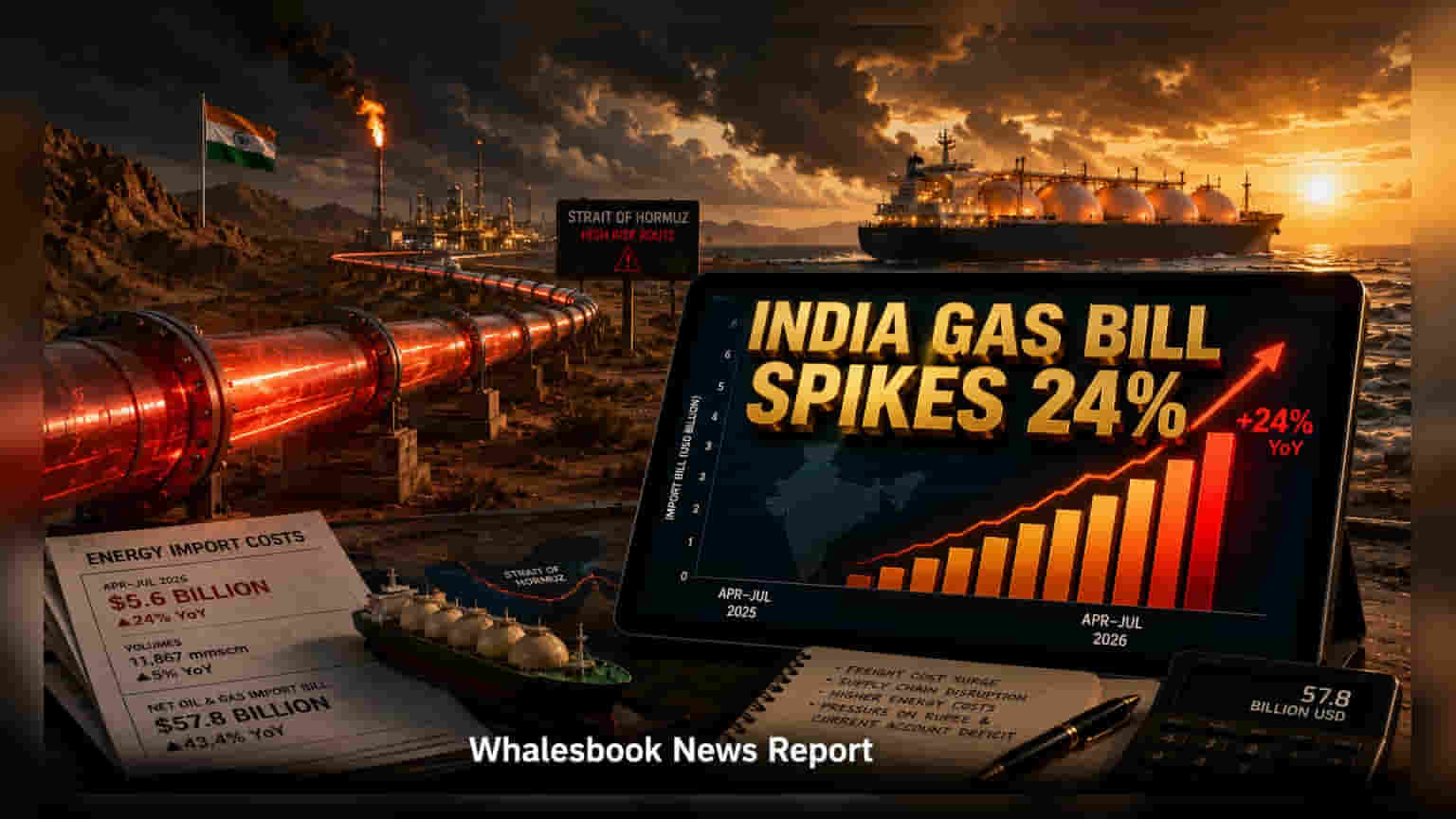
India’s natural gas import bill surged 24% to $5.6 billion between April and July 2026, driven by geopolitical instability in West Asia. As freight costs rise and domestic production slips, India has increasingly turned to the US to secure its energy needs, raising concerns about import dependency and the national trade balance.
India’s energy import costs have seen a sharp increase in the current fiscal year as geopolitical tensions in West Asia continue to disrupt traditional supply chains. Between April and July 2026, the country’s natural gas import bill reached $5.6 billion, marking a 24% increase compared to the same period last year. While import volumes grew by a modest 5% to 11,867 million standard cubic metres (mmscm), the primary reason for the rising bill is the surge in the landed cost of energy.
Impact of Soaring Freight Costs
The rising costs are not solely due to the price of gas itself, but also the high expense of bringing it to India. Geopolitical instability, particularly around the Strait of Hormuz, has forced shipping companies to navigate longer, more dangerous routes. This has led to a dramatic spike in freight rates and war-risk insurance premiums, with costs on key routes surging between 137% and 411% since early 2026. These additional expenses are ultimately passed on to the buyer, making energy imports significantly more expensive than they were a year ago.
Diversification and Reliance on the US
To bypass the supply disruptions in West Asia, India has been forced to diversify its energy sources. This shift is most evident in the country's Liquefied Petroleum Gas (LPG) imports. By August 2026, the US became a primary supplier, accounting for over 73% of India's LPG imports. While this shift provides a necessary safety net against supply shortages, it also introduces new logistical challenges. Relying on more distant suppliers like the US involves longer transit times and higher transport costs compared to traditional partners in the Gulf region.
Domestic Production and Economic Pressure
The financial strain is compounded by a decline in local output. Domestic natural gas production contracted by 4.3% to 11,245 mmscm during the April–July period. As local supply failed to keep pace with growing demand, India’s dependence on foreign gas widened to 51.7%, up from 49.3% a year ago.
This trend has broader implications for India's economy. The cumulative net oil and gas import bill for the April–July 2026 period rose by 43.4% to $57.8 billion. Such a large increase in the cost of essential energy imports puts downward pressure on the Indian Rupee and can widen the current account deficit, which is the gap between what the country earns from trade and what it spends on foreign goods. Investors and policymakers will be monitoring whether these higher energy costs persist or if global shipping conditions stabilize, as sustained high costs could impact India's broader inflation and growth outlook.