

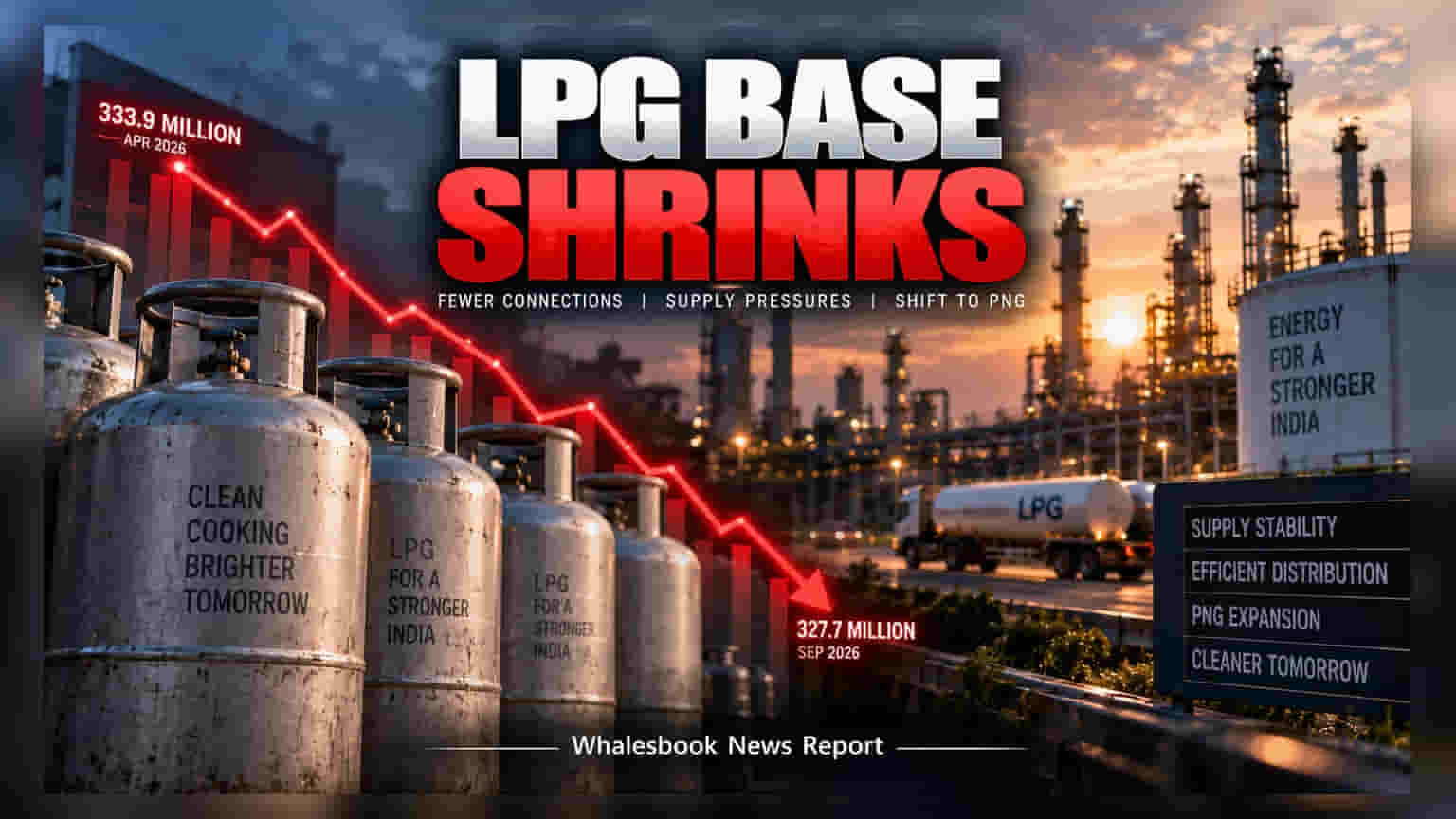
India’s LPG household user base declined by 6.2 million between April and August 2026, marking the first drop in a decade. The fall is driven by supply chain constraints from Middle East conflicts and a government-led shift toward Piped Natural Gas (PNG). Investors are tracking how this slowdown in new connections affects state-run Oil Marketing Companies and the broader City Gas Distribution sector.
For the first time in over ten years, India’s LPG user base has seen a contraction. Data from the Ministry of Petroleum and Natural Gas indicates that the number of active LPG connections fell from 333.9 million in April 2026 to 327.7 million by September 2026. This 6.2 million reduction represents a 1% decline, contrasting sharply with the consistent growth seen since 2015-16, when the network expanded from 148.6 million users.
Supply Pressures and Operational Audits
The primary driver behind this sudden dip is a mix of global supply challenges and internal operational cleanup. India relies heavily on the Middle East for about 90% of its LPG imports. Recent geopolitical conflicts in the region have created supply bottlenecks, prompting state-run Oil Marketing Companies (OMCs) to pause the release of new LPG connections to preserve existing inventory for current users.
Simultaneously, the companies are conducting mandatory Aadhaar-based biometric audits to weed out duplicate accounts and inactive users. By removing these inactive connections, the government is streamlining the subsidy and supply mechanism, which is part of a larger effort to improve distribution efficiency.
The Shift to Piped Natural Gas
Not all of the decline reflects a loss of cooking energy access. A portion of this contraction is linked to a deliberate policy shift to move urban households from traditional LPG cylinders to Piped Natural Gas (PNG). Between April and July, City Gas Distribution (CGD) companies added approximately 0.6 million new PNG connections. This transition is viewed by policymakers as a modernization step, replacing physical cylinder delivery with a direct pipeline network.
Investor Implications
For investors, this trend offers two distinct angles. For state-run OMCs like Indian Oil Corporation, Bharat Petroleum, and Hindustan Petroleum, the halt in new connections helps manage supply-side pressure but reduces the immediate growth momentum in new user acquisition. The focus for these companies remains on stabilizing supply and improving efficiency through the current audit process.
Conversely, the trend supports the growth narrative for City Gas Distribution companies. As the government prioritizes PNG expansion, firms in this space may benefit from the migration of urban consumers. Regional data shows the highest attrition in Southern India, with 2.63 million fewer households, while Northern India remains the most dense market with 99.3 million active connections.
Going forward, the key monitorables for investors include the stabilization of import supply lines from the Middle East and the pace at which PNG infrastructure can replace traditional LPG cylinders in high-density urban areas. The industry's current phase suggests a cooling in the aggressive expansion seen in previous years as it balances supply constraints with long-term infrastructure modernization.