 Whalesbook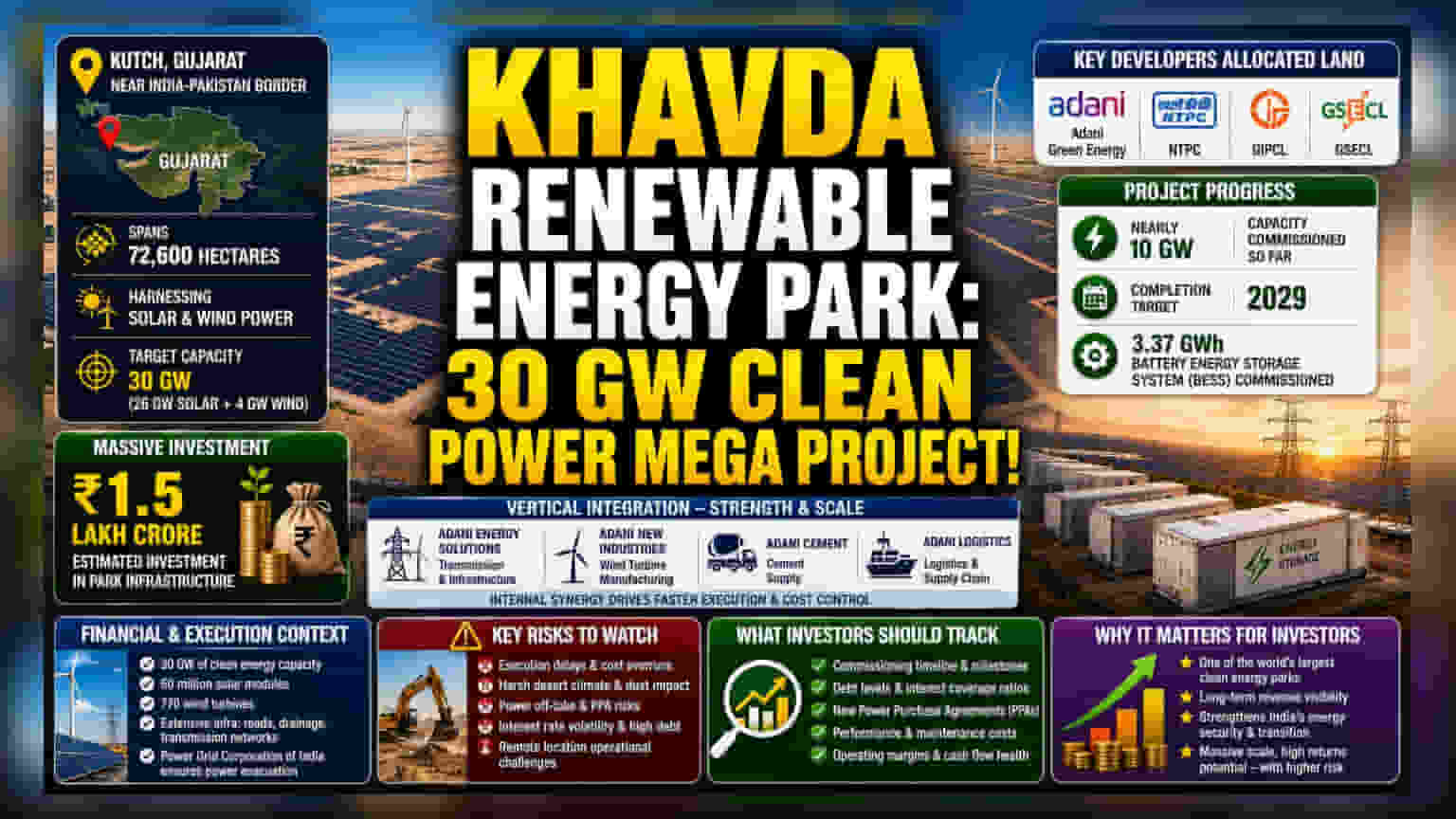


Adani Green Energy’s 30 GW renewable project in Khavda, Gujarat, is rapidly turning a remote wasteland into a global clean energy powerhouse. With 10 GW already active, investors are focused on the massive capital expenditure, execution timelines, and group-wide synergy required to complete this world-scale project by 2029.
What Happened
The Khavda Renewable Energy Park in Gujarat's Kutch district is rapidly becoming one of the largest clean energy projects globally. Spanning 72,600 hectares near the India-Pakistan border, this massive site is being developed to harness solar and wind power. While the Gujarat government has allocated land to several major players including NTPC, Gujarat Industries Power Company (GIPCL), and Gujarat State Electricity Corporation (GSECL), Adani Green Energy (AGEL) is leading the charge with a 30 GW capacity target. To date, nearly 10 GW of capacity has been commissioned, with the project slated for completion by 2029.
Why This Matters For Investors
For investors, the Khavda project represents a massive capital-intensive undertaking. The estimated investment for the broader park infrastructure reaches approximately ₹1.5 lakh crore. Beyond the sheer size, the project demonstrates a strategy of vertical integration. The Adani group is leveraging its internal companies to manage the construction, with Adani Energy Solutions handling transmission, Adani New Industries producing wind turbines, and other group entities supplying cement and logistics. While this internal synergy can help control costs and ensure faster execution, it also concentrates the execution risk within the group. Investors watch such scale because it requires continuous capital injection, which impacts the company’s debt levels and free cash flow.
The Financial And Execution Context
Developing 30 GW of capacity—consisting of 26 GW of solar and 4 GW of wind—is a logistical challenge in a harsh, arid desert environment. The project is not just about generating power; it requires extensive infrastructure including roads, drainage, and sophisticated transmission networks to evacuate electricity to the main grid. Power Grid Corporation of India plays a critical role here, ensuring the power generated can actually reach the rest of the country. The recent commissioning of a 3.37 gigawatt-hour Battery Energy Storage System (BESS) is a significant step, as storage is essential to manage the intermittent nature of solar and wind energy. The financial success of this park depends on how efficiently the company can manage its debt-to-equity ratio while maintaining healthy operating margins despite the high initial cost of equipment and infrastructure.
Potential Risks And Challenges
Large-scale renewable projects face inherent risks that investors should acknowledge. Execution risk is at the top of the list; any delay in setting up 60 million solar modules or 770 wind turbines can lead to cost overruns. Furthermore, because the project is in a remote region, it faces unique environmental challenges, including dust management and harsh weather, which could affect the efficiency of solar panels and maintenance schedules. There is also the broader sector risk of power off-take; the company must ensure that the electricity generated is purchased by distribution companies at viable rates under long-term agreements. Interest rate volatility also remains a factor, as significant borrowing is typically required to fund such ambitious infrastructure projects.
What Investors Should Track
Moving forward, the primary monitorable is the project's commissioning schedule. Any deviation from the timeline could indicate execution bottlenecks. Investors should also pay attention to the company’s quarterly updates regarding its debt position and interest coverage ratios, as large capital spending often places pressure on the balance sheet. Management commentary on the signing of new Power Purchase Agreements (PPAs) will be crucial, as these contracts provide the long-term revenue visibility needed to justify such massive investments. Finally, observing the performance and maintenance costs of the commissioned capacity will provide insights into how effectively the company is managing its assets in the challenging desert climate.