 Whalesbook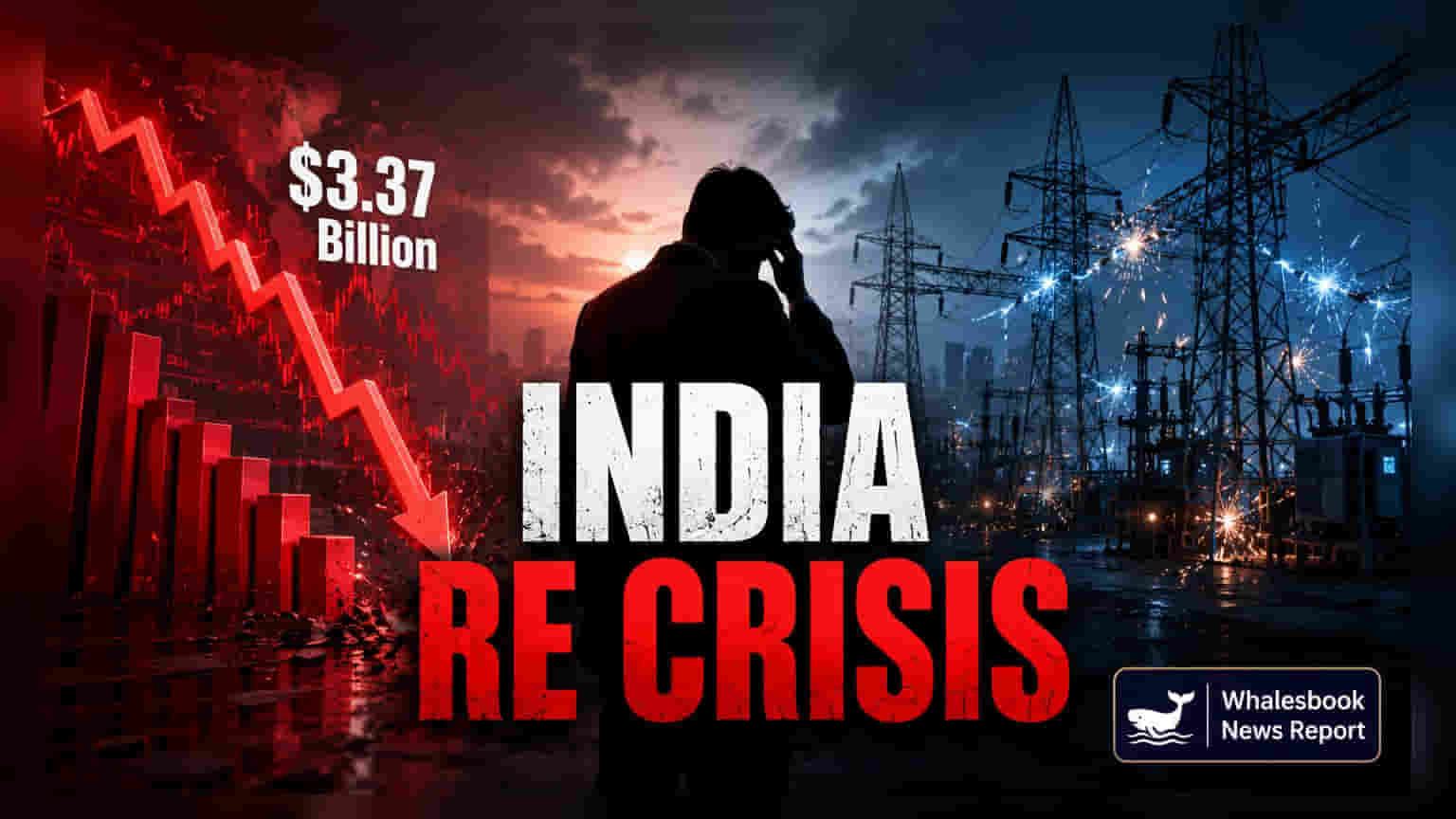


The Investment Vacuum
Financial capital is voting with its feet, effectively slamming the brakes on Indian renewable energy expansion. While the headline drop to $3.37 billion represents a clear retreat from the $9.84 billion deployed during the same period in 2025, the underlying reality is more insidious. Investors are no longer merely pricing in regulatory or interest rate risk; they are now discounting the probability that their generation assets will be physically unable to deliver power to the grid. The sequential decline of 40.5% from the final quarter of 2025 suggests that the sector’s structural deficiencies have moved from a long-term concern to an immediate barrier for project bankability.
The Transmission Mismatch
The fundamental conflict arises from the aggressive pursuit of generation capacity—now totaling 275 GW—without a commensurate acceleration in high-voltage infrastructure. This imbalance manifests as chronic curtailment, a silent tax on productivity that direct investment figures often mask. By forcing operators to throttle output, the grid operator renders otherwise profitable solar arrays unproductive. The data confirms this is not a theoretical risk; the loss of 300 GWh of clean energy in the first quarter of 2026 alone demonstrates that the grid is currently operating at a maximum threshold that cannot sustain current growth trajectories.
The Forensic Bear Case
From a risk-mitigation perspective, the Indian renewable sector faces a severe 'delivery gap' that could take years to resolve. The state’s historical record, failing to meet nearly 20% of its transmission targets over the last half-decade, provides little confidence in a rapid turnaround. With one in four major inter-state transmission projects currently delayed by at least twelve months, institutional investors are increasingly viewing renewable energy in India as a high-beta bet on infrastructure execution rather than a pure play on energy transition. The risk is that if connectivity delays for the projected 20 GW of upcoming capacity materialize, return profiles will be decimated by prolonged commissioning cycles and interest accrual on idle capital.
Structural Limitations and Future Outlook
The reliance on generation-led planning has clearly reached its limit. Future project viability will hinge on the pivot toward co-optimal planning, where transmission availability serves as the prerequisite, rather than the afterthought, of generation development. Unless policy frameworks shift to guarantee grid access—or at least provide compensation mechanisms for curtailment—the sector is likely to see continued capital flight. Market analysts suggest that until the execution rate for transmission schemes improves significantly, the risk premium on new Indian green energy assets will remain elevated, favoring only the most diversified utilities with existing captive infrastructure and high-quality balance sheets.