 Whalesbook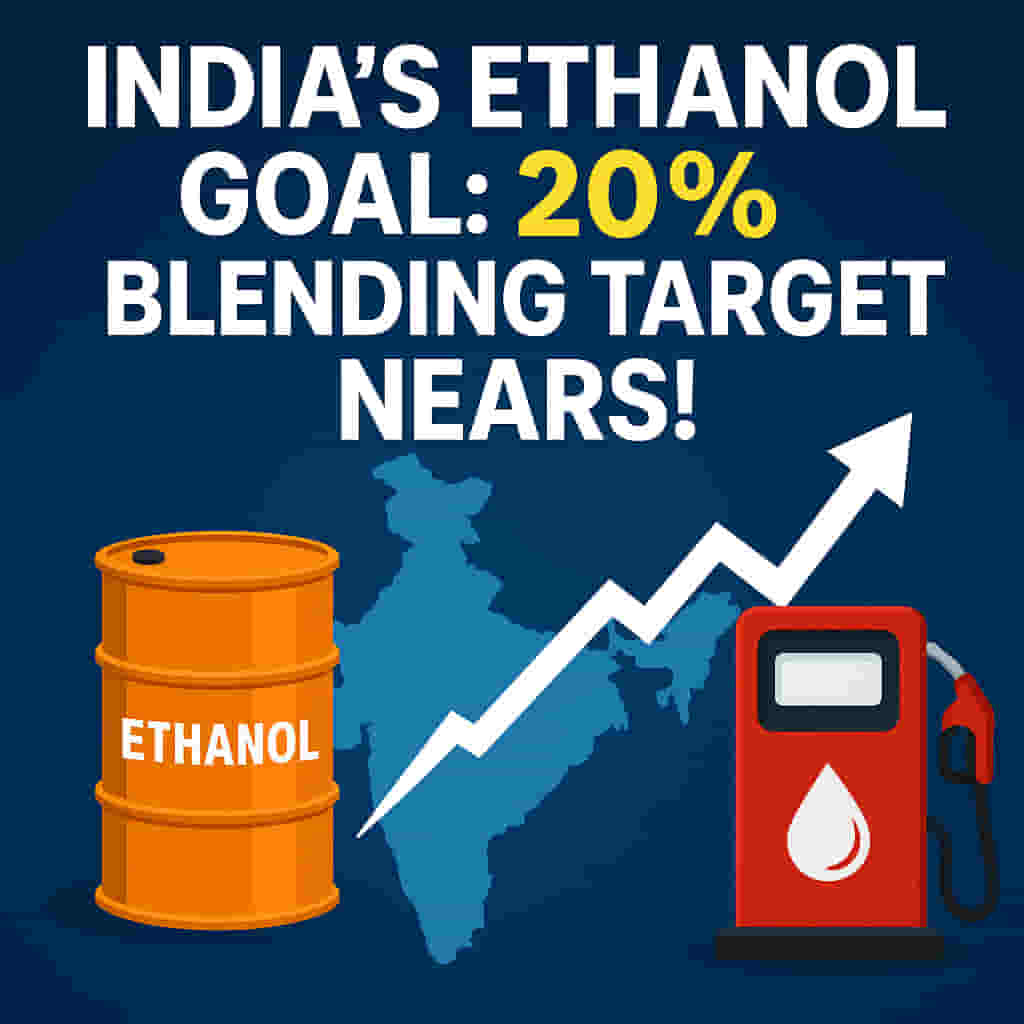


India is making significant strides towards its ambitious ethanol blending targets, with recent data showing substantial progress in ESY 2024-25 and a clear path set for achieving 20% blending by October 2026.
Progress Towards 20% Blending Target
- Ethanol blending in petrol reached 19.2% during the Ethanol Supply Year (ESY) 2024-25.
- The target for 20% blending was advanced to ESY 2025-26 (November 2025 to October 2026).
- By October 2025, the blending rate is projected to reach 19.97%.
- Over 77 crore litres of ethanol were in storage at the end of October 2025.
- Public Sector Oil Marketing Companies (OMCs) received approximately 1,003 crore litres of ethanol during ESY 2024-25.
- Approximately 1,022 crore litres of ethanol were consumed to achieve the 19.2% blending rate.
- Earlier targets were met ahead of schedule, with 10% blending achieved in June 2022 and 12.06% in ESY 2022-23, followed by 14.60% in ESY 2023-24.
Government Initiatives and Feedstock
- The National Policy on Biofuels, amended in 2022, is driving these advancements.
- To ensure sufficient feedstock for the 20% blending target, the government has approved significant allocations.
- This includes 52 Lakh Tonnes (LT) of surplus Food Corporation of India (FCI) rice for ethanol production in both ESY 2024-25 and ESY 2025-26 (up to June 30, 2026).
- Additionally, 40 LT of sugar has been diverted for ethanol production in ESY 2024-25.
- These measures aim to secure the supply chain for ethanol production, crucial for meeting the blending goals.
Ethanol Pricing Structure
- The pricing of ethanol varies based on its source, incentivizing different production methods.
- For ESY 2024-25:
- Ethanol from sugarcane juice/syrup: ₹65.61 per litre.
- Ethanol from B heavy molasses: ₹60.73 per litre.
- Ethanol from C heavy molasses: ₹57.97 per litre.
- Ethanol from damaged food grains: ₹64 per litre.
- Ethanol from maize: ₹71.86 per litre.
- For ESY 2025–26, the price of ethanol produced from surplus FCI rice has been fixed at ₹60.32 per litre, an increase of about 3% from ₹58.50 per litre in ESY 2024-25. This revision reflects the increased cost of surplus rice from FCI.
Future Outlook and Supply Plans
- OMCs have already invited bids for the supply of 1,050 crore litres of Ethanol for ESY 2025-26.
- The supply schedule for ESY 2025-26 shows significant quantities planned for key months:
- November 2025: 100 crore litres.
- December 2025 and January 2026: 200 crore litres each.
- The remaining volume is distributed quarterly:
- February-April 2026: 280 crore litres.
- May-July 2026: 250 crore litres.
- August-October 2026: 220 crore litres.
- This structured supply plan indicates a robust strategy to meet the upcoming blending targets.
Impact
- This news has a significant positive impact on the renewable energy sector and agricultural stakeholders in India.
- Increased ethanol blending reduces India's reliance on imported crude oil, contributing to energy security and foreign exchange savings.
- It provides a stable market for agricultural produce like sugarcane, rice, and maize, supporting farmer incomes.
- Oil Marketing Companies are central to this transition, managing procurement and distribution.
- The policy signals a strong commitment to environmental goals and sustainable energy practices.
- Impact Rating: 7/10
Difficult Terms Explained
- Ethanol Supply Year (ESY): A designated period (typically November to October) for tracking ethanol production and supply, used for policy and target setting in India.
- Ethanol Blending: The process of mixing ethanol, a biofuel often derived from agricultural sources, with petrol to reduce reliance on fossil fuels and lower emissions.
- Public Sector Oil Marketing Companies (OMCs): State-owned companies in India responsible for refining and marketing petroleum products, such as Indian Oil Corporation, Bharat Petroleum, and Hindustan Petroleum.
- Biofuels: Fuels derived directly or indirectly from organic matter, such as plants or animal waste, used as an alternative to fossil fuels.
- Feedstock: The raw material used in an industrial process; in this context, agricultural products like sugarcane, molasses, grains, or rice used to produce ethanol.
- Sugarcane Juice/Syrup: The sweet liquid extracted directly from sugarcane, a primary source for producing ethanol.
- B Heavy Molasses (BHM) / C Heavy Molasses (CHM): By-products of sugar refining. BHM is a less concentrated form than CHM, and both can be fermented to produce ethanol.
- Food Corporation of India (FCI): A government agency responsible for food grain procurement, storage, and distribution in India; its surplus rice can be allocated for ethanol production.
- Surplus Rice: Rice stocks held by FCI that exceed immediate buffer stock requirements and can be diverted for non-food uses, such as ethanol production.