

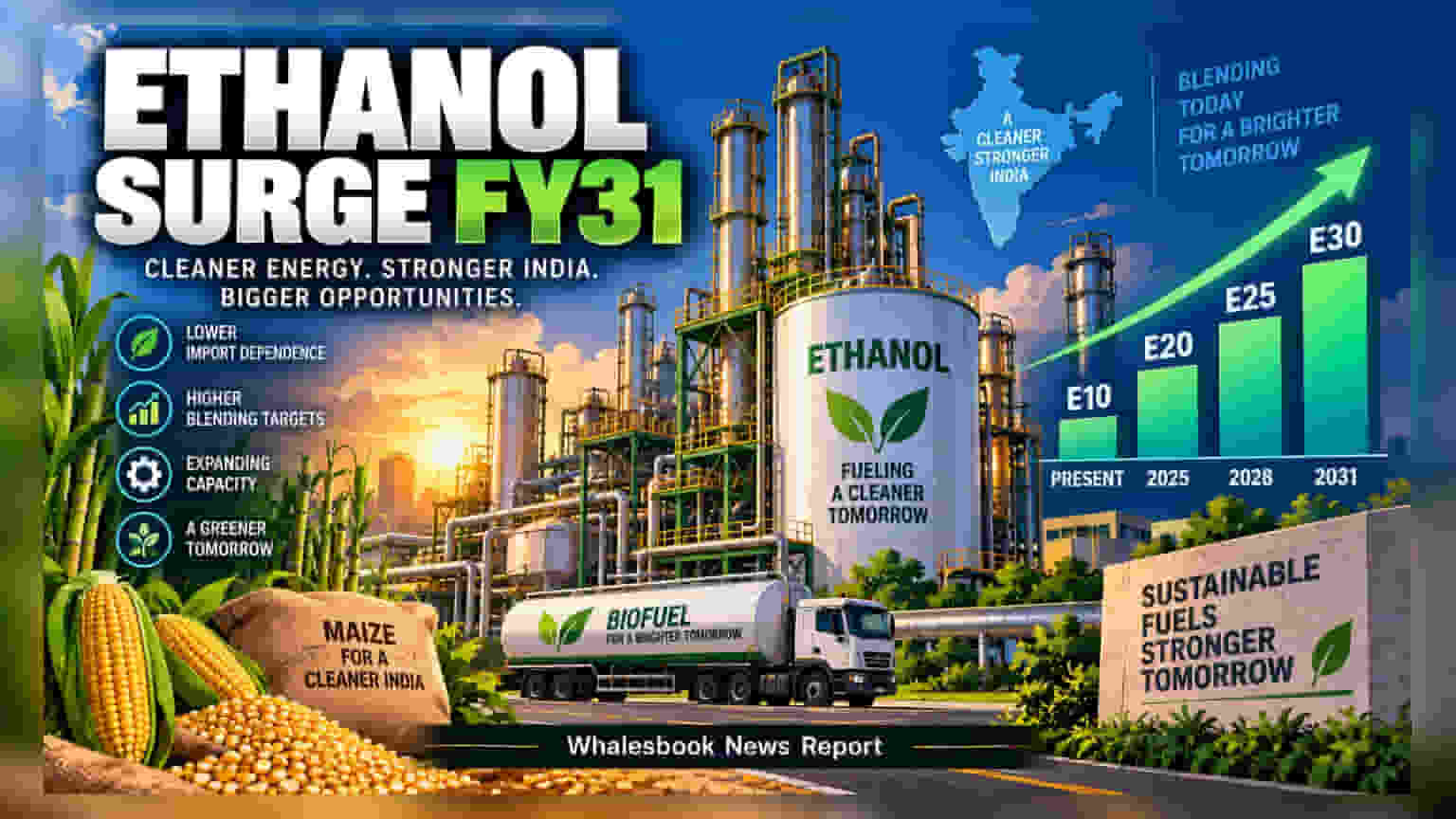
India aims to meet rising ethanol demand via E25 and E30 blending by 2031, requiring significant capacity expansion. While the long-term volume outlook is positive, investors should watch for potential profit margin compression in grain-based distilleries as feedstock costs rise and government interest subsidies begin to expire.
India is accelerating its ethanol blending program, with targets set to reach E25 and eventually E30 levels by 2031. This policy shift is intended to reduce energy import dependence, but it presents a mixed picture for the companies involved in the production and technology supply chain.
Infrastructure and Capacity Requirements
Currently, India has an installed distillation capacity of approximately 18.25 billion litres. This is generally sufficient to meet near-term requirements under the base-case scenario. However, moving to an E25 blending level would stretch utilization rates to nearly 98%, leaving very little buffer for supply shocks. A further shift to an E30 target would increase total demand to roughly 21.5 billion litres. Achieving this will require substantial capital spending to build new facilities, as relying only on existing infrastructure will not be enough. For investors, this creates a clear distinction between companies that provide the technology and machinery for these plants, such as Praj Industries, and the actual producers like Balrampur Chini Mills, Triveni Engineering, and Dalmia Bharat Sugar, who must fund the expansion.
Feedstock and Margin Pressures
The industry has fundamentally changed its production mix, moving away from a primary reliance on sugarcane toward grain-based production, with maize now accounting for nearly 46% of feedstock allocations. This shift has not come without financial cost. Grain-based distilleries have faced significant margin pressure, with EBITDA margins dropping from 9.2% in FY21 to roughly 6.7% in FY25. The core issue is the volatility of feedstock prices. When grain prices spike, these companies struggle to pass on costs to oil marketing companies, leading to compressed profitability. Investors should monitor whether these companies can optimize their operational efficiency to offset the rising cost of raw materials.
Impact of Subsidy Expiry
Another important factor for investors is the government's interest subvention scheme, which has helped producers manage the high cost of debt during the initial phase of capacity building. These benefits are scheduled to expire between FY26 and FY28. As these subsidies end, lenders are expected to become more selective, tightening their credit scrutiny and favoring producers who have a proven track record of consistent supply to oil marketing companies. This may force smaller, less efficient players to consolidate or struggle with higher interest costs in an already competitive market.
Moving forward, the primary monitorables for investors will be the actual pace of the E25 and E30 rollout, the stability of maize and sugar prices, and how effectively companies navigate the transition as government interest subsidies phase out. Quarterly results will be crucial for assessing whether producers can protect their profit margins in this new, more competitive phase of the ethanol program.