 Whalesbook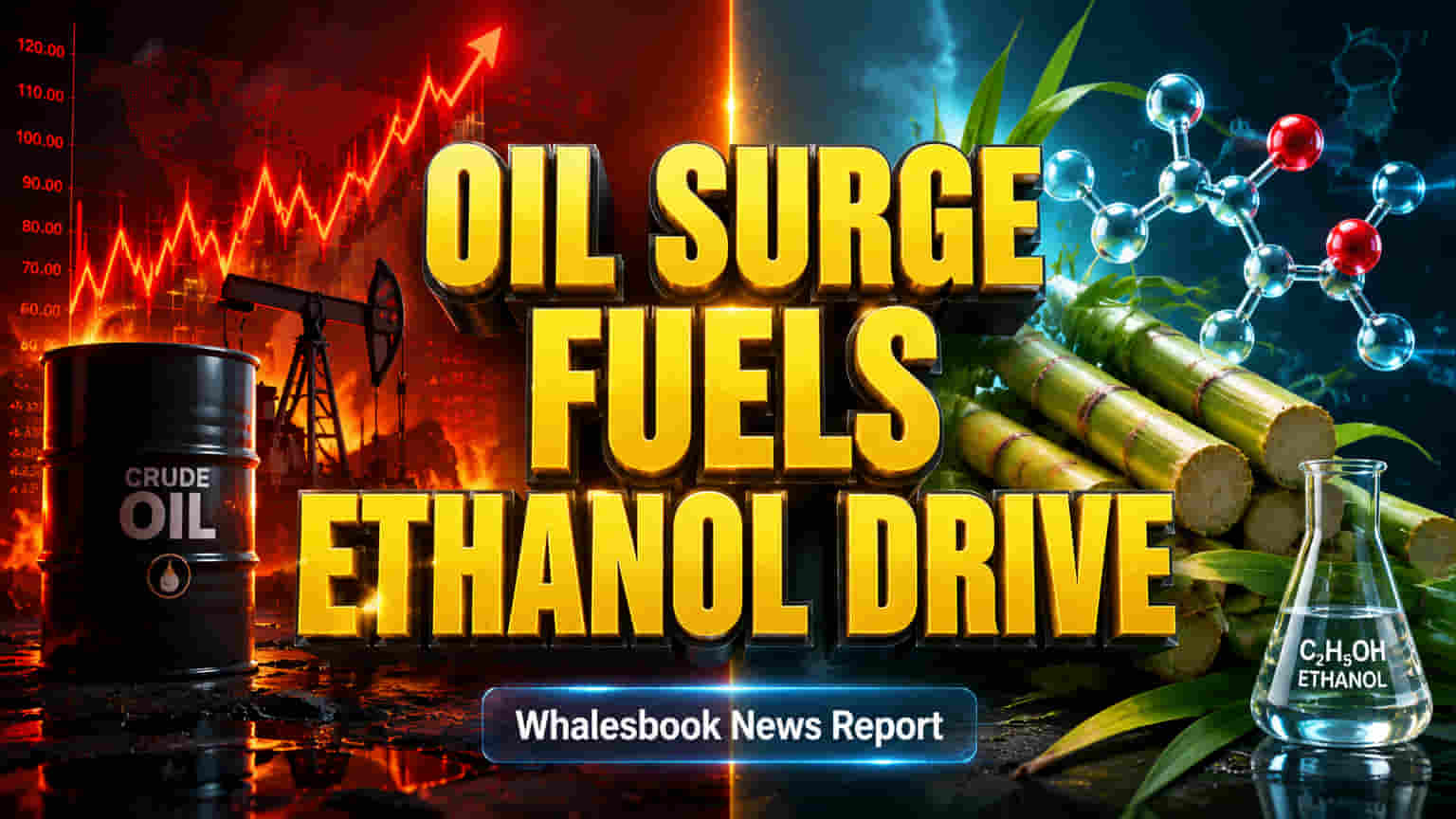


Why India Pushes Ethanol
India is rapidly accelerating its ethanol blending program, driven by the need for energy security and lower costs in uncertain global times. With crude oil prices volatile, New Delhi sees higher ethanol content as a key way to reduce its large crude oil import bill, which meets about 88% of the nation's needs. India has already surpassed its goal of a 20% ethanol blend (E20) in petrol ahead of schedule. Encouraged by this progress, Transport Minister Nitin Gadkari has even proposed ambitious targets like 85% ethanol blends (E85). The government estimates significant savings, reporting over ₹1.06 trillion ($12 billion) in crude oil import reductions and avoiding 54.4 million tonnes of carbon emissions over the past decade. This policy mirrors global trends, with Brazil recently increasing its mandatory blend to 32% (E32) from 30% (E30) to combat rising fuel costs. However, crude oil prices have shown volatility; for instance, WTI dropped to $98.07 USD/Bbl, influenced by geopolitical pauses like 'Project Freedom'. Despite government claims of marginal efficiency dips, the sector's fundamental metrics show steady valuations; for example, the Indian Energy Exchange's P/E ratio is 22.2x, a 5-year low. Major players like Indian Oil Corporation (IOC) command market caps around ₹2.01 trillion, and ONGC around ₹3.64 trillion.
Environmental and Resource Costs
The accelerated ethanol mandate, however, is facing growing criticism for its potential environmental and resource impacts. Ethanol's lower energy density compared to gasoline means vehicles consume more fuel for equivalent power, potentially affecting claims of overall oil demand reduction. Shyamasis Das, a fellow at the Centre for Social and Economic Progress, notes that higher blending levels limit definitive benefits. Furthermore, the production of ethanol, mainly from food crops like sugarcane and maize in India, places considerable strain on water and land resources. Estimates for water consumption vary widely; while NITI Aayog suggests 2,860 litres of water per litre of ethanol from sugarcane, industry bodies dispute figures exceeding 3-5 litres for industrial processing alone, and a recent government study claims sugarcane ethanol is more water-efficient (3,630 L/L) than maize (4,670 L/L) or rice (10,790 L/L). This intensive agricultural demand worsens water scarcity issues in many regions. Beyond water, burning ethanol can increase emissions of pollutants like nitrogen oxides and toxic carbonyl compounds, requiring strict regulations, as seen in Brazil.
Consumer Impact and Policy Risks
Drivers' experiences show a gap between policy goals and reality. Many have reported reduced fuel efficiency and concerns over increased engine wear and potential damage, particularly with older vehicles not designed for higher ethanol blends. Shell India has warned customers about potential engine damage and warranty loss with E20 fuel. This has sparked public debate and calls for greater transparency and choice at fuel pumps. Experts also caution that India's parallel pursuit of multiple decarbonization strategies, including biofuels, electric vehicles, and hybrids, risks splitting resources and confusing industry players. The focus on ethanol could inadvertently slow the transition to zero-emission mobility technologies. Regulatory bodies like the Centre for Study of Science, Technology and Policy (CSTEP) have highlighted risks of rising feedstock prices and increased fertilizer use tied to crop-based ethanol, similar to experiences with maize-based ethanol in the U.S.
The Path Forward
India's ambitious ethanol blending program presents a complex policy challenge, needing to balance immediate energy security with long-term environmental sustainability and keeping options open for various technologies. While there is a strong reason to cut oil imports, the associated resource pressures and potential for unforeseen environmental impacts cannot be ignored. The government faces pressure to reconcile these competing demands, possibly through technological innovation in production, more varied feedstock strategies, and clearer consumer communication. The sector's key entities, such as ONGC (₹3.64T market cap), Indian Oil Corporation (IOC, ₹2.01T market cap), BPCL (₹1.31T market cap), and HPCL (₹79.56T market cap), operate within a heavily regulated environment where policy changes and global commodity prices significantly influence outlook. The effectiveness of the ethanol strategy will ultimately depend on its ability to support, rather than hinder, broader energy transition goals.