 Whalesbook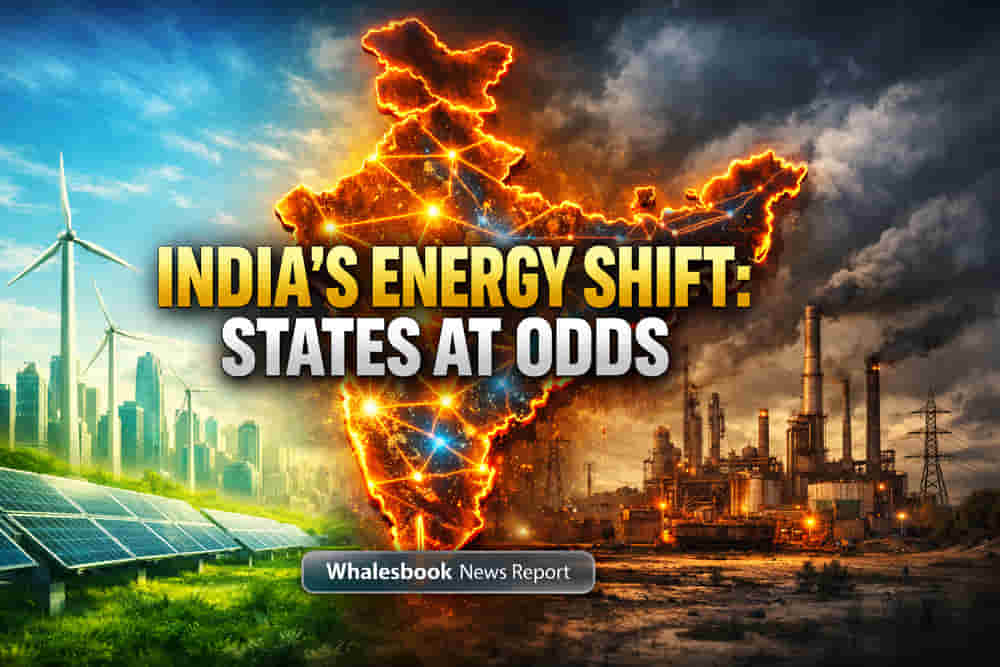


### The Seamless Link
The accelerated adoption of renewable energy across India, marked by surpassing 2030 targets for non-fossil fuel capacity ahead of schedule, underscores a national commitment to decarbonization. However, this broad progress belies a complex reality: the transition is not uniform. Instead, it has fragmented into a "multi-speed" phenomenon, where distinct state-level dynamics create a patchwork of opportunities and challenges. This unevenness, shaped by local resources, policy execution, and the financial health of power distribution companies (DISCOMs), demands a granular understanding for any investor or policymaker seeking to navigate India's evolving energy landscape.
### The Core Catalyst: Divergent State Performance
India has achieved a significant milestone, reaching 50% of its installed power capacity from non-fossil sources by October 2025, five years ahead of its 2030 target. This was fueled by an addition of 29 GW of renewable capacity in FY25 alone, with solar contributing 24 GW. However, this aggregate success masks a critical divergence. Leading states like Karnataka, Himachal Pradesh, and Kerala are recognized for their declining emissions intensity and increased renewable procurement. Simultaneously, Delhi and Haryana stand out for their robust power ecosystem performance, including reliable supply and distributed solar adoption.
Conversely, states such as West Bengal, Telangana, and Jharkhand remain in the nascent stages of transition, requiring substantial institutional strengthening and improved utility finances. This disparity is driven by inherent structural and historical factors, including varying resource endowments, development legacies, and fiscal conditions. The report emphasizes that progress is now broader, but the pace varies significantly, making targeted, state-specific policy interventions essential for balanced development.
### The Analytical Deep Dive
India ranks fourth globally in total installed renewable capacity and third in solar capacity, a testament to its rapid growth, which saw its renewable capacity expand by over 170% in the decade leading up to FY25. This surge is supported by policy frameworks like the National Electricity Act of 2003, which aimed to introduce market forces and deregulation. However, a critical bottleneck persists: the financial health of DISCOMs. Accumulated losses of distribution companies stood at approximately USD 75 billion in 2023, with many states owing generators billions in unpaid dues. This financial strain directly impedes their ability to scale renewable energy procurement effectively.
Internationally, India's approach combines policy frameworks with large-scale infrastructure projects, balancing progressive regulations with investment incentives. While India has demonstrated cost-effectiveness in emissions reductions linked to renewable capacity, other emerging economies like Indonesia have struggled to translate generation into consumption or emissions reduction due to implementation gaps. For India, challenges remain in transmission infrastructure, with over 60 GW of renewable capacity potentially impeded, and high material intensity and storage requirements acting as constraints to further scaling of renewables. The operational rigidity of coal plants, often running at minimum technical loads, also leads to avoidable curtailment of solar and wind generation, highlighting the need for system flexibility and grid upgrades.
### ⚠️ THE FORENSIC BEAR CASE
The fragmented nature of India's energy transition creates significant systemic risks. Lagging states, characterized by weak DISCOM finances, poor grid readiness, and institutional inertia, risk becoming stranded assets within the national energy framework. Their inability to effectively procure and manage renewable energy could lead to regional energy insecurity and hinder the national decarbonization agenda. This uneven progress places a disproportionate burden on states with stronger financial footing and regulatory capacity, potentially creating a two-tiered system. Furthermore, the continued, albeit declining, reliance on coal, with plans to add 100 GW of new coal capacity, poses a conflict. Existing and under-construction coal fleets already exceed projected needs for 2030, leading to potential overcapacity and financial distress for generators if they are bound by long-term power purchase agreements that prevent flexibility. The aggressive bidding in Battery Energy Storage System (BESS) auctions also raises concerns about long-term project viability, with fears of reduced profitability over 15-25 years, indicative of market pressures and potential execution risks.
### The Future Outlook
To bridge the widening gaps, coordinated national and state-level actions are paramount. Accelerated progress hinges on targeted, dimension-specific interventions to address areas where individual states lag. This includes substantial investment in grid infrastructure, improved DISCOM finances, and the expansion of digital platforms like the India Energy Stack to modernize power markets. Policy reforms aimed at enabling cost-reflective tariffs and rationalizing cross-subsidies are also critical for improving the financial viability of utilities and reducing counterparty risk for generators. With approximately 87 GW of solar, wind, and hybrid projects expected by the end of 2026, the pipeline for new capacity remains robust, but sustained execution and strategic policy refinement are necessary to ensure the benefits of India's clean energy transition are equitably distributed across all states.