

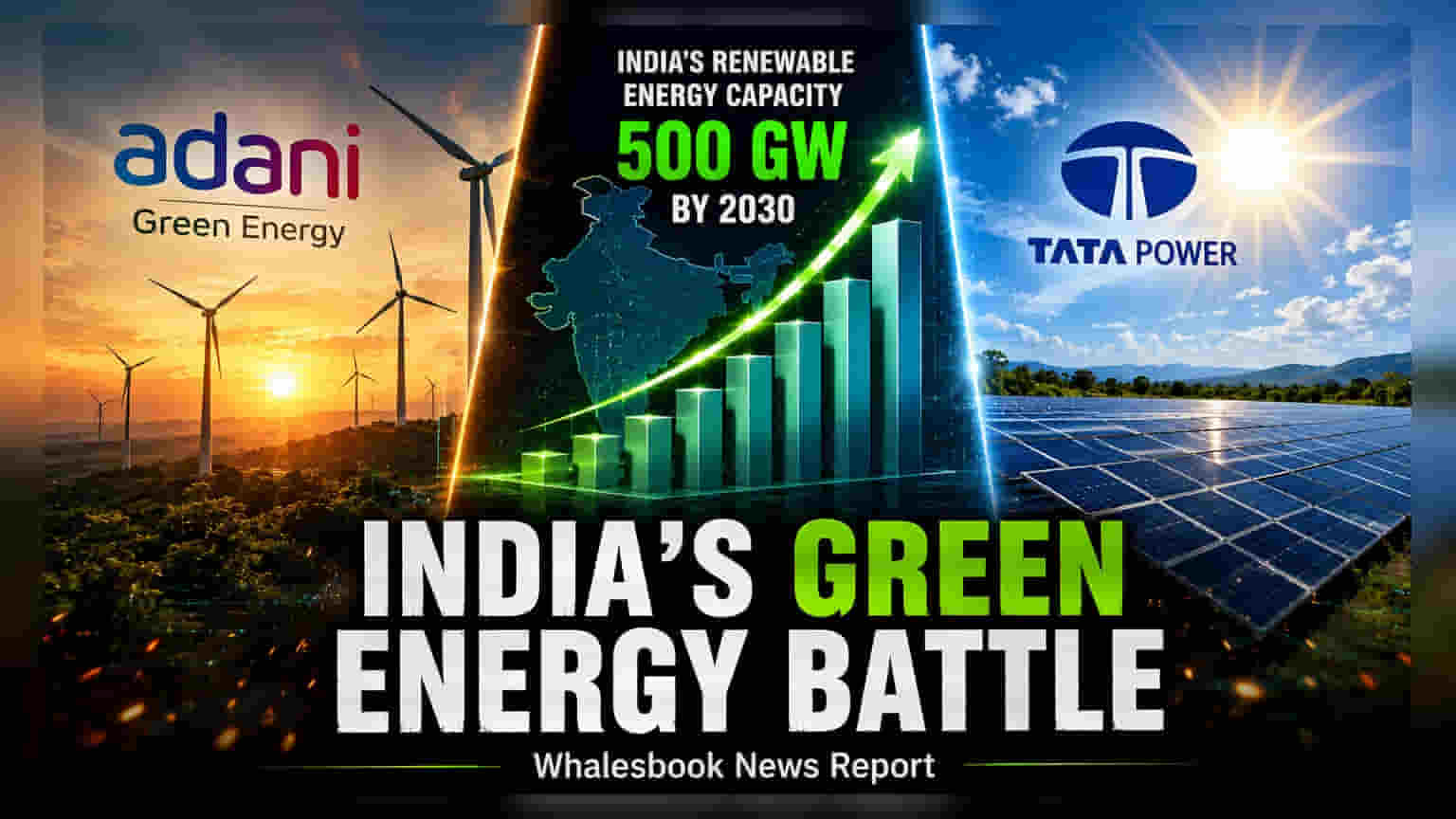
India's renewable energy sector is seeing aggressive competition as companies like Adani Green, JSW Energy, and NTPC Green expand to meet the national 500 GW goal by 2030. With current capacity crossing 300 GW, investors are closely watching how these firms manage capital-intensive expansion, storage integration, and execution timelines.
India’s renewable energy landscape is undergoing a massive shift, with major power developers aggressively scaling operations to meet the government’s ambitious target of 500 GW of non-fossil fuel capacity by 2030. As of August 2026, the country has crossed the 300 GW mark, prompting an intense race among top players to secure larger market shares through land acquisition, hybrid projects, and storage technology.
The Scale of Expansion
Adani Green Energy currently leads the pack, having surpassed 20 GW of operational renewable capacity as of July 2026. The company’s focus remains on rapid greenfield development to maintain its lead. JSW Energy has also carved out a significant position with a total locked-in generation capacity of 32.1 GW, of which approximately 13.45 GW is operational. Unlike companies that only count currently running assets, many developers now report 'locked-in' capacity, which includes projects won through tenders but not yet fully operational.
ReNew, another major developer, reported an operational portfolio of approximately 12.6 GW as of March 2026, with a total gross portfolio approaching 20 GW. Meanwhile, NTPC Green Energy has successfully navigated its public-sector expansion, crossing the 10 GW operational milestone in the last fiscal year and setting a target of 60 GW by 2032. Tata Power, which is also pivoting toward clean energy, has established an operational renewable footprint of about 6.5 GW, with another 5.1 GW currently under implementation.
Why Investors Are Watching
This rapid expansion is not without financial implications. The renewable sector is highly capital-intensive, requiring massive upfront spending before projects begin to generate stable revenue. As companies race to hit these capacity targets, investors are monitoring three key areas: capital allocation, debt levels, and project execution risks.
Projects are becoming more complex, moving from simple solar or wind farms to hybrid models that combine solar, wind, and battery storage. This shift is necessary to solve the issue of intermittency—when the sun isn't shining or the wind isn't blowing, renewable energy isn't generated. Companies that successfully integrate Battery Energy Storage Systems (BESS) and pumped hydro storage are expected to have a competitive edge in long-term power supply contracts.
Risks and Execution Challenges
While the growth trajectory appears strong, the industry faces distinct hurdles. Execution risk remains a significant factor, as large-scale projects can face delays due to land acquisition, environmental clearances, or infrastructure bottlenecks. Furthermore, the industry is heavily dependent on global supply chains for solar modules and battery cells. Price volatility in these raw materials can directly impact project costs and profit margins.
Another critical factor is the financing model. Aggressive capacity addition often requires higher levels of debt. Investors often track debt-to-equity ratios and interest coverage to assess whether these companies can sustain their expansion pace without compromising financial stability. The ability to manage these costs while navigating fluctuating power prices in the open market will be a key differentiator for these companies in the coming years.