

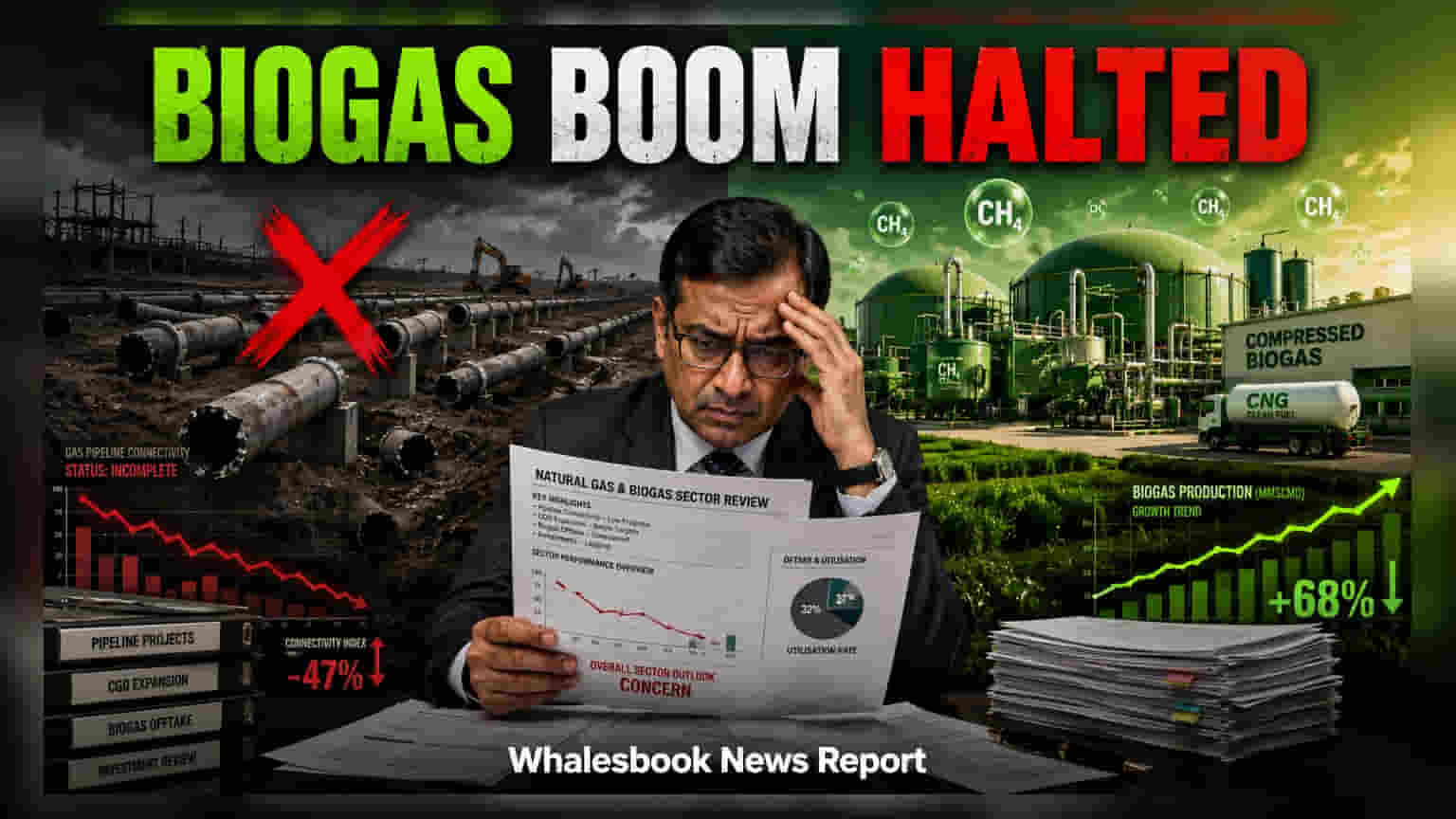
India's compressed biogas (CBG) expansion is facing an infrastructure bottleneck, with a Petroleum and Natural Gas Regulatory Board report revealing that 405 plants lack planned pipeline links. This shortfall complicates the government's aggressive mandate for city gas distribution companies to blend CBG into their supplies, which is set to increase to 5% by FY29. Investors should monitor the impact on compliance and operational costs for gas utility firms.
India's ambitious drive to integrate compressed biogas (CBG) into its city gas distribution networks is running into a significant infrastructure hurdle. A recent report from the Petroleum and Natural Gas Regulatory Board (PNGRB) has highlighted that 405 CBG plants—covering both operational and under-construction facilities—currently lack any planned pipeline connectivity. This physical gap threatens to derail the government's goal of scaling up renewable fuel usage to reduce import dependency.
The Blending Mandate Pressure
The central challenge lies in the widening gap between government-set blending mandates and the availability of connected supply. City gas companies, which operate the city gas distribution (CGD) networks, face a rising obligation to blend CBG with conventional gas. The mandate is scheduled to climb from 1% in fiscal year 2026 to 3% in FY27, 4% in FY28, and reaching 5% by FY29. Meeting these targets requires a significant jump in supply, with daily needs projected to climb from 1.03 million standard cubic metres per day (MMSCMD) in FY27 to 2.07 MMSCMD by FY29.
The PNGRB report paints a stark picture of the current state of infrastructure. Of the 207 functional CBG plants identified, only 24 have existing pipeline connections. A larger group of 148 functional plants have no connectivity plans at all. The situation is even more critical for the 328 plants still under construction, where 257 have no planned pipeline infrastructure. This means the vast majority of current and future production is not directly connected to the main gas grid.
Logistic Challenges and Operational Costs
Because direct pipeline integration is lacking, most CBG offtake currently relies on 'cascades'—a system where gas is transported via cylinders rather than through underground pipes. Data indicates that approximately 65.7% of CBG offtake from analyzed plants is handled through these cascades, while only 8.9% is injected directly into pipelines. Relying on road-based cascade transport instead of pipelines generally increases logistics costs and reduces the overall efficiency of distributing the fuel to households and vehicles.
The industry struggled to meet even the initial 1% blending target in FY26, where actual CBG sales were roughly 111.48 MMSCM against a much higher sales volume for CNG and domestic piped natural gas. With demand for piped and compressed gas growing at a compound annual rate of 7.9% over the next three years, the pressure on gas distribution companies to secure reliable, pipe-delivered CBG will only mount.
What Investors Should Monitor
For investors in city gas distribution companies, the key monitorable is how these firms manage compliance with rising blending mandates. If the infrastructure for direct pipeline delivery does not improve, companies may face higher operating costs due to the reliance on road-based transport or potential regulatory pressure if they fail to meet the mandatory blending thresholds. Future updates regarding capital spending on pipeline connectivity, incentives for plant developers, or any extensions to compliance timelines will be important for tracking the health and efficiency of the city gas sector.