

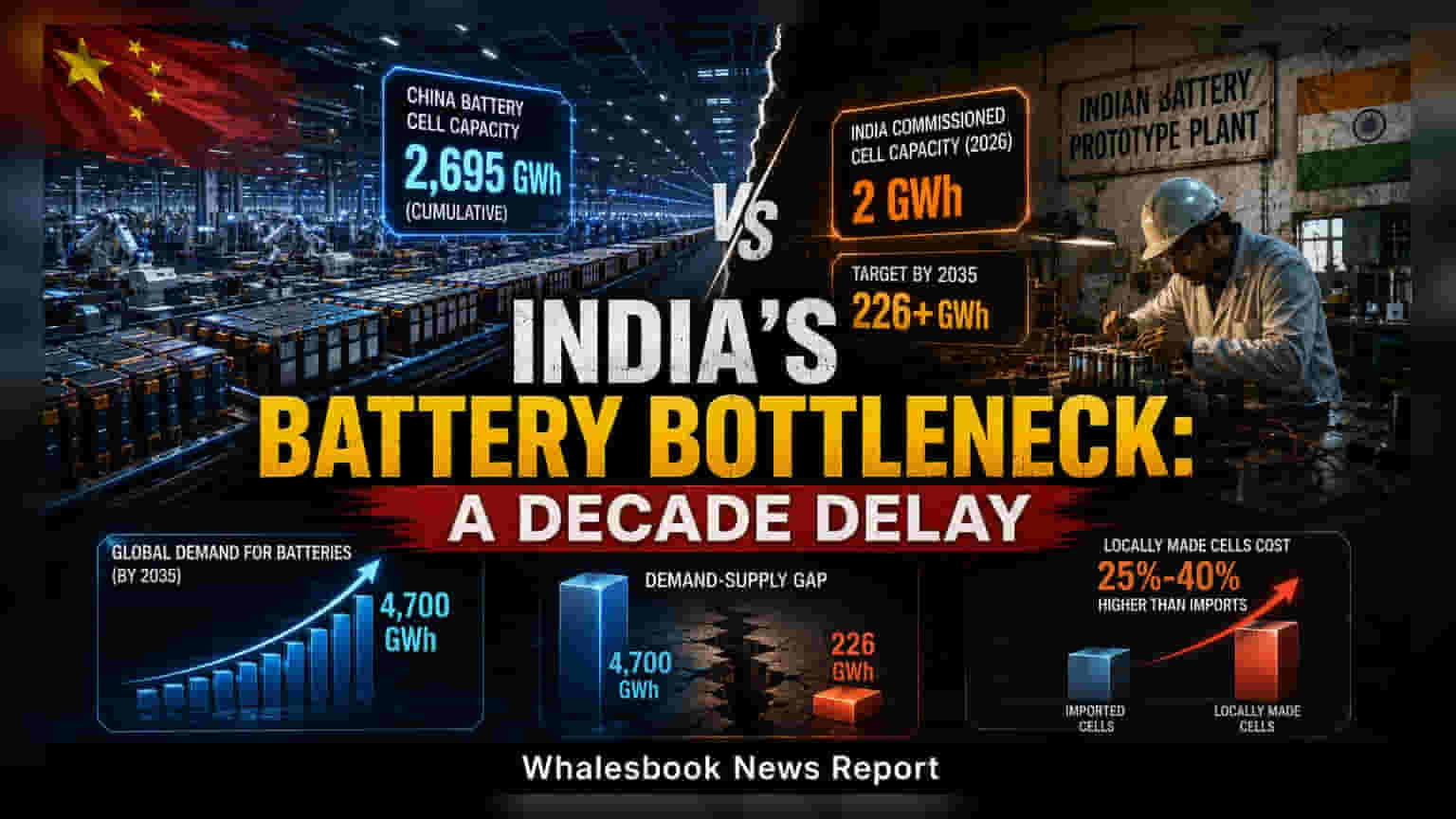
A new Wood Mackenzie report suggests India may take 10-15 years to build a self-sufficient battery cell supply chain. With domestic capacity currently meeting less than 1% of projected demand, the sector faces risks from import dependence and high initial costs. Investors may focus on downstream assembly and component manufacturing as more immediate opportunities before full-scale cell production matures.
India’s goal to become self-reliant in battery storage faces a significant timeline hurdle, with a new report from Wood Mackenzie projecting that a fully competitive domestic cell industry is still 10 to 15 years away. The report, titled "Chasing Self-Sufficiency: Cost of Building an Indigenous Battery Storage Supply Chain in India," highlights a massive gap between policy ambition and current industrial reality.
As of 2026, India has a commissioned cell manufacturing capacity of just 2 GWh. This is a small fraction of the scale seen in global manufacturing hubs, with China alone holding 2,695 GWh of cumulative capacity. While India has announced plans for over 226 GWh of capacity by 2035, the current reality leaves the country structurally dependent on imports from China and South Korea for critical components.
For investors, the report provides a clearer view of where the immediate business opportunities—and risks—lie. While the government is pushing for full cell manufacturing, establishing this requires deep technology partnerships and massive capital. Locally manufactured cells are currently estimated to be 25% to 40% more expensive than imports due to limited scale, higher financing costs, and a nascent domestic supplier base. This creates a potential margin pressure for companies trying to scale up domestic cell production in the short term.
However, the analysis points toward a different, more immediate strategy for manufacturers: downstream localization. This includes producing essential components like battery packs, containers, energy management systems, and SCADA (Supervisory Control and Data Acquisition) systems. These segments are technically easier to execute and commercially more viable today than building high-tech battery cells from scratch. Companies that focus on these "downstream" segments may find a more sustainable path to growth while the larger ecosystem for cell manufacturing matures.
The report also cautions that bridging the gap to self-sufficiency will require more than just government incentives. It necessitates a fundamental restructuring of the manufacturing ecosystem and sustained investment. The current dependence on technology licensors from China and Korea remains a significant operational risk, as it ties local production progress to external partnership stability and foreign technology transfer.
Moving forward, investors may track how companies execute their capital spending plans regarding Production Linked Incentive (PLI) schemes. The pace of commissioning, the ability to source critical raw materials, and the progress in localizing downstream components like battery packs will be key monitorables. The success of grid-scale Battery Energy Storage System (BESS) projects will also depend on how quickly firms can bring down the cost of these systems, which currently face a disadvantage compared to cheaper, imported alternatives.