

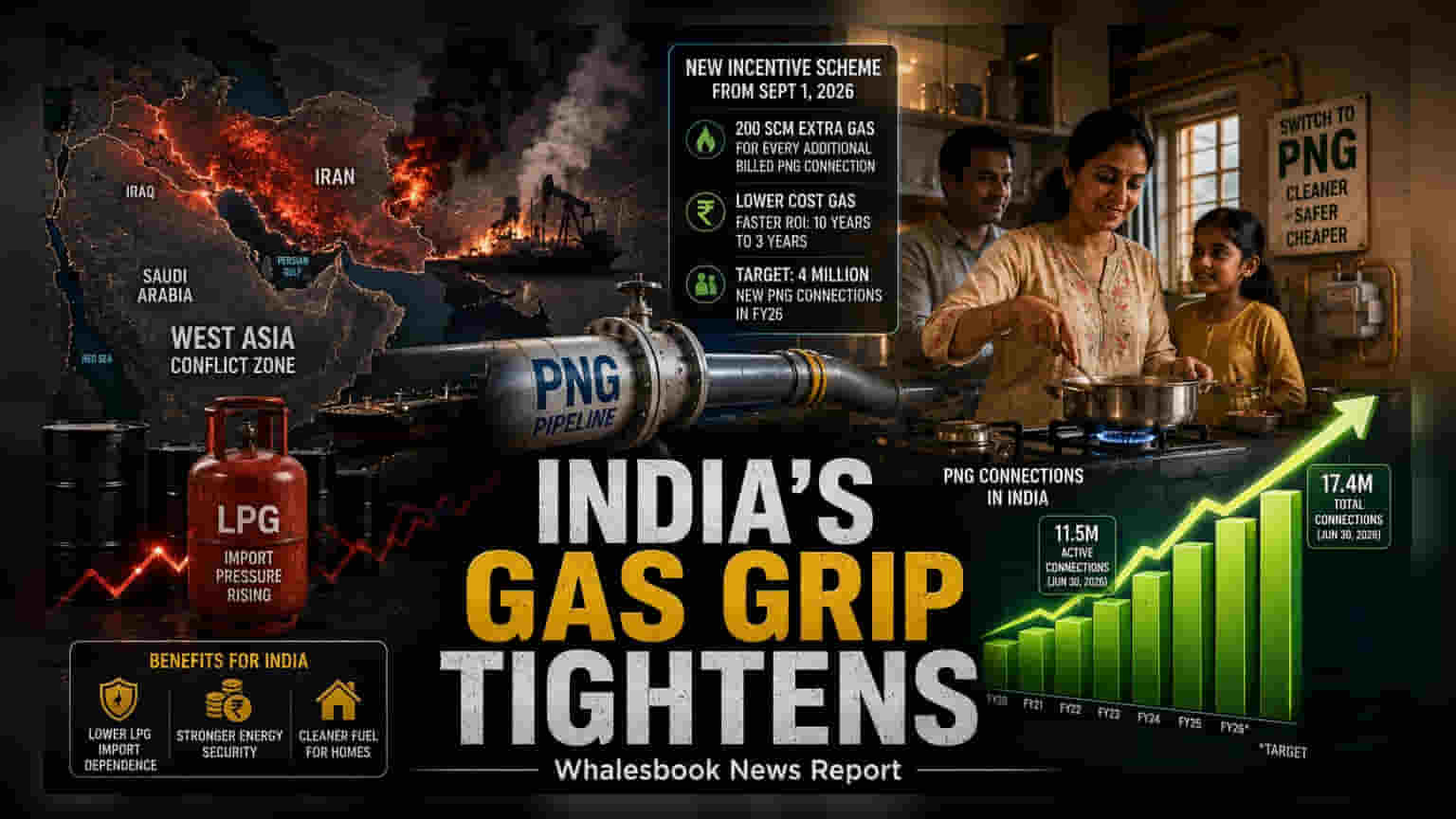
Starting September 1, 2026, the government will provide cheaper domestic gas to City Gas Distribution companies for every new active piped natural gas (PNG) connection. This move aims to accelerate connections to 4 million this fiscal year, helping firms reduce their reliance on expensive imported gas and offsetting infrastructure costs amid global supply risks.
The Ministry of Petroleum and Natural Gas has launched a new incentive scheme for City Gas Distribution (CGD) companies, effective September 1, 2026. The program aims to increase the pace of household piped natural gas (PNG) connections to 4 million in the current fiscal year. This initiative is designed to address the strain on imported liquefied petroleum gas (LPG) supplies caused by geopolitical tensions in West Asia, encouraging a shift toward domestically available gas.
Under this new structure, eligible CGD companies will receive an additional allocation of 200 standard cubic meters of lower-priced, domestically produced natural gas for every incremental billed PNG connection that exceeds their established targets. By providing cheaper gas, the government aims to help companies reduce their overall sourcing costs and displace more expensive imported liquefied natural gas. This could effectively lower the time required for companies to recover their initial investment in pipeline infrastructure from approximately 10 years to about 3 years.
The Petroleum and Natural Gas Regulatory Board is shifting its oversight focus from the total number of connections installed to the number of active, gasified connections. As of June 30, India reported 17.4 million total PNG connections, yet only 11.5 million were actively using the supply. The gap highlights a significant operational challenge: converting potential users into active consumers.
Despite the government's push, CGD companies face hurdles in increasing adoption. Many consumers remain hesitant to switch from traditional LPG cylinders, often preferring to keep them as a backup. Additionally, the upfront costs for new connections, which can reach around ₹6,000, may discourage potential households. To speed up migration, authorities have introduced measures, including policies that encourage households with PNG infrastructure to surrender their LPG connections.
For investors, the financial impact will depend on how effectively CGD companies can leverage this cheaper gas allocation to improve their profit margins. While the incentive scheme helps reduce sourcing costs, risks remain. These include high fixed costs associated with laying infrastructure in new geographical areas and the ongoing challenge of high connection dormancy rates. Investors may track whether the accelerated connection target of 4 million is met, as actual gas consumption remains the primary driver of revenue for these companies.