

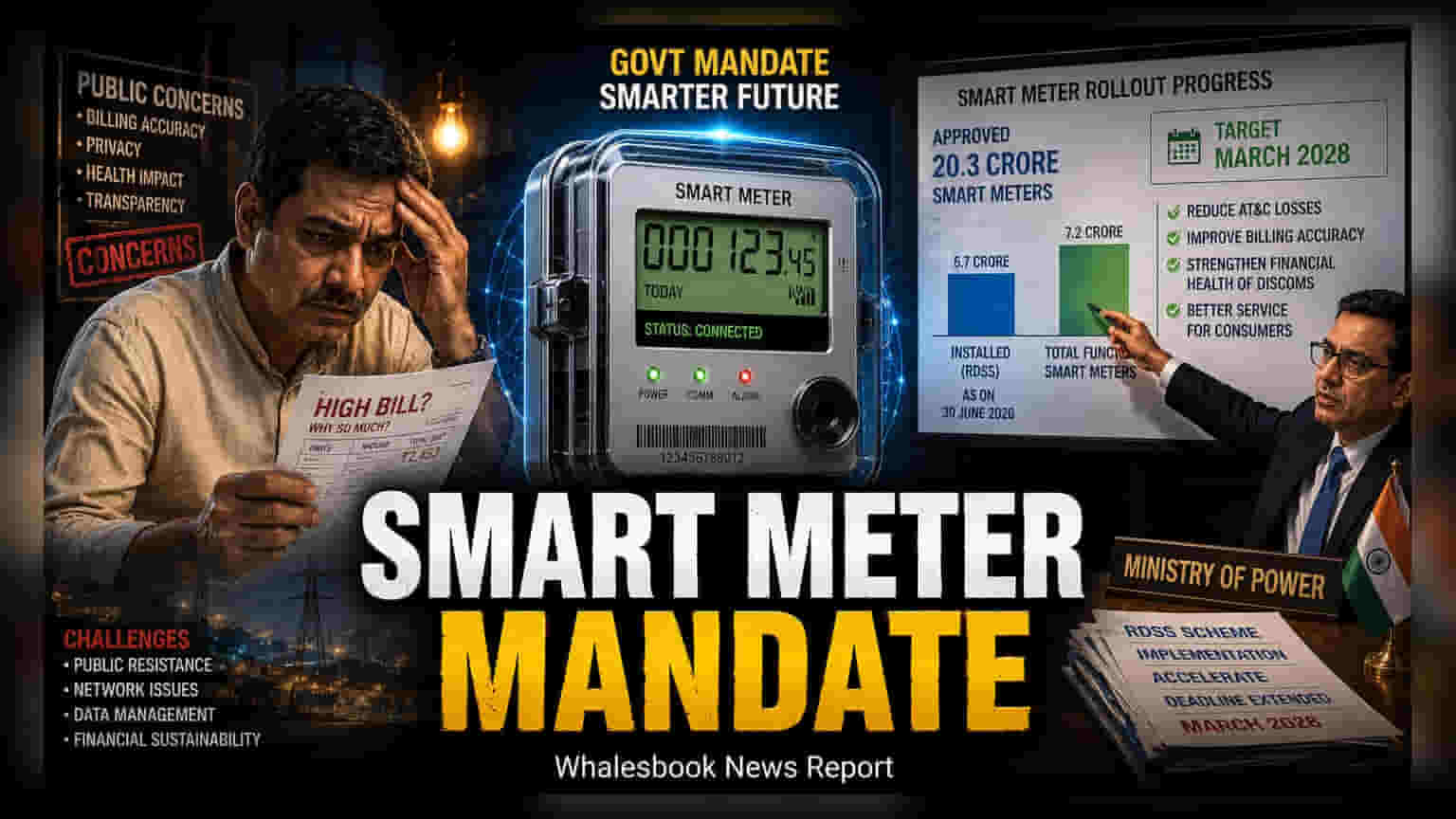
The Ministry of Power has ordered all states to speed up smart meter installations, clarifying that the mandate applies regardless of whether the billing is prepaid or postpaid. While the rollout aims to improve the financial health of state electricity distribution companies by reducing losses, progress remains below targets, with significant work needed before the 2028 deadline.
The Ministry of Power has issued a fresh directive to all states and Union Territories, requiring them to accelerate the installation of smart electricity meters. This move follows the Central Electricity Authority's (Installation and Operation of Meters) (Amendment) Regulations, 2026, which makes the installation of these advanced meters a statutory requirement in areas where communication networks are available. The government has clarified that this mandate is universal and is not dependent on the choice of billing mode, meaning consumers cannot cite a preference for prepaid or postpaid billing to avoid installation.
The central government is focusing on the Revamped Distribution Sector Scheme (RDSS) to modernize the power sector. Under this scheme, authorities have approved the installation of 20.3 crore smart meters. However, the pace of adoption has been a significant concern for stakeholders. As of June 30, 2026, data shows that only 5.7 crore smart meters have been installed under the RDSS, with the total number of functional smart meters across all initiatives reaching 7.2 crore. Recognizing the slow implementation, the government extended the original March 2026 deadline for the scheme by two years, setting a new target of March 2028.
For investors and market participants, the primary importance of this rollout lies in the financial health of electricity distribution companies, or DISCOMs. Historically, many DISCOMs have struggled with high Aggregate Technical and Commercial (AT&C) losses, which are losses due to electricity theft, faulty wiring, or unbilled consumption. Smart meters are a critical tool to curb these losses by providing real-time data on energy flow and consumption. This allows utilities to identify leakages and ensure accurate billing, which in turn improves their revenue collection cycle and reduces dependence on state subsidies.
Despite the clear benefits, the implementation path faces several challenges that investors should note. Public resistance has become a recurring theme in several regions, with consumer concerns about billing accuracy and technology transparency leading to delays. For instance, recent developments in Uttar Pradesh, where the government paused installations to conduct awareness drives following consumer complaints, highlight the practical hurdles. These implementation delays can push back the timeline for DISCOMs to achieve operational break-even.
Beyond public sentiment, there are operational and technical bottlenecks. Integrating these meters requires stable communication networks, which are not uniformly available across all rural and remote areas. Furthermore, the industry faces the challenge of managing the massive volume of data generated by these devices and ensuring interoperability between meters supplied by different vendors. The transition to the TOTEX model, which combines capital expenditure for installation with operational expenditure for maintenance, requires DISCOMs to have the financial discipline to sustain these projects over the long term.
The progress of this rollout will be a key factor to watch for the power sector. Investors will likely look for updates on tender issuance, the actual pace of meter deployment in major states, and, most importantly, evidence of reduced AT&C losses in the financial results of power utilities. Success in this mandatory rollout will be crucial for the long-term viability of the distribution segment.