

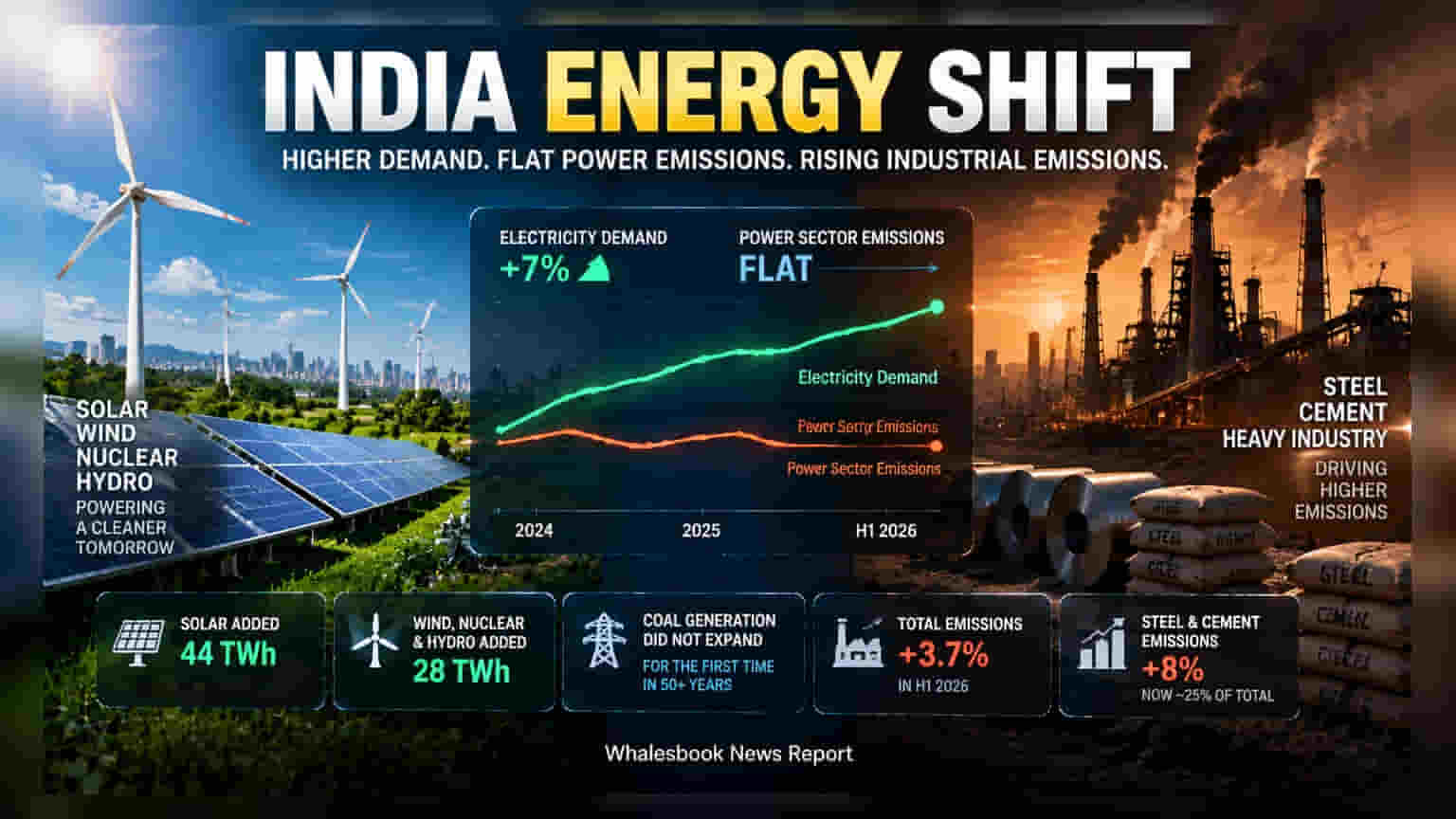
India’s power sector emissions remained flat from early 2024 to mid-2026, as renewable energy absorbed all growth in electricity demand. However, total emissions rose 3.7% due to an 8% increase in steel and cement production linked to real estate growth. Investors are observing margin pressure in heavy industry due to high coking coal costs and freight disruptions, while the power grid requires urgent infrastructure and storage upgrades.
The Indian power sector has reached a turning point, with carbon emissions remaining flat between early 2024 and mid-2026. This period marks the first time in over five decades that coal-based power generation did not expand, even as the country’s electricity demand increased by 7 percent. Instead, clean energy sources like solar, wind, and nuclear power provided the entire increase in electricity production. Solar energy led this shift, contributing 44 terawatt-hours to the grid, while wind, nuclear, and hydro power added another 28 terawatt-hours.
Despite this progress in the electricity sector, India’s total carbon emissions increased by 3.7 percent in the first half of 2026. This rise is primarily driven by heavy industries, specifically steel and cement. Emissions from these sectors climbed by 8 percent, now making up nearly one-quarter of the country’s total carbon output. This increase correlates with the strong growth in domestic real estate development witnessed throughout the second quarter of 2026.
Industrial Margins Under Pressure
While real estate demand remains high, steel and cement companies are struggling with financial performance. Producers face significant profit margin compression due to elevated raw material costs, particularly for imported coking coal. Furthermore, logistics have become more expensive due to rising freight costs stemming from the crisis near the Strait of Hormuz. These factors are creating a difficult environment for industrial margins, even as the broader economy sees growth in infrastructure and housing.
Infrastructure and Future Trends
The transition to clean energy faces several obstacles. Future grid stability requires urgent investment in transmission infrastructure and large-scale energy storage systems. Without these upgrades, it is difficult to integrate renewable energy efficiently. Meanwhile, improving the flexibility of existing coal-fired plants remains a focus area for policymakers.
The energy sector faces a dual path. While the power sector moves toward greener energy, the fossil fuel industry is still moving forward with major capital spending. Plans for new coal-fired power capacity and coal-to-chemical conversion projects suggest that traditional energy sources will remain part of the industrial base for years to come. Investors may track how effectively companies manage the balance between high raw material costs, the need for cleaner industrial processes, and the long-term requirement for grid infrastructure upgrades.