

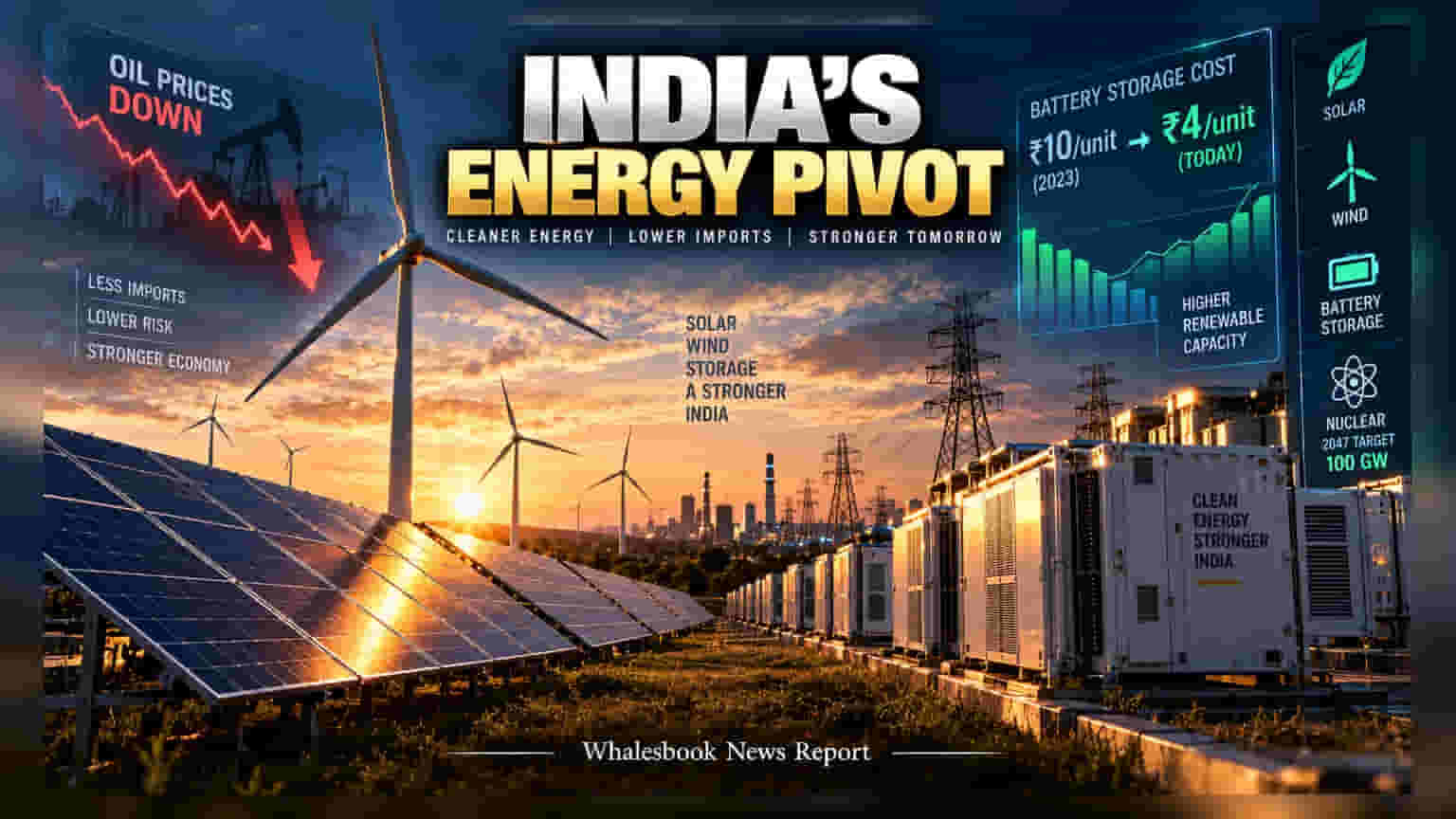
India is accelerating its transition from imported fossil fuels to renewable and nuclear power to ensure energy security. With battery storage costs dropping from Rs 10 to Rs 4 per unit, the government is focusing on grid stability and new infrastructure. Investors should monitor how this policy impacts renewable energy producers, grid transmission companies, and power equipment manufacturers in the coming quarters.
The Indian government has signaled a decisive shift in its national energy strategy, aiming to reduce dependence on imported oil and gas. Power Secretary Pankaj Agarwal recently outlined an roadmap that prioritizes renewable energy, including solar, wind, and biomass, alongside a long-term goal for nuclear power. This policy shift is driven by the need to protect the nation from the geopolitical risks associated with volatile global commodity markets and energy supply chains near key shipping routes.
The Economics of Battery Storage
A critical factor supporting this shift is the rapid change in technology costs. The government highlighted that the cost of battery storage has declined significantly, falling from approximately Rs 10 per unit in 2023 to Rs 4 per unit today. This reduction in storage costs is a game-changer for renewable energy, as it helps address the issue of intermittency—where power is generated only when the sun shines or wind blows. For independent power producers (IPPs) like Adani Green, Tata Power, and JSW Energy, lower battery costs can improve the financial viability of hybrid projects that bundle solar and wind with storage.
Beyond battery technology, the government is scaling up pumped storage, with 16,000 MW of projects currently in the pipeline. This infrastructure is essential for creating a reliable grid that can handle the influx of variable power from renewable clusters located in states like Rajasthan and Gujarat.
Infrastructure and Grid Expansion
The move toward massive renewable capacity requires a robust transmission network to carry power from generation hubs to industrial centers. This focus on grid stability provides a potential tailwind for transmission equipment manufacturers and engineering, procurement, and construction (EPC) companies such as Siemens India, ABB India, KEC International, and Hitachi Energy. These firms are critical to the government’s plan to expand transmission lines and implement modern grid management systems.
Furthermore, the upcoming National Electricity Policy is expected to introduce flexibility mandates for heavy energy users, including data centers and green hydrogen plants. These mandates are designed to ensure grid stability and reduce the burden on existing power infrastructure.
Long-Term Nuclear and Manufacturing Goals
Looking toward 2047, the government has formalized a target to reach 100 GW of nuclear power capacity. While this is a long-term vision, it underscores a commitment to base-load power that does not rely on imported fuel. To support this growth, the state is also encouraging domestic manufacturing of power electronics and design-in-India solutions.
For investors, the immediate monitorables include the tendering pace for new grid projects, the execution timeline of the 16,000 MW pumped storage projects, and the specific flexibility mandates in the new electricity policy. While the policy provides a clear direction, the speed of implementation, land acquisition for transmission lines, and the ability of companies to manage capital spending will determine the actual impact on bottom lines.