 Whalesbook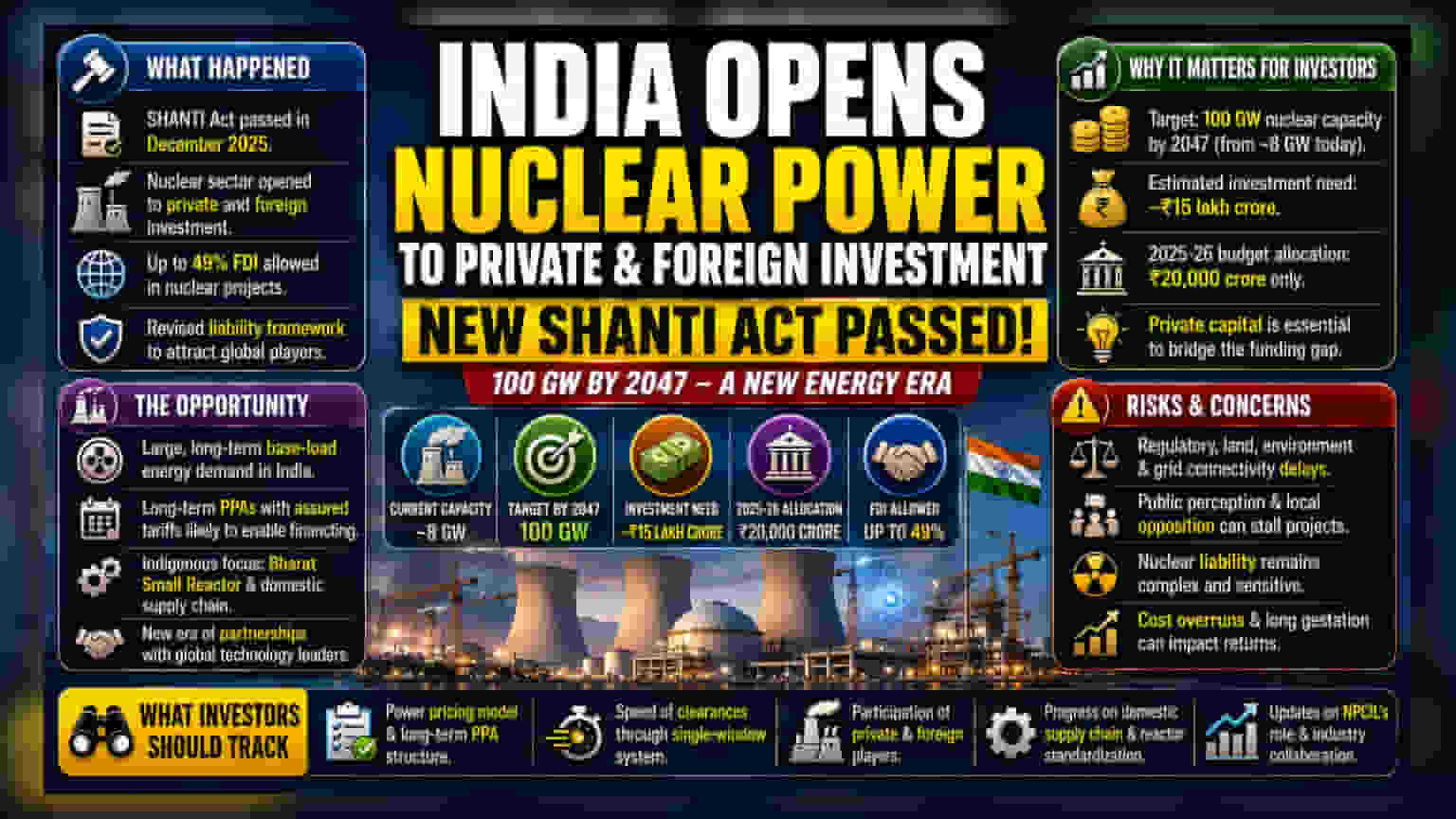


India’s new SHANTI Act allows private and foreign investment in the nuclear sector, aiming for a massive 100 GW capacity by 2047. This major shift from government-only control targets a Rs 15 lakh crore expansion. While the policy change is significant, the success of these long-term projects will depend on clear power pricing, faster regulatory approvals, and the ability of the industry to manage the high risks and costs involved in building nuclear plants.
What Happened
The Indian government has taken a major step to open the nuclear power sector to private and foreign investment through the SHANTI (Sustainable Harnessing and Advancement of Nuclear Energy for Transforming India) Act, passed in December 2025. This legislation is a significant change for an industry that has historically been managed entirely by the government through state-run entities like the Nuclear Power Corporation of India Limited (NPCIL). The goal is to reach 100 GW of nuclear power capacity by 2047, which is a massive jump from the current capacity of approximately 8 GW. To reach this, the government allows up to 49 percent foreign direct investment and has updated the liability framework for companies involved in the sector.
Why This Matters For Investors
Nuclear power projects are vastly different from solar or wind energy projects. They require enormous amounts of money upfront, take many years to build, and involve complex safety and regulatory standards. The government estimates that this expansion will require roughly Rs 15 lakh crore in investment. With the 2025-26 budget allocating only Rs 20,000 crore to the sector, it is clear that the government is relying on private sector capital to bridge this funding gap. For investors, this creates a new, long-term opportunity in the energy space, provided that the financial returns justify the significant risks associated with building such capital-intensive plants.
The Financial And Execution Challenge
Building nuclear capacity is not just about having the money; it is about execution. Unlike renewable projects that can be set up in a few years, nuclear power plants often take a decade or more from planning to operation. This creates a long waiting period before investors see any cash flow. For private players to participate, they will need revenue certainty. This means the government will likely need to offer long-term power purchase agreements with assured tariffs. Without such agreements, private companies might find it difficult to borrow money from banks for these projects. Additionally, the government's focus on indigenous technologies, such as the Bharat Small Reactor, aims to build a domestic supply chain to lower costs and reduce dependence on foreign tech.
Risks and Concerns
Investors should be aware of the specific risks in this sector. Regulatory risk is high; any delay in land acquisition, environmental clearances, or grid connectivity can lead to massive cost overruns. Public perception is another hurdle. Nuclear energy projects often face local opposition due to safety and waste management concerns, which can stall construction for years. Furthermore, nuclear liability—the financial responsibility in the event of an accident—remains a complex area. While the SHANTI Act aims to revise these frameworks, legal certainty is vital for international companies to enter the Indian market.
What Investors Should Track
Moving forward, the success of this initiative will hinge on how the government handles the practical side of these reforms. Key monitorables include the announcement of specific power pricing models, the speed at which the government sets up a single-window system for project clearances, and the actual participation levels of private corporations. Investors may also look for updates on the supply chain development and how the government plans to balance the role of public sector giants like NPCIL with new private entrants. The ability of the industry to standardize plant designs to speed up construction will be another major indicator of success.