

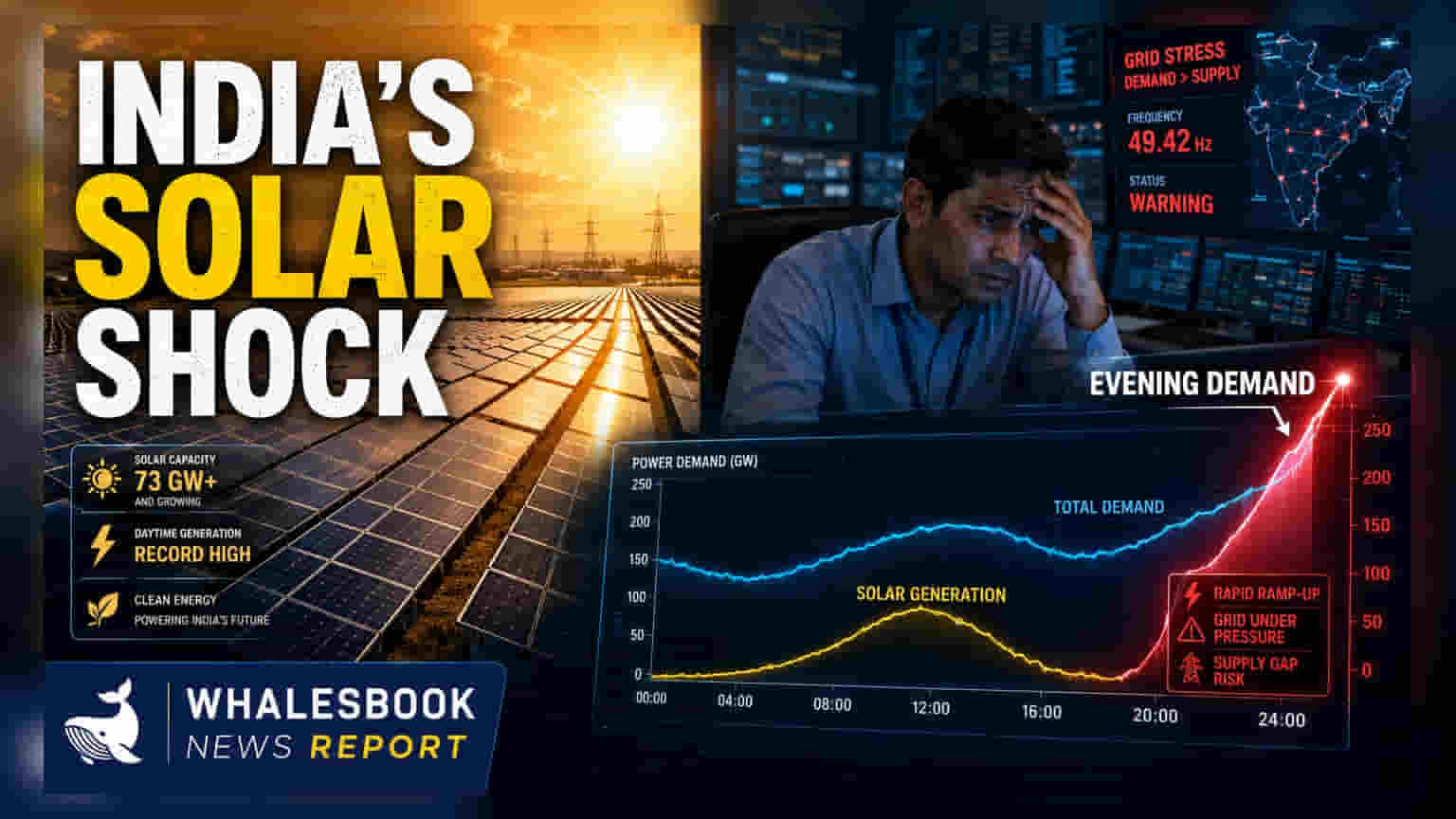
A report from the Prime Minister's Economic Advisory Council warns that India's solar power growth is stressing the national grid due to a lack of battery storage. With only 24 GWh of capacity currently available, the study estimates a need for 130 GWh to manage evening peak demand. This shortfall creates operational pressure on thermal power plants and leads to extreme price volatility between daytime and nighttime electricity.
India’s rapid transition toward solar energy is creating an urgent need for grid-scale battery storage solutions. A recent working paper from the Prime Minister's Economic Advisory Council (PM-EAC) has highlighted that the country’s current storage capacity is insufficient to handle the volatility caused by large-scale solar power injection during midday hours. While India has made significant strides in renewable generation capacity, the grid’s ability to manage this influx is now being tested.
The Operational Strain on Thermal Plants
The fundamental challenge arises because solar energy production peaks when the sun is brightest, often flooding the grid with supply. As demand patterns do not align perfectly with solar generation, conventional thermal power plants are forced into frequent and rapid adjustments—known as ramping—to maintain grid stability. This increased operational intensity can lead to higher wear and tear on existing thermal facilities, potentially impacting their long-term maintenance costs and efficiency. The report suggests that the lack of flexibility is shifting the nation's energy bottleneck from generation capacity to grid management.
Storage Gap and Market Price Volatility
The report underscores a massive gap between the current battery capacity of approximately 24 GWh and the estimated requirement of 130 GWh needed to balance evening peak loads. This deficit is directly reflected in the power market, where electricity prices have shown extreme variance. In May, average spot prices plummeted to ₹1.11 per kWh during solar-rich daylight hours, only to spike to ₹9.71 per kWh at night when solar power is unavailable and demand remains high. This price disparity creates uncertainty for power distributors and industrial consumers who rely on consistent pricing to plan their operations.
Future Policy and Implementation Risks
To address this, the PM-EAC points toward the California grid model, where large-scale battery systems successfully absorb excess daytime energy to be discharged during evening peaks. While the report views ongoing policy efforts—such as new time-of-day tariffs and updated electricity laws—as positive steps, the primary risk for investors lies in the execution speed of these infrastructure projects. The transition requires substantial capital spending on battery infrastructure, and the speed at which this capacity is added will be crucial for the financial health of the energy sector. Investors should track the implementation timeline of upcoming energy storage tenders and the actual adoption rate of battery systems across the utility sector. The ability of the grid to integrate renewable energy without forcing massive price swings will be a major indicator of sector stability in the coming years.