 Whalesbook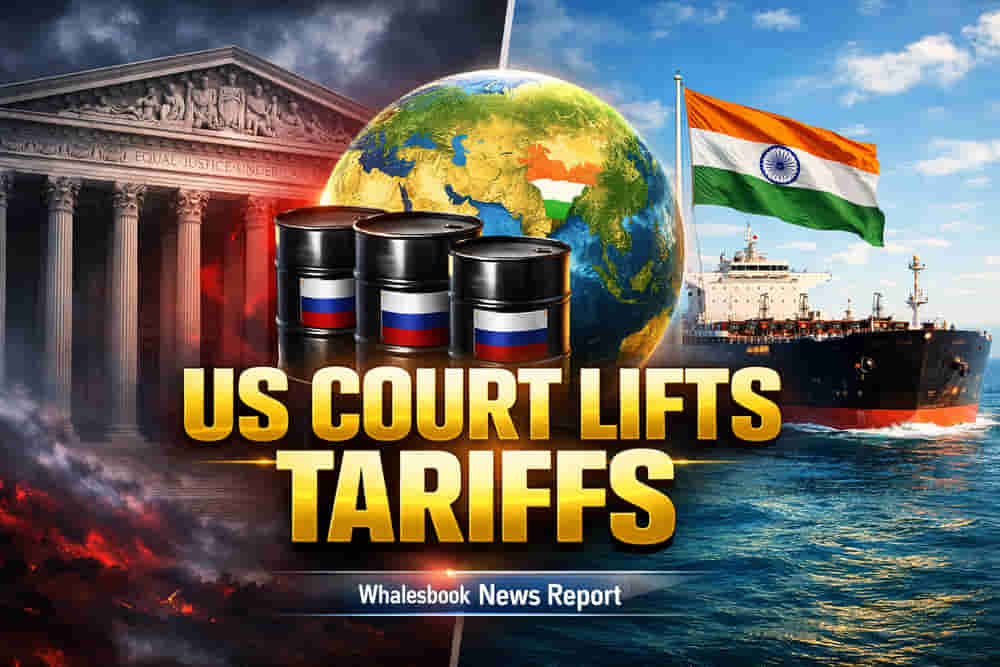


### The Judicial Catalyst and Strategic Recalibration
The United States Supreme Court's recent decision to strike down President Donald Trump's broad tariffs, imposed under the International Emergency Economic Powers Act, has fundamentally altered the trade policy landscape. This ruling effectively removed a significant, albeit blunt, instrument of US pressure on global trade partners, including India [38, 40, 44]. However, the immediate aftermath saw President Trump announce a revised 15% global tariff under a different legal authority, Section 122 of the Trade Act of 1974, maintaining a degree of economic leverage [38]. For India, this judicial development, occurring against the backdrop of an interim trade framework with the US, introduces a period of strategic reassessment and opportunity [10, 40, 43]. The framework, initially negotiated under the shadow of significant tariffs, including a 50% rate linked to India's Russian oil imports, has now seen its legal and economic foundation shift materially, prompting India to postpone bilateral trade talks [40].
### Shifting Oil Tides Amid Geopolitical Currents
The past months have witnessed a pronounced rebalancing in India's crude oil import strategy. Russia's share of India's imports has notably declined, with its contribution falling to approximately 21.2% in January 2026, a low not seen since late 2022 [4, 32]. This marks a significant reduction from peak volumes where Russian crude constituted as much as 40% of India's imports post-Ukraine conflict [19]. Concurrently, Saudi Arabia has reasserted its position as India's foremost oil supplier, with import volumes reaching record levels in February 2026 [4, 9, 16, 19, 20]. This pivot contrasts sharply with China, which has amplified its purchases of Russian crude, capitalizing on deep discounts and India's reduced intake [6, 18, 30, 33]. The trend indicates diverging energy strategies across Asia.
### India's Strategic Autonomy and Lingering Pressures
New Delhi's energy policy continues to be anchored by a steadfast commitment to national interest, prioritizing price, supply stability, and energy security above geopolitical dictates [3, 31]. India's pursuit of 'strategic autonomy' dictates independent decision-making on critical matters, and the recent tariff ruling provides a more favorable environment to pursue this strategy. This moment allows India to negotiate trade terms with reduced fear of punitive, blanket tariff punishments [1]. However, the US retains other significant levers, including targeted sanctions, financial restrictions, and the threat of secondary sanctions on entities transacting with sanctioned Russian firms, which continue to exert pressure [1, 13, 29]. These measures have already impacted Russian oil prices and transaction volumes, contributing to its reduced appeal for Indian refiners [25]. Furthermore, escalating geopolitical tensions in the Middle East, particularly concerning the Strait of Hormuz—through which over 50% of India's crude imports transit—introduce persistent supply route risks [8, 11].
### The Bear Case: Navigating Persistent Headwinds
Despite the judicial setback for US tariff policy, the threat of external pressure on India's energy procurement decisions has not vanished. The US retains multifaceted avenues for influence, including sanctions and diplomatic pressure, which can create commercial and policy frictions for Russian oil transactions [17, 29]. The evolving geopolitical climate in West Asia presents a constant risk of supply disruptions, potentially leading to price volatility and increased import costs for India, which imports nearly 85% of its oil [8, 12]. The trade relationship with the US remains transactional, with the potential for future friction evident in the ongoing renegotiation of the interim trade pact [10, 39, 40]. Moreover, China's aggressive acquisition of discounted Russian crude creates a dynamic where India's strategic calculations must also consider regional competitive pressures.
### Future Outlook: Resilience and Diversification
India is poised for substantial growth in energy demand through 2050, projected to be the largest contributor to global oil demand growth [7, 14]. Its strategy centers on diversifying import sources, enhancing strategic petroleum reserves (currently providing around 74 days of cover), and ensuring refinery flexibility [5, 36]. The current rebalancing in its crude slate is a calibrated adjustment rather than an abrupt realignment, reflecting a sophisticated approach to risk management [15, 28]. India's commitment to navigating complex global energy markets while upholding its strategic autonomy will be crucial in ensuring sustained energy security and economic stability.