

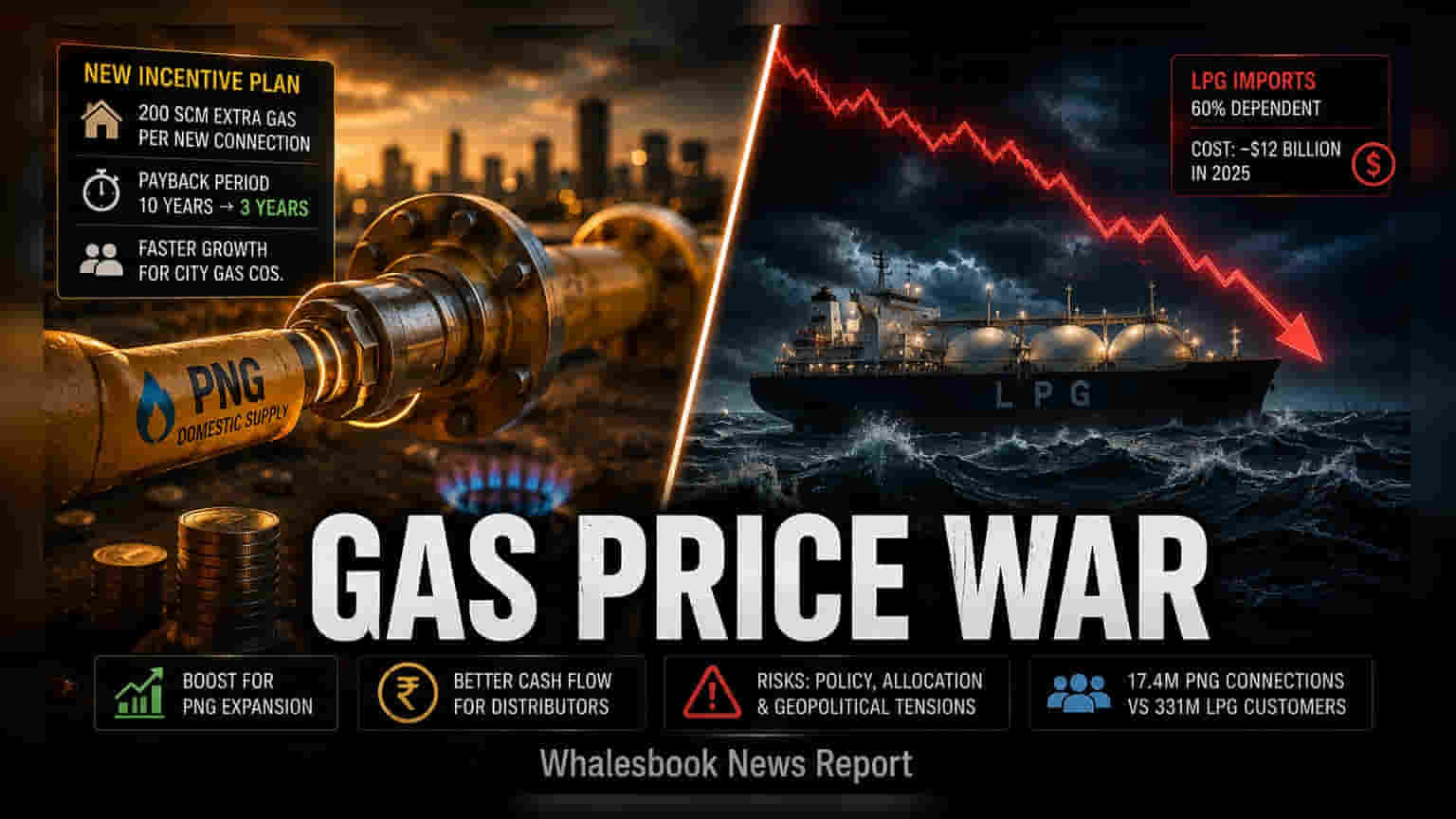
Starting September 2026, the government will provide cheaper domestic gas to City Gas Distribution companies for every new household connection. This move aims to reduce the high cost of LPG imports caused by global tensions. By helping companies recover their expansion costs faster, the plan seeks to speed up the adoption of piped gas for Indian households.
The Indian government is launching a new incentive plan effective September 2026 to accelerate the reach of Piped Natural Gas (PNG) for domestic cooking. City gas distribution companies will now receive an additional 200 standard cubic meters of lower-priced, domestically produced gas for every new billed household connection they secure above a set threshold.
This initiative is a strategic response to the rising costs of Liquefied Petroleum Gas (LPG) imports. Global supply disruptions stemming from conflicts in West Asia have driven up fuel prices, prompting the government to find ways to reduce the country’s reliance on imported LPG. India currently imports about 60% of its LPG needs, costing the nation nearly $12 billion in 2025.
For investors, the most significant change is the expected impact on the financial returns of city gas distributors. Under the current model, it takes about ten years for these companies to earn back the money they spend to install a new household connection. The government estimates that this new, cheaper gas supply could reduce that payback period to approximately three years. A faster recovery of the money spent on expansion can improve the cash flow and financial flexibility of companies in this sector.
Despite the potential for faster growth, the sector faces several risks and challenges. The profitability of city gas companies remains heavily tied to the government’s allocation of cheaper domestic gas, known as Administered Price Mechanism (APM) gas. This allocation is subject to government policy changes, which means companies are not entirely in control of their own input costs.
Furthermore, while the policy provides an incentive, companies still face the practical difficulty of laying pipelines in crowded urban areas to convert customers from traditional LPG cylinders to piped gas. As of July 1, 2026, India had 17.4 million PNG connections compared to over 331 million active LPG customers, indicating a large potential market but also a challenging infrastructure hurdle. Additionally, the risk of geopolitical tension continues to affect global gas prices, which may impact companies that have to source extra supply from the spot market.
Investors may track how efficiently companies use these incentives to expand their customer base without hitting significant project delays. The effectiveness of this scheme will ultimately depend on how quickly providers can convert new households into active, paying customers, rather than just installing pipes.