

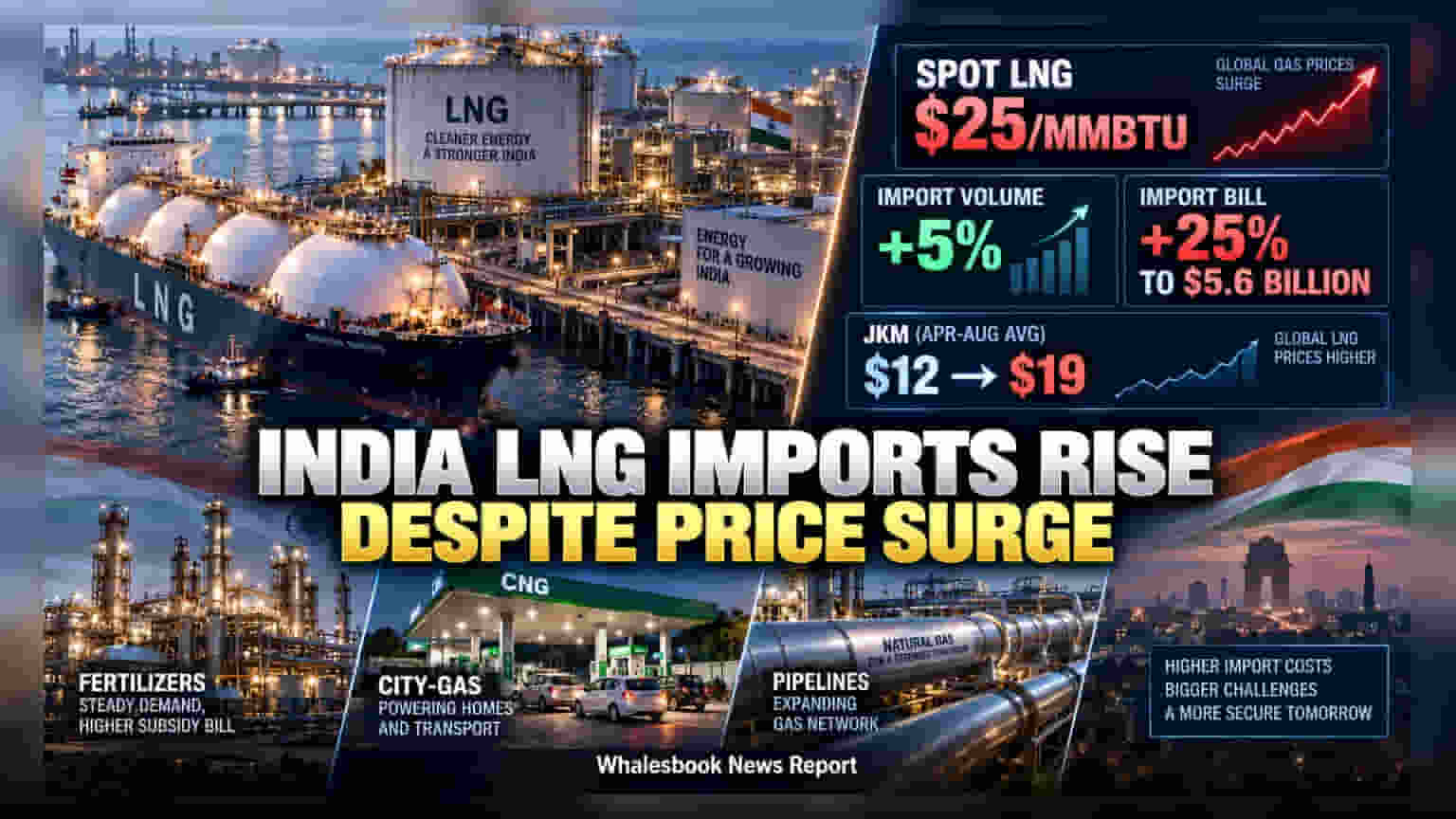
India's LNG import volumes grew 5% from April to July 2026, despite global spot gas prices testing $25 per mmbtu. While demand from fertilizer and city-gas sectors remains strong, the 25% surge in the import bill highlights a rising financial burden for the government and potential margin pressure for industrial users. Investors may monitor how downstream companies manage these high input costs in upcoming quarterly results.
India’s appetite for liquefied natural gas (LNG) has remained resilient even as global prices surged during the first four months of the current fiscal year. According to data covering April through July 2026, the country’s LNG import volumes increased by 5% year-on-year. However, the cost of these imports saw a sharper spike, jumping 25% to reach a total of $5.6 billion.
This growth is largely anchored by two sectors: fertilizers and city-gas distribution. Fertilizer producers continue to drive a significant portion of LNG demand, as gas is a primary raw material for urea manufacturing. Because this sector is classified as a high-priority user with heavy government subsidies, its consumption has remained steady despite the price increases. Similarly, city-gas networks, which supply CNG to vehicles and piped gas to households, benefit from priority allocation of lower-cost domestic gas, shielding them from the full impact of expensive spot-market cargoes.
The Impact of Spot Market Volatility
While long-term contracts remain more affordable, the volatility is concentrated in the spot market. Recent disruptions in West Asia have pushed spot LNG prices toward $25 per mmbtu, creating a difficult environment for industrial users that rely on these spot shipments. With India sourcing roughly 35% to 40% of its LNG from the spot market, companies that cannot rely entirely on long-term contracts face significant pressure on their profit margins.
For investors, this situation presents a dual challenge. First, industrial sectors that are not protected by priority domestic gas allocation—such as petrochemicals, ceramics, or glass manufacturing—may see their profitability dip if they are unable to pass these high gas costs on to their customers. Second, the government’s fertilizer subsidy bill is likely to rise. As imported gas costs climb, the gap between the cost of production and the controlled selling price of fertilizers widens, requiring higher budget allocations.
Monitoring Future Triggers
Looking ahead, the sustainability of this demand trend will depend heavily on global supply dynamics. If prices remain near $25 per mmbtu for an extended period, even price-insensitive sectors may eventually be forced to look for alternatives or reduce output. Market participants will likely track upcoming corporate results to see which companies are effectively hedging their exposure to spot prices and which are seeing their operating margins squeezed by rising fuel expenses. Additionally, any changes in the government’s subsidy policy or new allocations for domestic gas will be critical updates for shareholders in the energy and fertilizer sectors.