

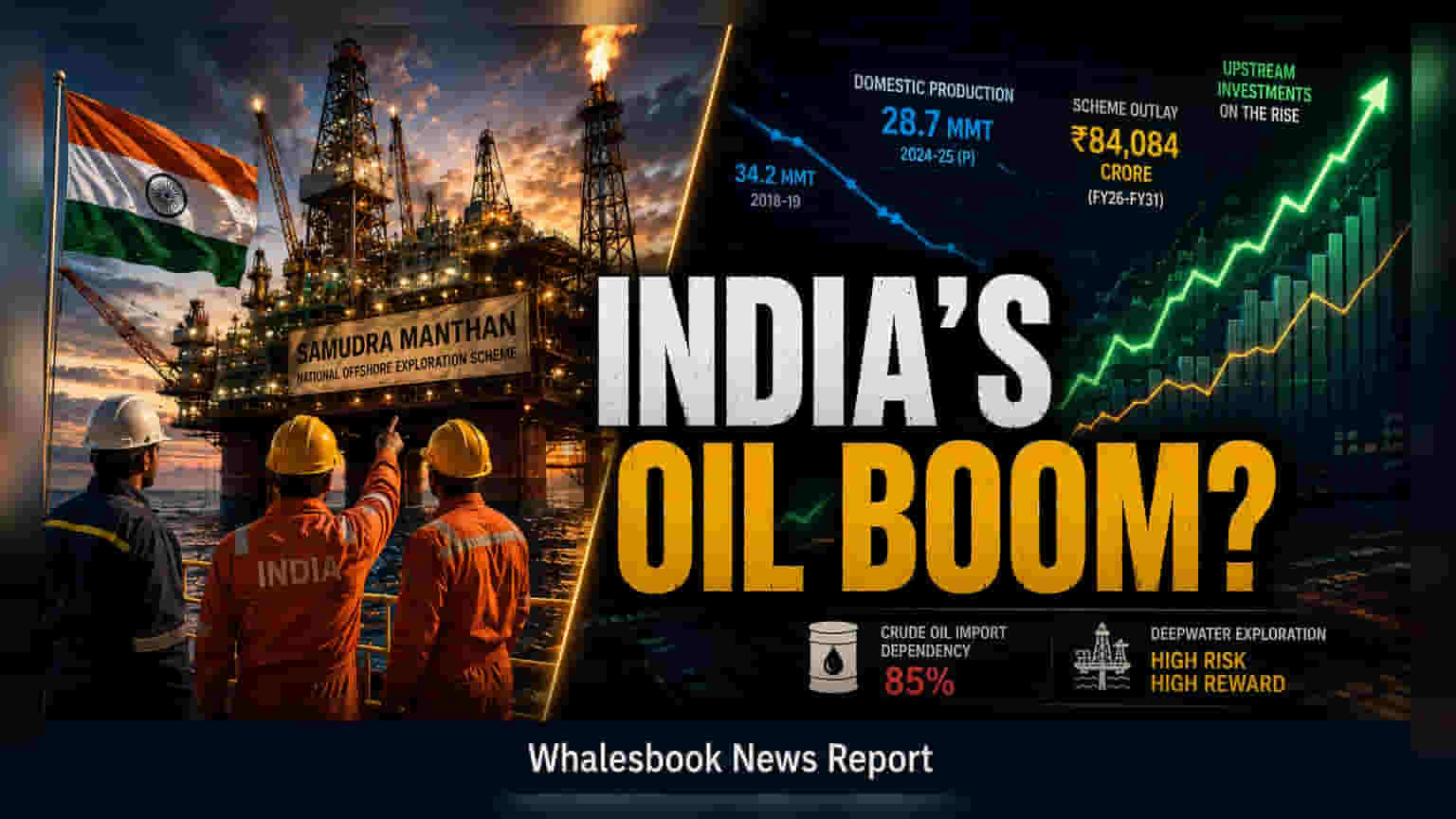
The government has established an Empowered Committee of Secretaries to unify oversight for oil and gas exploration. This move aims to accelerate bid rounds and resolve contractual disputes, supporting the recently approved ₹84,084 crore 'Samudra Manthan' scheme designed to boost offshore production.
The Ministry of Petroleum and Natural Gas has set up an Empowered Committee of Secretaries (ECS) to standardize decision-making across all oil and gas contract regimes. This high-level panel will be responsible for reviewing auction recommendations, finalizing contract terms for various licensing models, and resolving complex contractual disputes. By centralizing these functions, the government aims to create a more efficient and predictable environment for both public and private players in the upstream petroleum sector.
This administrative update follows the Cabinet's recent approval of the 'Samudra Manthan' National Offshore Exploration Scheme on July 31, 2026. With an ambitious outlay of ₹84,084 crore extending through fiscal year 2030-31, the scheme focuses on increasing domestic offshore hydrocarbon production. The committee is expected to play a vital role in clearing administrative hurdles that often delay the deployment of such large-scale capital investments.
The move addresses a significant sector challenge: India imports approximately 85% of its crude oil, leaving the economy vulnerable to global price swings and geopolitical tensions, such as the ongoing instability in West Asia. Domestic production has struggled to keep pace with rising demand, declining from 34.2 million metric tonnes (MMT) in 2018-19 to a projected 28.7 MMT in 2024-25. The committee's ability to facilitate contract stability and expedite approvals will be tested as it works to reverse this trend.
While the government is incentivizing investment by offering financial support covering up to 50% of the costs for eligible deepwater exploration wells, the sector remains high-risk. Exploration in deepwater and ultra-deepwater areas involves complex technological challenges and substantial costs. Furthermore, investors often track fiscal policies, such as the Special Additional Excise Duty (SAED) on domestic crude, which can impact profitability.
Looking ahead, the effectiveness of this committee will be measured by the speed at which it processes upcoming bid rounds and clears long-standing disputes. Investors may track future updates regarding the operational success of the 'Samudra Manthan' scheme and any subsequent policy adjustments the committee recommends to make the domestic exploration space more attractive to global and local energy firms.