 Whalesbook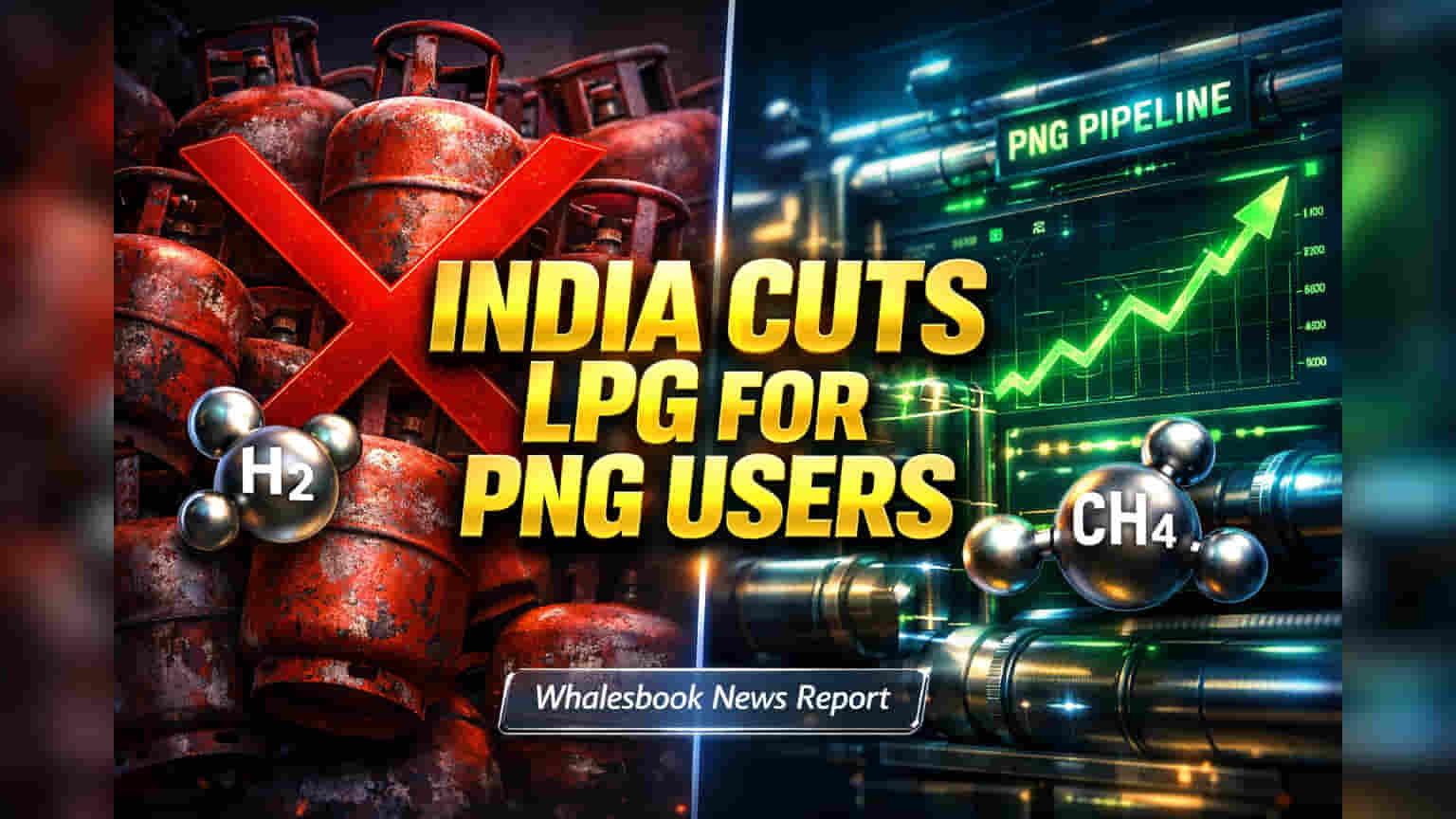
A new government order requiring households with Piped Natural Gas (PNG) connections to surrender their LPG supplies marks India's strategic move to boost energy security amidst rising geopolitical tensions. With global energy markets disrupted by conflicts in West Asia, including threats to vital shipping routes like the Strait of Hormuz, India is accelerating its domestic gas infrastructure development. This policy prioritizes PNG as a more reliable and domestically controlled energy source. The shift creates opportunities for City Gas Distribution (CGD) companies, but also exposes them to global energy trade volatilities.
Government Order Pushes PNG Adoption
A new government order, issued under the Essential Commodities Act, requires about 60 lakh eligible households with existing PNG connections to surrender their LPG connections. This policy is driven by India's high energy import dependency – roughly 88% for crude oil, 50% for natural gas, and 60% for LPG. The move aims to reallocate LPG cylinders to households without piped gas, ensuring basic energy needs are met despite potential supply chain disruptions. The conflict in West Asia has disrupted key transit routes like the Strait of Hormuz, impacting energy flows. While India has diversified crude suppliers, gas supply vulnerability necessitates a stronger domestic network. Consequently, PNG and Compressed Natural Gas (CNG) users are prioritized for stable supply, while industrial and commercial consumers may face cutbacks. As of March 28, around 6,000 PNG users had surrendered their LPG connections.
Gas Distributors Poised for Growth
This strategic shift towards PNG presents significant growth opportunities for leading City Gas Distribution (CGD) companies. Indraprastha Gas Limited (IGL), with exclusive rights in Delhi-NCR, traded around ₹148.33 on March 28, 2026, holding a market capitalization of approximately ₹20,755 Cr and a P/E ratio of about 12.47x (as of March 2026). Mahanagar Gas Limited (MGL), dominant in Mumbai, traded near ₹940.20, with a market cap around ₹9,288 Cr and a P/E of roughly 9.70x. GAIL (India) Ltd., the nation's largest gas transporter, has a market capitalization of about ₹90,177 Cr and a P/E of ~10.50x. Bharat Petroleum Corporation Ltd (BPCL), an integrated energy firm in CGD, traded around ₹282.70, with a market cap of ~₹1.23 trillion and a P/E of ~4.91x, reflecting its diverse revenues. These companies are expanding their pipeline networks, aided by government incentives and a streamlined 15-day approval process for right-of-way. GAIL plans to invest approximately ₹10,000 crore annually in pipeline infrastructure. The government targets 12.6 crore PNG connections by 2032, aiming for natural gas to comprise 15% of India's energy mix by 2030. Analysts generally view IGL and MGL as less exposed to industrial supply cuts, benefiting from secure domestic and CNG supplies.
Key Risks and Challenges
Despite government efforts, significant risks shadow India's energy transition. Geopolitical volatility in West Asia remains a primary concern. Prolonged conflict could cause sustained disruptions, driving up energy prices and worsening India's current account deficit and currency depreciation. The mandatory LPG to PNG switch may encounter public resistance and logistical challenges, particularly in remote areas, potentially slowing rollout targets. Reliance on imported LNG, despite diversification, means higher costs, with LNG rates reportedly doubling amid the conflict. Industrial and commercial consumers, vital to CGD revenue, are already facing supply cuts of up to 40-50%, risking agricultural output and food inflation. This threatens sales volumes and profitability for CGD companies heavily exposed to these segments, such as Gujarat Gas, even as domestic PNG and CNG supplies are protected. BPCL, while benefiting from scale, could see refining margins squeezed if crude price hikes aren't passed on. Execution risks in infrastructure expansion, potential consumer pushback, and broader inflationary pressures from higher energy costs pose significant challenges.
Outlook: Sustained Growth Expected
The government's strong push for PNG expansion, supported by easier approvals and consumer incentives, signals a long-term commitment to energy security. The target of 12.6 crore PNG connections by 2032 points to a sustained growth path for companies such as IGL, MGL, and GAIL, assuming they can manage current geopolitical and execution risks. Analyst consensus generally favors the sector's growth potential, driven by policy support and infrastructure development. Ratings include 'Strong Buy' for BPCL and 'Buy' for GAIL from some analysts. However, sector performance will remain tied to global energy market stability and India's ability to manage import dependency.