 Whalesbook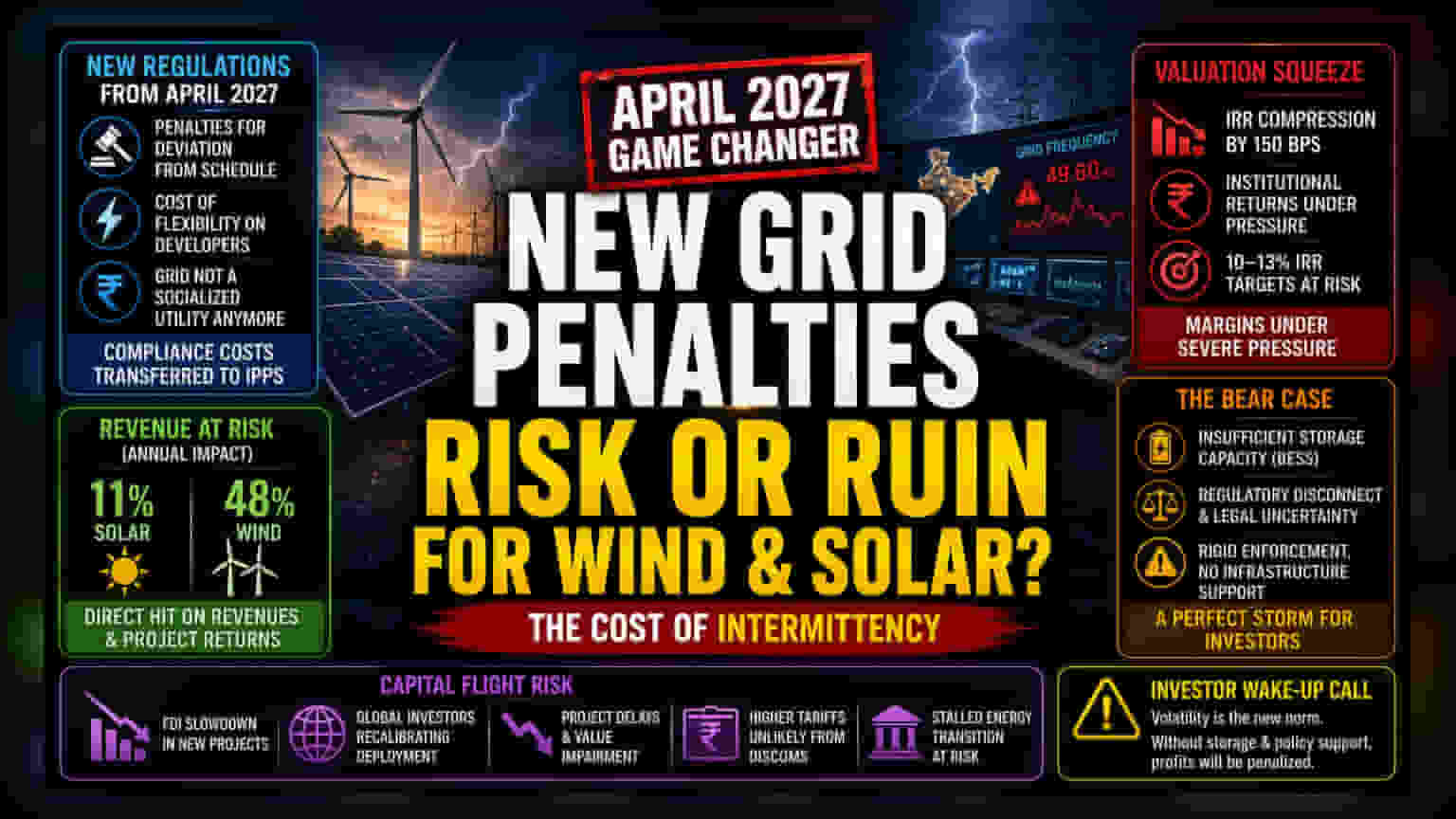


The Arbitrage of Compliance
The regulatory tightening scheduled for April 2027 represents a fundamental shift in how the Indian energy market manages intermittent power supply. Rather than viewing the grid as a socialized utility, the Power Ministry is moving toward a punitive model that effectively transfers the cost of load balancing onto independent power producers. This transition is not merely an operational nuisance; it is a direct attack on the margins of capital-intensive projects that were underwritten with far more forgiving assumptions regarding grid dispatch consistency.
The Valuation Squeeze
While the headline figures point to an 11% to 48% revenue risk, the deeper institutional concern lies in the contraction of Internal Rates of Return (IRR). Institutional investors who entered the Indian market at 10-13% return thresholds now face a reality where compliance costs may erode those gains by 150 basis points. This compression forces a difficult choice for major players like Actis and the Canada Pension Plan Investment Board: either demand higher off-take tariffs—which state-owned distribution companies are notoriously resistant to—or face permanent impairment of asset value. The math simply does not support current project valuations if the volatility of Indian monsoon patterns remains unhedged by adequate storage infrastructure.
The Forensic Bear Case
From a risk-mitigation standpoint, the disconnect between central regulators and developers is absolute. Grid India’s insistence on enforcement ignores the physical reality that intermittent generation cannot be commanded like base-load thermal power. Unlike mature markets in Europe that have integrated massive battery energy storage systems (BESS) to buffer against these exact penalties, India’s storage capacity remains in a nascent phase. Furthermore, the legal challenge brought by the National Solar Energy Federation of India suggests a prolonged period of regulatory uncertainty. For any investor, this is the worst possible environment: a hostile regulatory framework coupled with a lack of the technical infrastructure required to comply with the new, stricter standards.
Future Trajectory and Capital Flight
Capital is inherently mobile, and the current friction is already causing a recalibration of deployment timelines. Even entities like Blueleaf Energy, which remain publicly committed to multi-billion dollar deployments, are likely performing a silent audit of their risk-adjusted returns. If the government maintains this rigid stance without providing subsidies or infrastructure support for frequency management, the most likely outcome is a sharp decline in foreign direct investment for new greenfield projects. The market is not yet pricing in the full extent of this margin degradation, leaving significant downside exposure for firms heavily leveraged in wind energy assets where the penalty impact is most acute.