

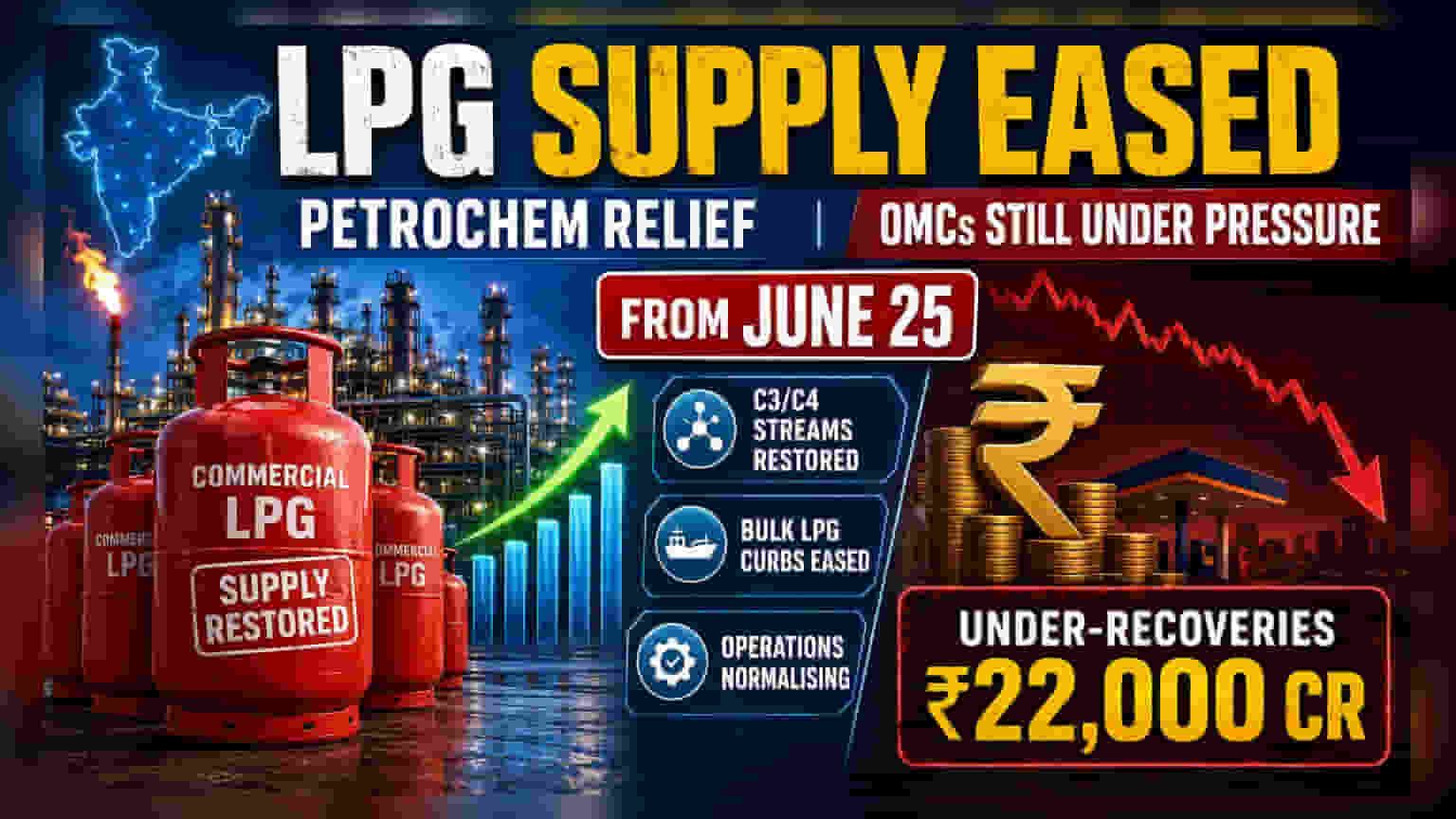
India has withdrawn all restrictions on non-domestic packed LPG and eased bulk LPG limits following improved supply conditions. This allows refineries to redirect C3/C4 streams back to petrochemical production, providing relief to industries facing feedstock shortages. Investors should watch for the impact on oil marketing company margins and petrochemical capacity utilization.
What Happened
The Indian government has fully restored non-domestic packed Liquefied Petroleum Gas (LPG) supplies and eased restrictions on bulk LPG, effective June 25, 2026. These curbs were initially imposed to secure domestic cooking gas availability during supply disruptions linked to the recent West Asia crisis. With energy supply lines stabilizing, the Ministry of Petroleum and Natural Gas has shifted its policy, allowing refineries to move away from exclusive LPG production and restore the supply of C3/C4 hydrocarbon streams—such as propylene and butylene—to their intended petrochemical and downstream industrial uses.
Relief For Petrochemical Players
For months, petrochemical manufacturers faced severe feedstock shortages as the government mandated that all C3/C4 streams be channeled into the LPG pool. This forced several plants, including units operated by majors like Reliance Industries and GAIL (India), to either throttle production or shut down specific operations. By reversing this diversion, the government is effectively unblocking a critical supply chain. Companies that rely on these streams for manufacturing plastics, polymers, and other specialty chemicals can now expect higher capacity utilization and improved operational stability, which may help them recover from the supply-led production drops witnessed in the first half of 2026.
The Financial Impact On OMCs
Public sector oil marketing companies (OMCs)—including Indian Oil Corporation (IOCL), Bharat Petroleum Corporation (BPCL), and Hindustan Petroleum Corporation (HPCL)—have been under significant financial strain. During the peak of the West Asia crisis, these companies absorbed a major portion of the procurement cost increases to protect domestic retail consumers from extreme price volatility. Estimates suggest these under-recoveries reached approximately Rs 22,000 crore between March and May 2026. While the easing of restrictions allows for a normalization of commercial sales, OMCs still face the challenge of managing the debt built up during this period of high under-recoveries.
Why This Matters For Investors
The stabilization of LPG supply is a dual-benefit event. For petrochemical companies, it removes a major operational bottleneck, potentially restoring margins that were squeezed by lower volumes and higher input costs for alternative feedstocks. For OMCs, the normalization of the industrial and commercial LPG market (where prices are market-linked) helps balance the marketing economics, although the focus will remain on how quickly they can recover the losses accumulated over the past few months. Market participants should note that while the current easing is positive, the sector remains sensitive to any renewed geopolitical tension that could affect import volumes.
What To Monitor Next
Investors should track the upcoming quarterly results of OMCs to assess the actual quantum of under-recoveries and the pace of recovery in their marketing margins. For petrochemical companies, the key monitorable will be the ramp-up in production volumes and any management commentary on the return to pre-crisis utilization levels. Additionally, tracking the stability of international crude and product prices remains vital, as any fresh volatility could again test the government's resolve to prioritize domestic LPG availability over industrial feedstock needs.