

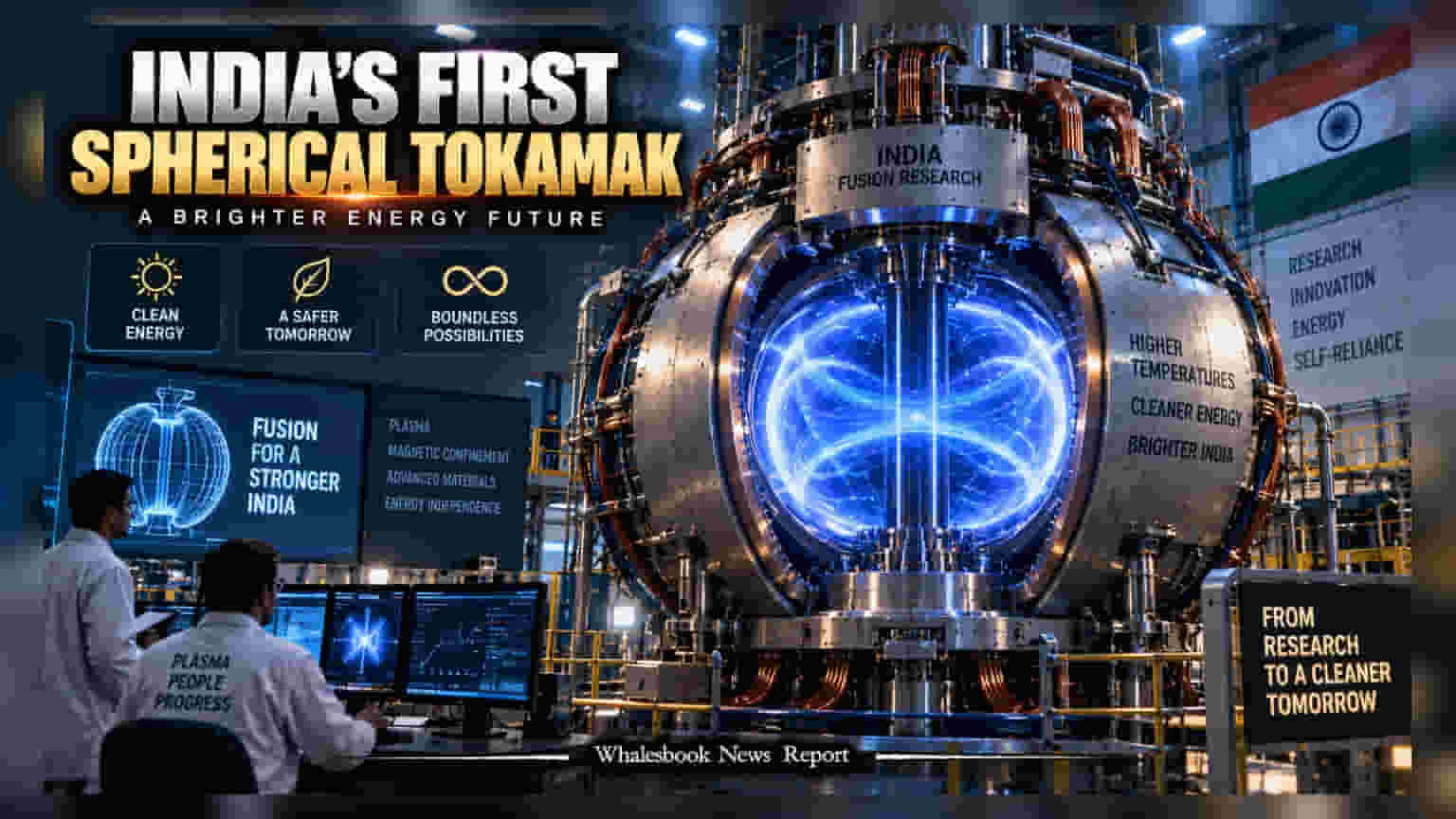
India’s Institute for Plasma Research has launched its first spherical tokamak, joining a global effort to master nuclear fusion. This development is a scientific milestone focused on long-term energy research rather than a commercial product. Investors should note that neither the institute nor the private startup involved in similar local projects are publicly listed, meaning there is no direct impact on stock markets at this stage.
The Institute for Plasma Research (IPR) in Gujarat has successfully commissioned India’s first spherical tokamak. This device is designed to advance the study of nuclear fusion, the process that powers the sun, by using magnetic fields to contain plasma at extremely high temperatures. Alongside this government-led initiative, a Bengaluru-based private startup named Pranos has also independently unveiled its own compact spherical tokamak, branded 'PRAGYA'. These launches highlight India’s growing focus on mastering advanced fusion technology for future energy needs.
For investors and market participants, it is important to distinguish these scientific advancements from commercial investment opportunities. Neither the government-funded IPR nor the private startup Pranos are publicly traded companies on the National Stock Exchange (NSE) or the Bombay Stock Exchange (BSE). Consequently, these developments do not currently impact listed stock prices, and there are no direct corporate financial results associated with these experimental reactors.
Fusion energy is fundamentally different from traditional nuclear fission, which powers existing nuclear plants. Fusion is considered safer because the process is designed to terminate instantly if experimental conditions are compromised. However, the technology is still in the research and development phase globally. Commercializing fusion power remains a massive challenge that involves complex reactor engineering, extreme heat management, and the need to achieve a sustained net energy gain, where the energy produced exceeds the energy consumed to run the reactor.
Energy research projects of this nature are highly capital-intensive and typically have very long timelines. They face significant execution risks, including the potential for high costs, lengthy construction periods, and technical difficulties such as managing plasma stability and magnetic interference. Because fusion technology is still experimental, it is not yet a viable solution for the power grid, and it will likely require years of further testing and refinement before any form of industrial application can be considered.
Investors who track the energy sector may view these experiments as part of a long-term strategy for energy independence. While there is no immediate commercial output, the progress in diagnostic capabilities and technical expertise in fields like magnet technology, vacuum systems, and advanced materials can eventually provide spillover benefits to broader industrial sectors. The key monitorable for those interested in the space remains the accumulation of experimental data and any future partnerships that might emerge between research entities and established industrial engineering firms as the technology moves closer to maturity.