 Whalesbook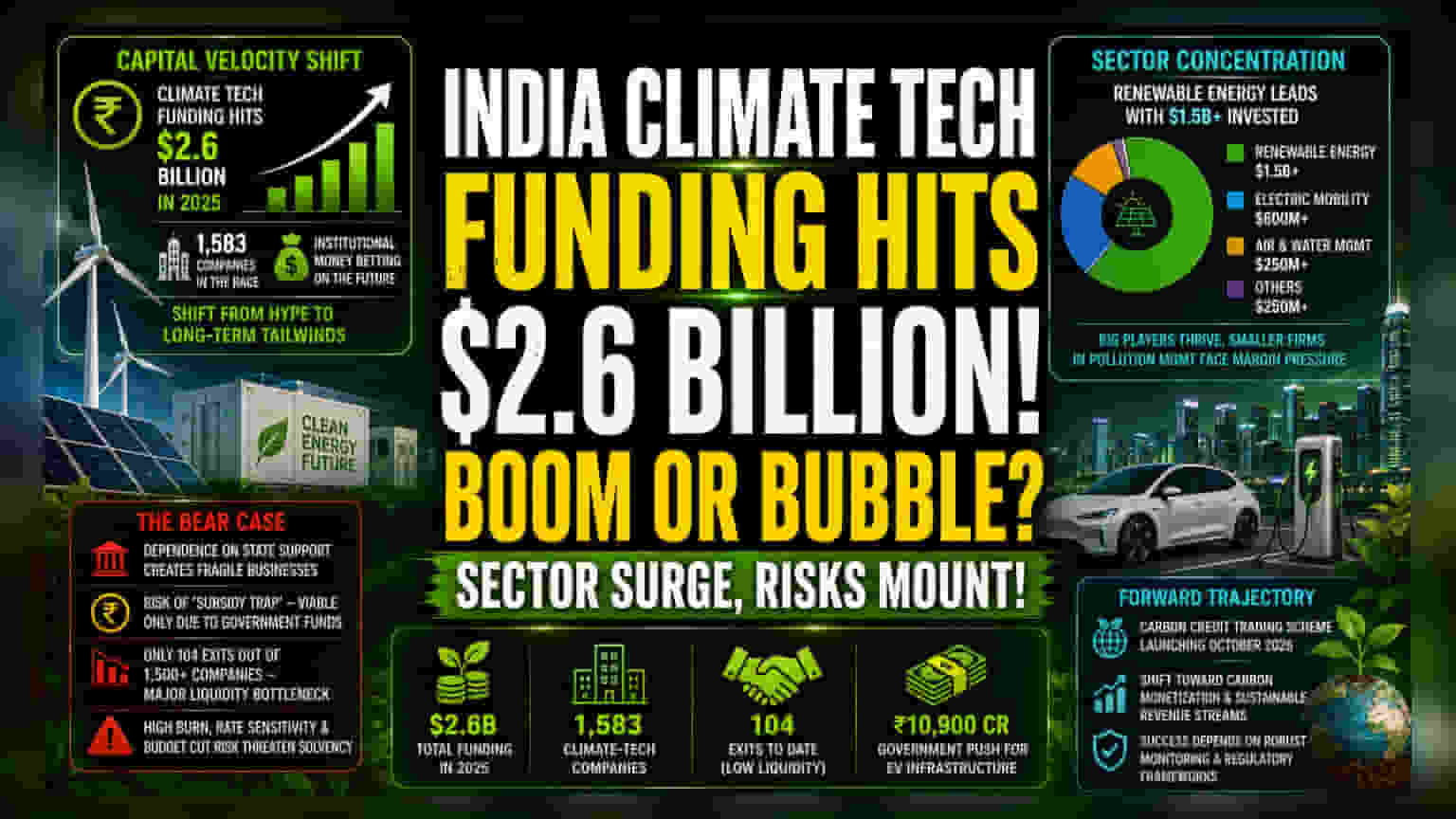


The Capital Velocity Shift
The acceleration of capital into Indian climate technology reflects a fundamental reallocation of private equity toward transition-related assets. While headline numbers showcase a rise to $2.6 billion in annual funding by 2025, the underlying velocity of capital suggests that institutional investors are betting heavily on long-term regulatory tailwinds rather than immediate cash-flow generation. With 1,583 companies competing for this pool, the market is approaching a saturation point where early-stage enthusiasm may soon be superseded by a demand for proof of scale.
Sector Concentration and Competitive Disparity
Unlike broader tech segments that saw funding pullbacks in 2023 and 2024, renewable energy and electric mobility have maintained high-conviction backing. The concentration of capital in renewable generation—surpassing $1.5 billion—highlights a pivot toward asset-heavy business models. However, this creates a distinct competitive disadvantage for smaller players in air and water management. While larger entities like Inox Clean Energy and Erisha E Mobility have secured nine-figure rounds, smaller firms in the pollution management space are increasingly vulnerable to margin compression. They lack the scale to absorb rising costs for raw materials required for decarbonization hardware, potentially leading to a wave of consolidation in the next 18 to 24 months.
The Forensic Bear Case
The reliance on state-mandated demand creates a fragile foundation for long-term valuation. The efficacy of the PM E-DRIVE program and the upcoming Carbon Credit Trading Scheme remains unproven at scale. Investors should remain cautious of the 'subsidy trap,' where companies become artificially viable only due to government budget allocations—like the Rs 10,900 crore set aside for EV infrastructure—rather than organic market demand. Furthermore, the limited track record of successful exits—only 104 in a cohort of over 1,500 entities—points to a significant liquidity bottleneck. As global interest rates remain sensitive, the capital required to sustain these cash-burning operations may dry up if the government revises its support budgets, leaving over-leveraged startups exposed to significant solvency risks.
Forward Trajectory and Market Outlook
The market’s focus is now shifting toward the October 2026 launch of the Carbon Credit Trading Scheme. This initiative is expected to transition the sector from a reliance on venture capital toward a more stable revenue stream through carbon monetization. Analysts remain divided on whether this will provide genuine growth or merely create a secondary market for accounting-based firms. Success will ultimately hinge on the robustness of the monitoring frameworks implemented by the regulatory bodies, which will dictate whether these climate-tech assets provide alpha or become stranded investments.