

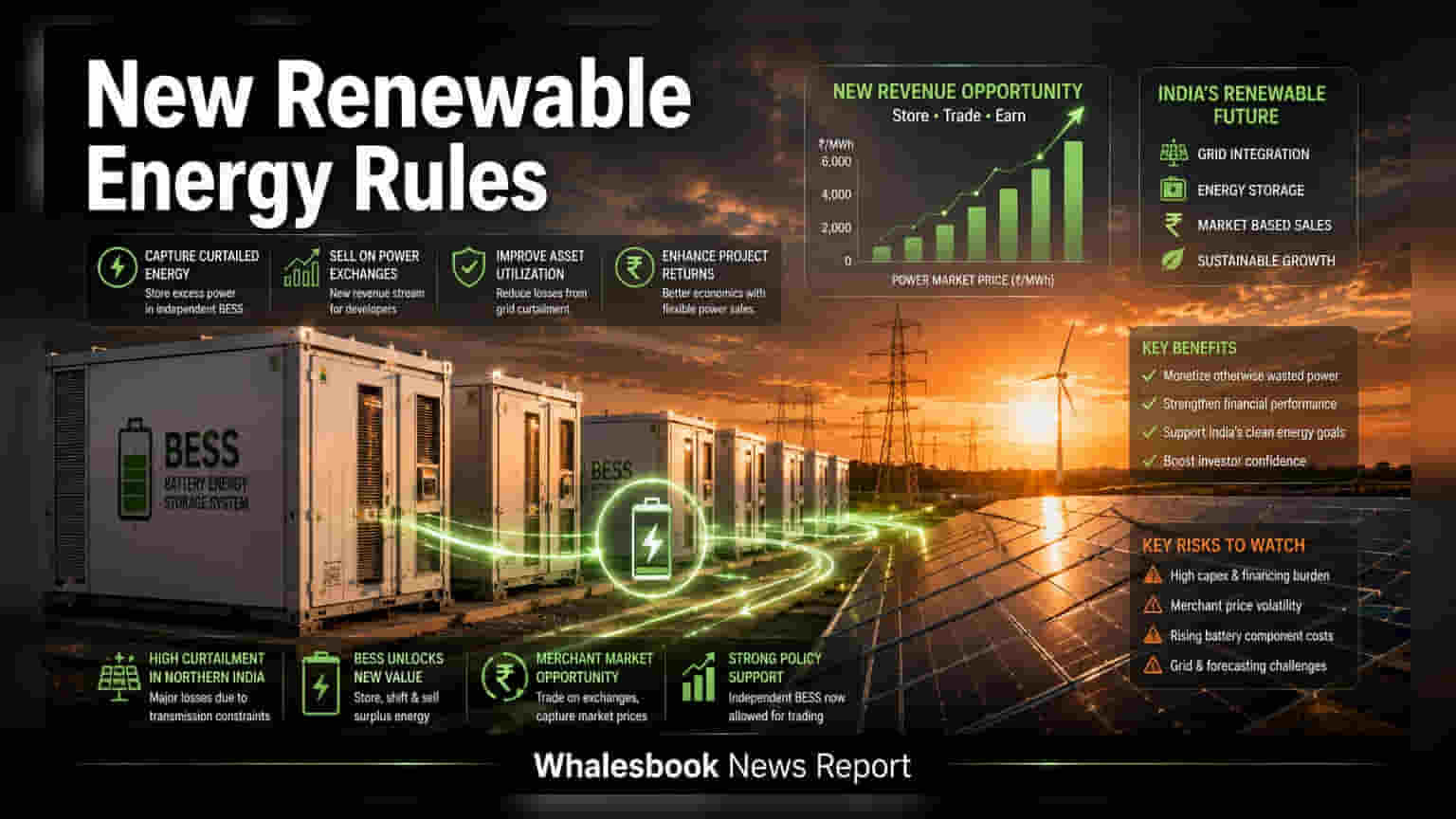
India’s Ministry of Power now permits renewable energy firms to store and sell curtailed power using Battery Energy Storage Systems (BESS). This directive creates a new revenue stream for developers by allowing them to monetize electricity that was previously lost to grid constraints, potentially improving project economics for major renewable players.
The Ministry of Power has issued a new directive, effective August 27, 2026, that allows renewable energy developers to utilize co-located Battery Energy Storage Systems (BESS) to capture and independently sell power that would otherwise be wasted. This move is significant because it addresses the persistent issue of grid curtailment, where excess power generation is often rejected by the grid due to transmission constraints, particularly in the northern regions of India.
Previously, renewable energy producers were restricted by the terms of their long-term Power Purchase Agreements (PPAs), which often prohibited the sale of excess or curtailed energy to third parties without complex approvals. With this new policy, developers can store this surplus energy in independent BESS units and sell the electricity on power exchanges. By classifying these BESS assets as independent operations, the government has essentially provided a legal framework for renewable companies to enter the merchant power market for this specific segment of their generation.
Strategic Impact on Renewable Developers
For large-scale renewable players such as NTPC, Tata Power, and JSW Energy, this policy change offers a way to improve the utilization of their assets. Instead of losing revenue when the grid cannot accept power, companies can now convert that energy into a tradable product. This shift is expected to enhance project returns, provided the companies can effectively manage the operational and financial challenges associated with storage technology.
Financial and Operational Risks
While the policy opens a new revenue stream, investors should consider the complexities involved. Developing and operating BESS units requires significant capital spending, which adds to the project’s debt burden. Furthermore, the merchant power model involves price volatility. Unlike long-term PPAs that guarantee a fixed price for electricity, power exchanges fluctuate based on supply and demand. If the cost of storing and selling this power exceeds the market price, the investment may not deliver the expected returns.
Additionally, the sector faces broader cost pressures. Recent data suggests that capital costs for solar and battery components remain sensitive to currency depreciation and commodity price swings. Increased project costs, potentially ranging between 20-25% for certain components, could tighten profit margins and impact the debt service coverage ratios for developers heavily invested in this technology. Companies must also navigate the technical challenges of grid integration and precise energy forecasting, which require specialized operational expertise.
What Investors Should Monitor
As this policy begins to take effect, the key focus for investors will be the implementation pace of BESS projects. It will be important to track which companies can successfully integrate these storage assets without significantly straining their balance sheets. Future updates from management regarding their capacity to manage merchant power volatility, alongside trends in battery component costs and project commissioning timelines, will offer a clearer picture of whether this policy shift will materially boost profitability or primarily serve as a risk-mitigation tool for grid curtailment.