

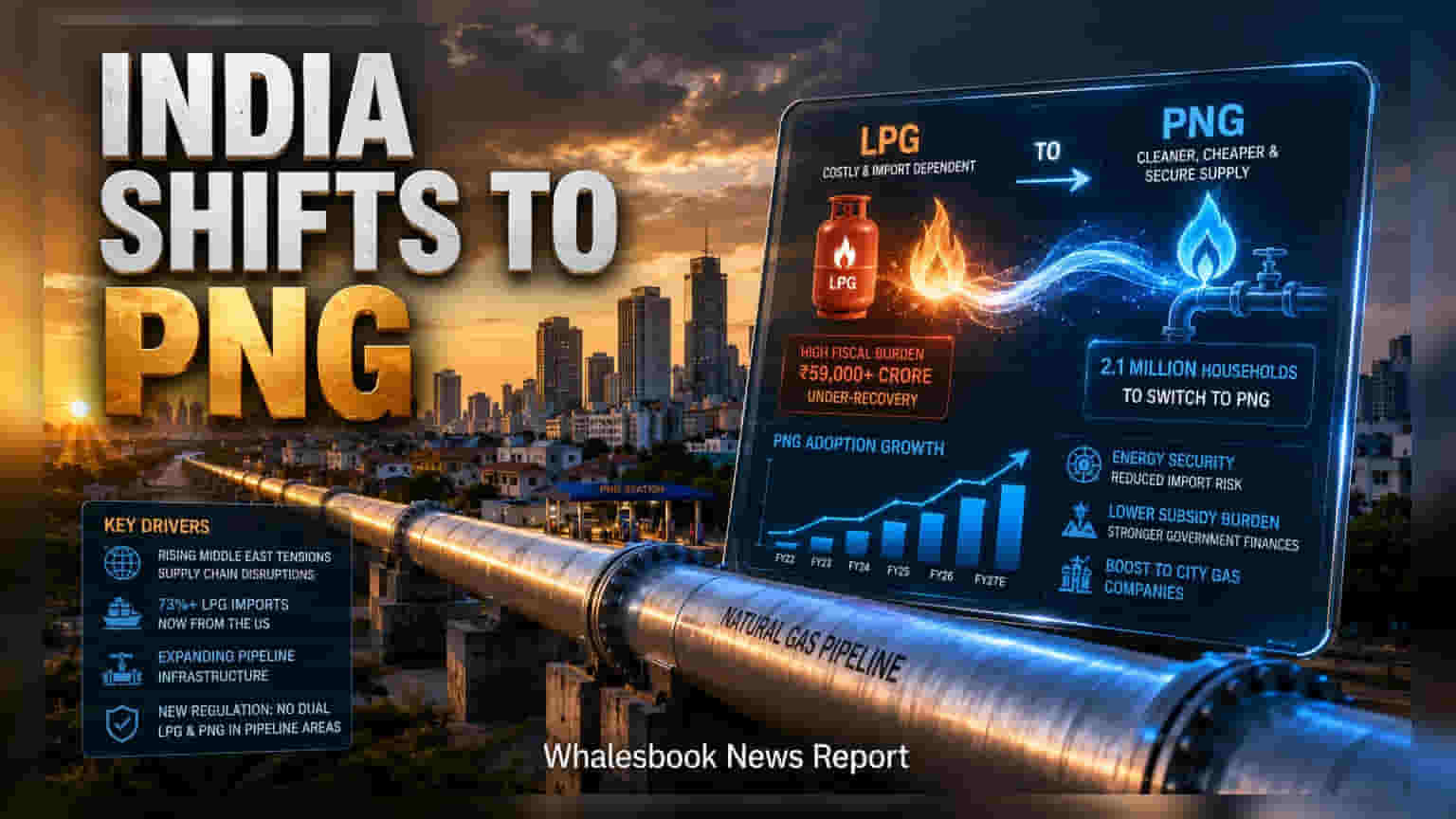
The government has directed a shift of 2.1 million households to piped natural gas (PNG) to reduce reliance on volatile LPG imports. This move aims to cut financial losses on state-run fuel companies and secure domestic energy supplies amid rising geopolitical instability.
The Ministry of Petroleum and Natural Gas has initiated a rapid transition plan to move 2.1 million households from LPG cylinders to Piped Natural Gas (PNG). This decision comes as the government looks to mitigate energy supply risks stemming from rising tensions in the Middle East. By mandating this shift, authorities aim to secure energy supply lines and reduce the heavy fiscal burden that state-owned oil marketing companies currently face due to LPG imports.
A Push for Energy Security
Recent geopolitical instability in traditional supply routes, particularly the Strait of Hormuz, has made the import of cooking fuel increasingly difficult and expensive. In response, India has already begun diversifying its import sources, with data showing that over 73 percent of the country’s recent LPG imports have shifted to the United States. While this improves energy security, it comes at a higher cost. Moving supplies across longer distances increases freight and insurance expenses, which adds to the national energy import bill.
To manage these costs and protect government finances, the Ministry is pushing to increase domestic pipeline connectivity. As of July 2026, state-owned oil marketing companies reported a cumulative financial loss—often called under-recovery—of over ₹59,000 crore on LPG sales. By encouraging households to switch to PNG, the government aims to lower the need for these expensive fuel subsidies.
Regulatory Tailwinds for City Gas Companies
To speed up the adoption process, the government has notified the Liquefied Petroleum Gas (Regulation of Supply and Distribution) Amendment Order, 2026. A crucial part of this regulation is the effort to prevent households from keeping both LPG and PNG connections in areas where pipeline infrastructure is already set up. By effectively mandating the switch in these regions, the government intends to force higher adoption rates.
This policy provides a direct boost to City Gas Distribution (CGD) companies, such as Indraprastha Gas, Adani Total Gas, and other regional players. These companies, which are responsible for laying and maintaining the pipeline networks, stand to see increased volume growth as more homes migrate to the grid. The Petroleum and Natural Gas Regulatory Board has already identified that while 17.4 million connections exist, there is significant room for growth to reach the targeted targets.
Operational and Cost Hurdles
While the mandate provides a clear direction for the industry, the execution remains a challenge. Connecting 2.1 million households is a massive infrastructure task. CGD companies must rapidly scale their operations, which involves significant spending on laying new pipelines and ensuring safety compliance. Investors should monitor whether these companies can execute these projects without facing cost overruns or major delays. Furthermore, while the shift to PNG helps the government reduce LPG subsidies, the long-term impact on energy costs for the average household will depend on natural gas pricing, which remains sensitive to global market fluctuations.