

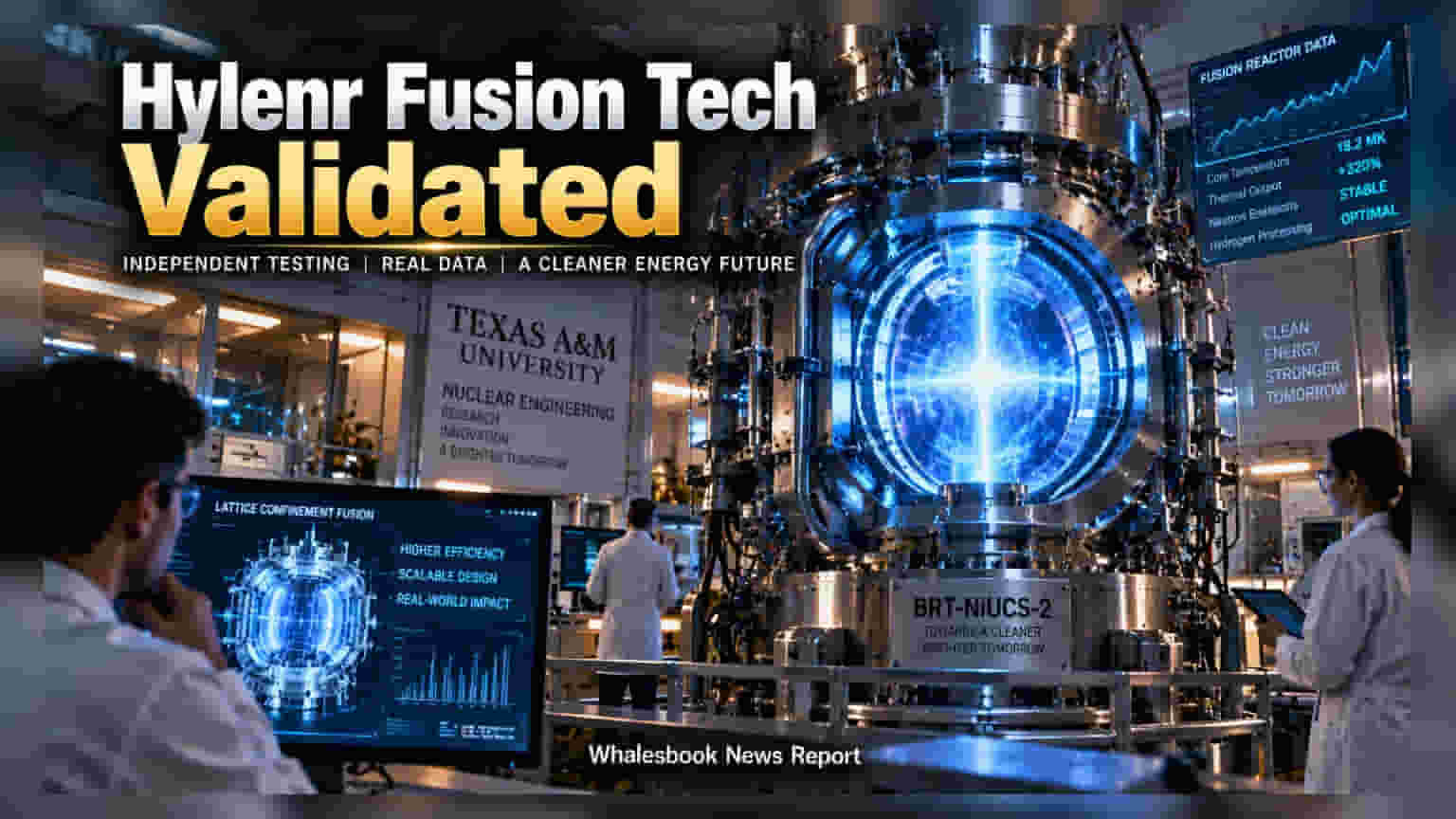
Hylenr has successfully completed Phase 1 validation of its Lattice Confinement Fusion technology at Texas A&M University. The independent study of its BRT-NiUCS-2 reactor provides data on thermal output, which is a step forward in de-risking the technology. However, the company still faces significant hurdles in scaling the system and proving long-term commercial viability.
Hylenr, a deep-tech company working on Lattice Confinement Fusion, has completed a Phase 1 validation study at Texas A&M University. The evaluation, conducted by the university's Nuclear Engineering Department, examined the company’s BRT-NiUCS-2 reactor. This move is significant as it shifts the company from internal testing to external, independent verification of its technology.
Independent Validation of Reactor Tech
The study focused on the reactor's unique design, which uses a nickel-palladium catalyst system to manage hydrogen-loaded fusion. By testing multiple reactor samples under strict laboratory conditions, researchers aimed to measure thermal output and gas composition. The goal was to provide data that could be reviewed by the broader scientific community, such as the findings presented at the 27th International Conference on Condensed Matter Nuclear Science in Canada. For early-stage companies, such academic endorsements are often used to build credibility with potential industrial partners.
Challenges in Commercial Scaling
While the validation is a scientific milestone, the gap between laboratory success and commercial energy production remains wide. Deep-tech and fusion energy startups operate in a high-risk environment. Even with confirmed physics data, the company must now solve complex engineering challenges, such as ensuring the catalyst lasts for long periods and scaling the reactor output to meet the energy needs of utility providers.
Investors in this space typically track these developments for proof that the technology can move from a controlled lab environment to a reliable, industrial-scale system. The engineering difficulty, combined with the capital-intensive nature of energy research, means that the road to revenue is long. Future progress will depend on the company's ability to demonstrate that the reactor can operate consistently, safely, and efficiently in real-world conditions. Stakeholders and industry partners will likely monitor the upcoming research phases to see if the technology can solve the practical issues of durability and power scale.