 Whalesbook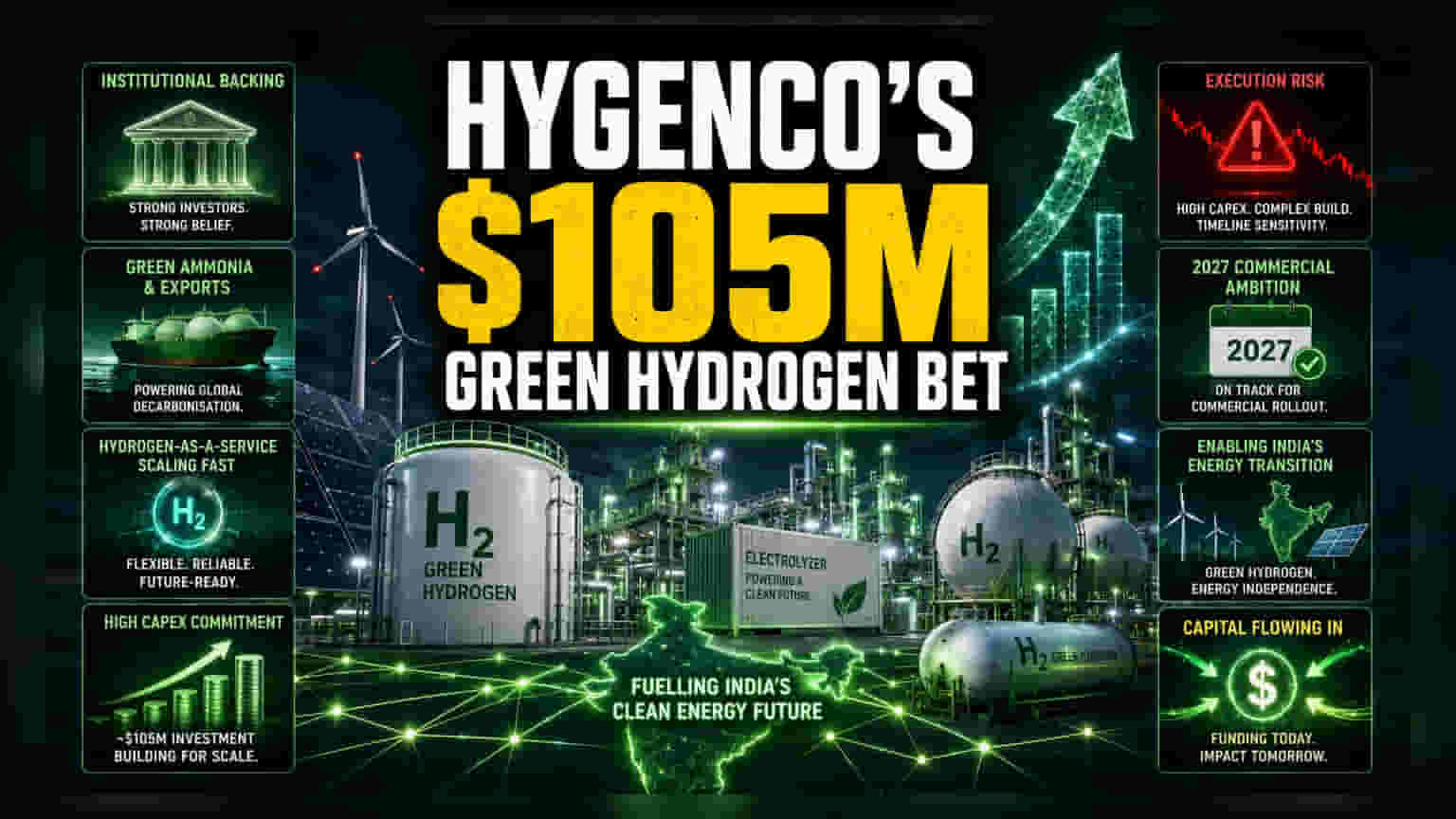


The Capital Pivot and Market Reality
The infusion of $105 million into Hygenco arrives at a critical juncture for India's clean energy ambitions. While the participation of the International Finance Corporation and Siemens Financial Services provides a veneer of institutional validation, the move is less about immediate production and more about establishing a foothold in a notoriously capital-intensive sector. The firm now operates under the imperative to transition from a pilot-based operator to a commercial-scale infrastructure provider. This requires not just funding, but the successful execution of its 'Hydrogen-as-a-Service' model, which aims to shift the burden of capital expenditure from off-takers to producers—a strategy that remains untested at scale in a high-interest-rate environment.
Scaling Against Sector Headwinds
Comparing Hygenco’s trajectory to the broader green energy market reveals the structural hurdles inherent in the shift toward green ammonia. Many legacy players in the fertilizer and chemical sectors are currently grappling with high electrolyzer costs and the inconsistent availability of low-cost, round-the-clock renewable power. While Hygenco aims to launch several facilities by 2027, the company must manage the inherent volatility of the renewable energy supply chain. Unlike traditional power plants, the profitability of these new sites depends heavily on the cost-efficiency of integrating local wind and solar grids with hydrogen production units. Analysts tracking the sector note that while government incentives under the National Green Hydrogen Mission provide a safety net, they do not shield companies from the technical complexities of scaling electrolyzer deployment without significant margin dilution.
The Forensic Bear Case
The primary risk factor for Hygenco lies in the maturity of the technology stack compared to traditional natural gas-based hydrogen production. Despite the optimism surrounding this funding round, the company faces stiff competition from established industrial conglomerates that are also pivoting toward carbon neutrality. These incumbents often possess deeper balance sheets and existing distribution networks that could effectively squeeze out smaller, specialized platforms. Furthermore, the reliance on blended finance, including $20 million from the Clean Technology Fund, suggests that private capital alone remains cautious about the immediate commercial viability of these assets. Should the promised industrial off-take agreements fail to materialize or if the cost of renewable energy input exceeds current projections, the company may find itself burning through this latest liquidity cushion far faster than its current five-year timeline suggests.
Future Outlook
The path to 2027 will be defined by the firm’s ability to manage its debt-to-equity ratio as it transitions from venture-backed status to an infrastructure-heavy utility. Market participants will be watching for the successful commissioning of the first, large-scale commercial facilities as a proxy for the broader health of India’s private green hydrogen sector. Investors remain focused on whether Hygenco can achieve a consistent cost-per-kilogram of hydrogen that competes with subsidized grey hydrogen, a benchmark that has proven elusive for many global pioneers in the field.