 Whalesbook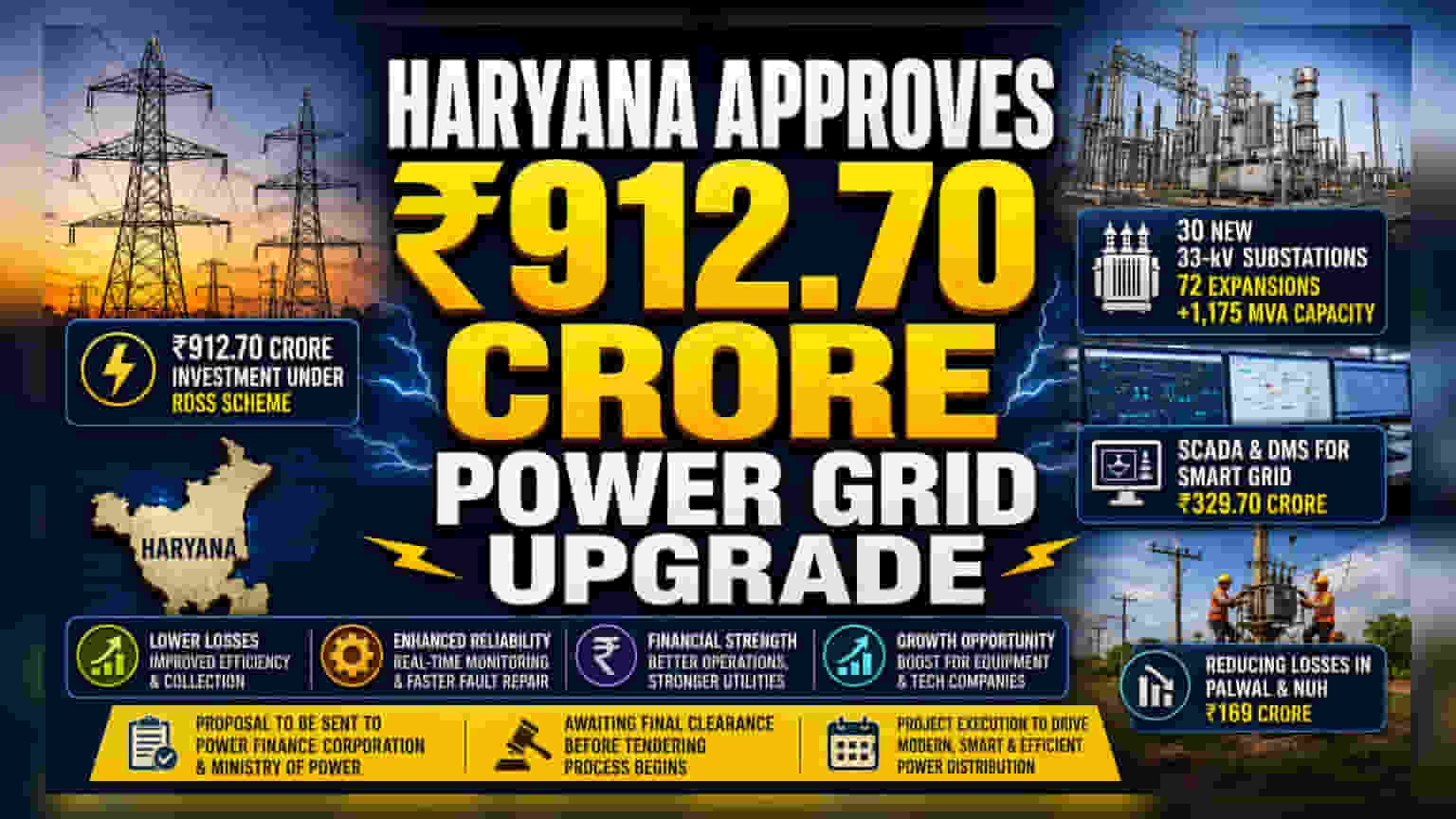


The Haryana government has approved a Rs 912.70 crore power infrastructure plan to improve grid reliability. The initiative focuses on adding substation capacity and automation systems under the central government's RDSS scheme. This move highlights potential business opportunities for electrical equipment suppliers and EPC contractors, while reflecting the state's focus on maintaining high operational efficiency in its power distribution utilities.
What Happened
The Haryana government has officially approved a significant investment of Rs 912.70 crore to modernize its state-wide electricity distribution network. This approval, granted by the Distribution Reforms Committee, is part of the Revamped Distribution Sector Scheme (RDSS), a national initiative designed to improve the operational and financial health of power distribution companies across the country. The proposal is now set to be sent to the Power Finance Corporation and the Union Ministry of Power for final clearance.
The Scope of the Investment
The approved funds are earmarked for three major areas of power infrastructure. A sum of Rs 414 crore is dedicated to the construction of 30 new 33-kV substations and the expansion of 72 existing ones, which will add a total of 1,175 MVA to the state's transformation capacity. Another Rs 329.70 crore will be utilized to implement advanced Supervisory Control and Data Acquisition (SCADA) and Distribution Management Systems (DMS) in towns like Hisar. These technologies are crucial for real-time monitoring and faster fault repairs. Additionally, Rs 169 crore is allocated specifically for reducing line losses in the Palwal and Nuh districts.
Why This Matters for the Power Sector
For investors and market observers, this development serves as an indicator of sustained infrastructure spending in the state utility sector. The focus on adding substation capacity creates direct demand for power equipment manufacturers, including companies that produce transformers, switchgear, and protective relays. Similarly, the rollout of SCADA and DMS systems signals opportunities for technology and automation firms that provide grid management software.
This investment also comes on the back of notable improvements in Haryana’s power utilities, specifically Dakshin Haryana Bijli Vitran Nigam Ltd (DHBVNL) and Uttar Haryana Bijli Vitran Nigam Ltd (UHBVNL). Both companies have reported significant drops in Aggregate Technical and Commercial (AT&C) losses, which are the primary metrics used to measure efficiency in the power distribution business. With losses now well below the national average, the state utilities are demonstrating a track record that suggests new capital investments are likely to be managed with a focus on efficiency.
Business and Operational Context
The RDSS scheme is designed to help utilities become financially sustainable by modernizing their infrastructure and improving billing and collection systems. Since collection efficiency in these utilities is already strong, these new upgrades are primarily focused on system reliability and loss reduction. For companies in the electrical engineering and procurement space, this transition toward automated, tech-heavy grid management is a positive trend, as it shifts the business from traditional civil works to more high-value, tech-integrated infrastructure projects.
Potential Risks
The primary risk factor for investors tracking this development is execution timeline. Infrastructure projects of this scale often face challenges such as land acquisition hurdles, delays in equipment delivery, or regulatory bottlenecks during the final approval phase from central bodies. Any significant delay in project commissioning could push back revenue realization for contractors and delay the expected efficiency gains for the state utilities.
What Investors Should Track
Moving forward, market participants should watch for the official sanction from the Power Finance Corporation and the Ministry of Power, which will mark the start of the tendering process. Investors in the electrical equipment and automation sectors should monitor upcoming tender announcements, as these will indicate the specific order flows and timelines for implementation. Additionally, the pace of project completion will be a key performance indicator for the contractors involved, as it directly impacts the timeline for grid modernization in the targeted regions.