

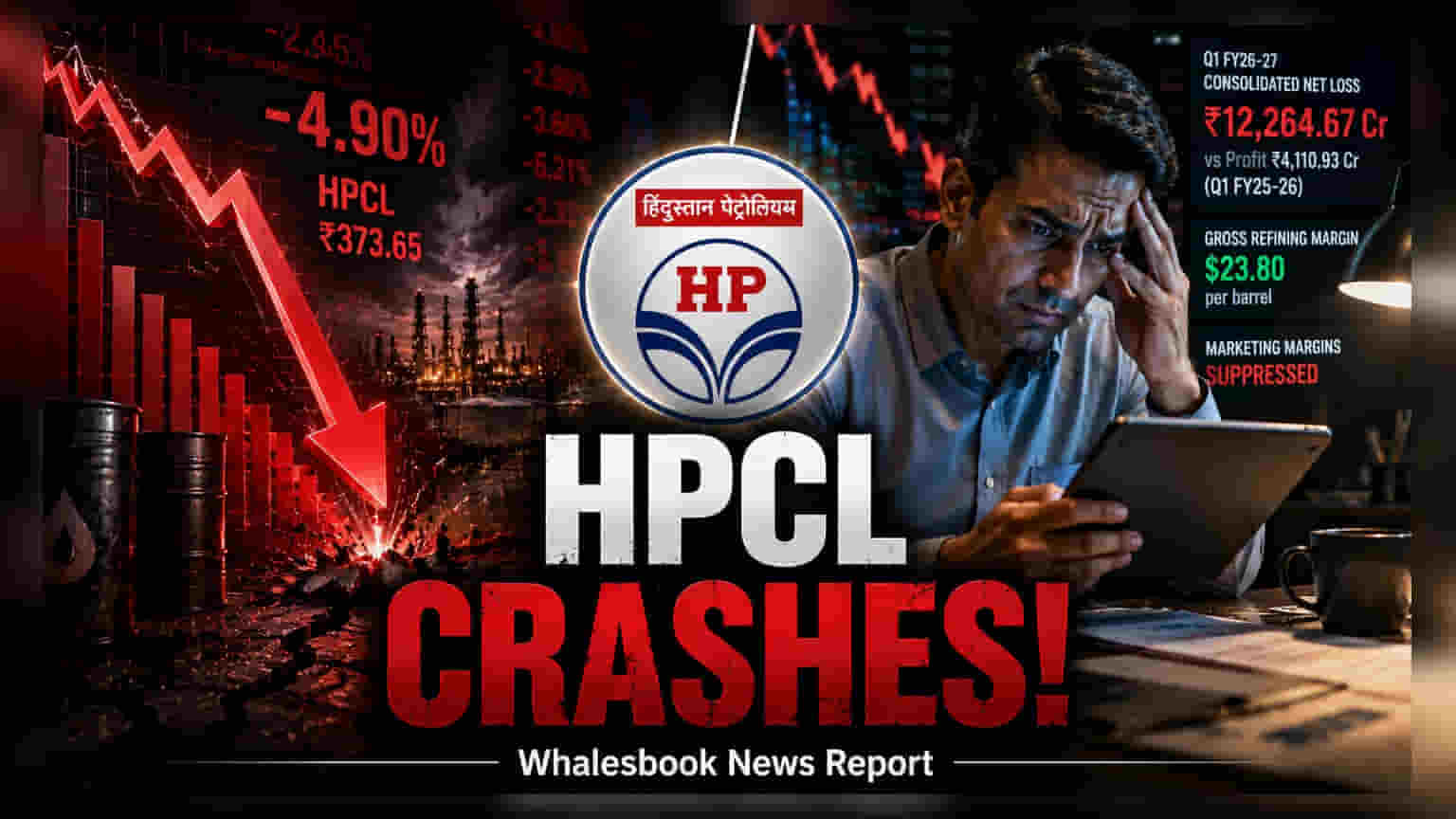
Hindustan Petroleum Corporation shares fell 4.9% on Friday as the stock traded ex-dividend for a payout of Rs 19.25 per share. The decline also follows the company’s report of a consolidated net loss of Rs 12,264.67 crore for the June 2026 quarter, driven by compressed marketing margins on regulated fuels.
Hindustan Petroleum Corporation (HPCL) saw its share price decline by 4.9% on Friday, trading at Rs 373.65. The downward movement in the stock price is influenced by two primary factors: the company trading ex-dividend and the announcement of a significant consolidated net loss for the first quarter of the 2026-27 fiscal year.
On August 14, 2026, the company’s stock traded ex-dividend, meaning investors who bought shares on or after this date are not eligible for the recently declared final dividend of Rs 19.25 per share. When a stock goes ex-dividend, its market price typically adjusts downwards by approximately the amount of the dividend payment, as the cash leaves the company's books and goes to shareholders.
Alongside the ex-dividend adjustment, the company reported a consolidated net loss of Rs 12,264.67 crore for the June 2026 quarter. This result marks a sharp reversal from the net profit of Rs 4,110.93 crore recorded in the same quarter of the previous year. While the company's standalone Gross Refining Margin (GRM) remained strong at $23.80 per barrel, these gains were offset by suppressed marketing margins for petrol, diesel, and liquefied petroleum gas (LPG).
Marketing margins refer to the difference between the cost at which oil marketing companies buy fuel and the price at which they sell it to consumers. For regulated products like petrol and diesel, pricing is often sensitive to government policy and global crude oil trends. When the company cannot fully pass on rising input costs to consumers, marketing margins come under pressure, which directly impacts profitability.
Despite the bottom-line loss, the company recorded revenue growth of approximately 20-21% year-on-year for the June quarter. However, the profitability struggle highlights the inherent risks in the oil marketing sector. Investors often monitor the company's ability to balance its refining strength against the unpredictability of marketing margins. Factors such as volatility in international crude oil prices, inventory losses due to price fluctuations, and government intervention in fuel pricing remain key risks for the sector.
Moving forward, the financial impact of government pricing policies on marketing margins and the stability of global crude prices will be the primary factors for investors to track. The company's future performance will depend on its ability to manage these input costs while maintaining its refining operations efficiency.