

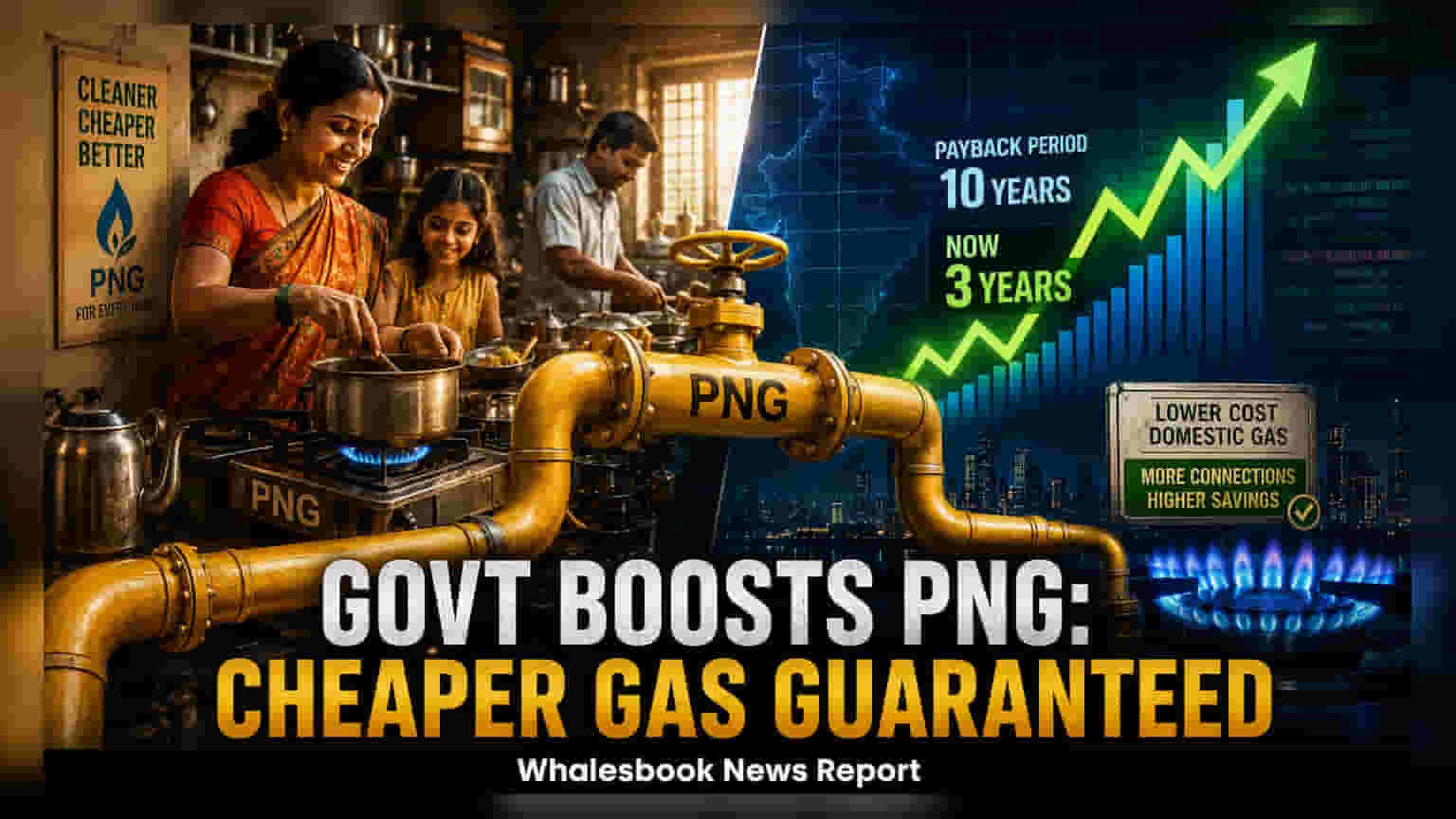
The government has introduced an incentive scheme for City Gas Distribution companies to increase domestic piped natural gas connections, starting September 1, 2026. Firms will receive allocations of lower-priced, domestically-produced gas for each new billed connection, which is expected to lower operating costs and significantly shorten the payback period for infrastructure expansion. This change aims to improve margins for CGD companies and accelerate household access to clean energy.
The Ministry of Petroleum and Natural Gas has introduced a new incentive program designed to fast-track the expansion of domestic piped natural gas (PNG) networks across India. Starting September 1, 2026, City Gas Distribution (CGD) companies will be eligible for additional allocations of lower-priced, domestically-produced gas, known as Administered Price Mechanism (APM) gas. This policy is structured to encourage companies to increase their billed household connections by offering a direct financial benefit for each new user added beyond a specific target.
Financial Impact and Payback Timelines
Under this scheme, eligible CGD entities will receive 200 standard cubic metres (SCM) of lower-cost APM gas for every incremental billed domestic PNG connection they achieve. The primary financial benefit for these companies is the ability to substitute more expensive imported Liquefied Natural Gas (LNG)—which they currently use for their Compressed Natural Gas (CNG) transport operations—with this cheaper domestic gas allocation. By lowering the average cost of gas procurement, the companies can improve their operating margins.
The government expects this initiative to have a major impact on the economics of expanding gas infrastructure. Traditionally, the capital spending required to set up piped gas connections in new households has had a long payback period, often estimated at around 10 years. With this incentive, the government projects that this payback period could be reduced to approximately 3 years. This shift could make aggressive expansion into new residential areas more financially viable for gas distributors.
Sector Context and Execution Risks
While the incentive is designed to help, the eventual benefit for individual CGD companies—such as Indraprastha Gas, Mahanagar Gas, Gujarat Gas, and Adani Total Gas—will depend on several factors. The success of the scheme relies on the companies' ability to successfully convert unbilled connections into active, paying ones, which requires logistical coordination and consumer adoption. There is an execution risk that if the pace of new connections does not match the company's planned expansion, the anticipated financial relief may be limited.
Additionally, companies remain sensitive to broader sector pressures. While the APM gas allocation provides a cushion, the sector is still exposed to global LNG price volatility. If the supply of domestic APM gas faces constraints or if global LNG prices spike significantly, the overall cost burden may still rise, potentially pressuring profit margins regardless of the new incentives. Furthermore, the reliance on APM gas availability means that if domestic production fails to meet the increased demand, the incentive benefits could be reduced.
Investors may monitor the upcoming quarterly reports of CGD companies to see how management plans to utilize these gas allocations and whether the scheme leads to a measurable improvement in profit margins and capital efficiency. The next key update will be the official data on the pace of new PNG connections following the September implementation date.