

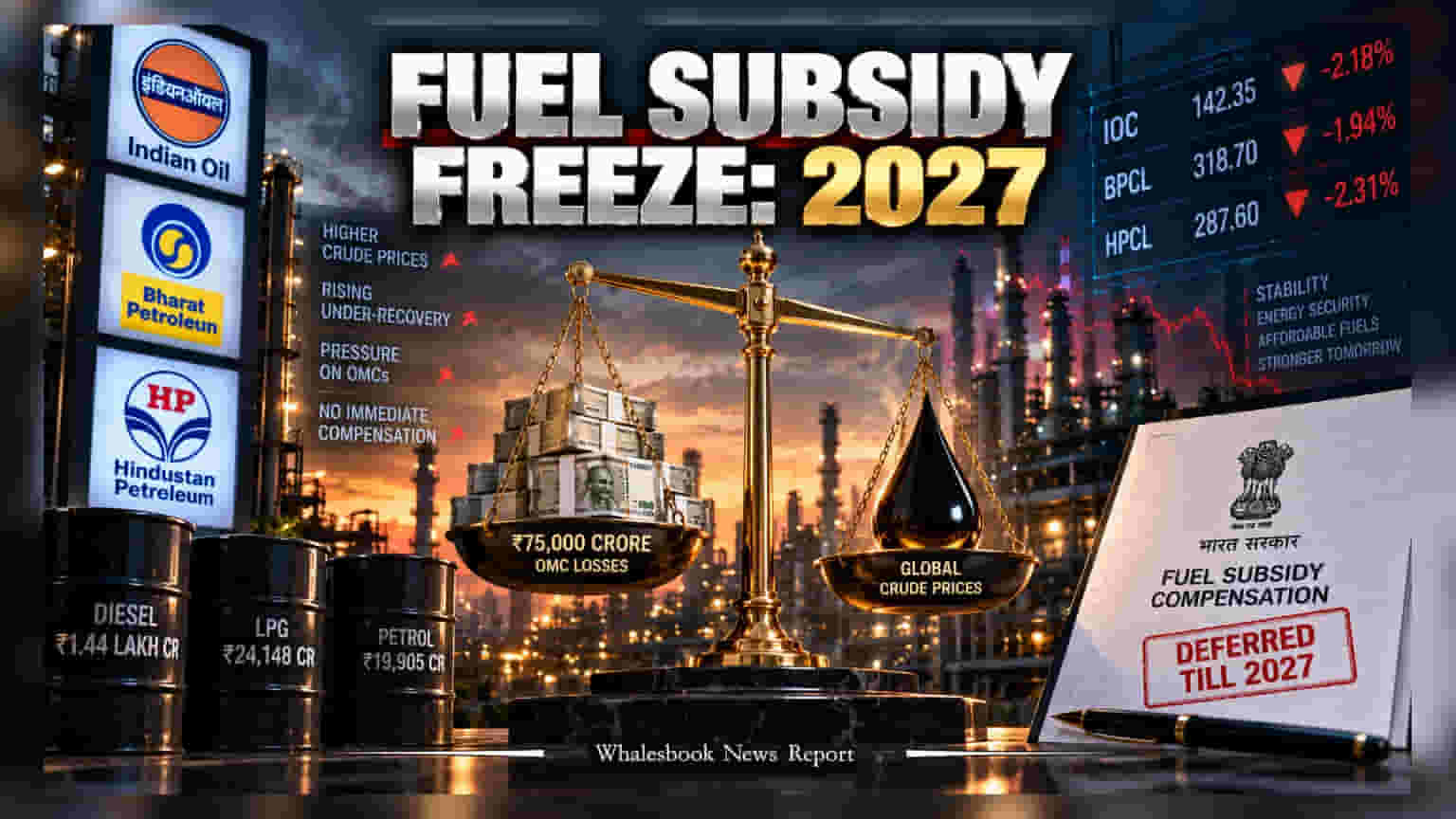
The government has postponed the decision to compensate state-run oil marketing companies—IOC, BPCL, and HPCL—for fuel under-recoveries until 2027. Despite requests for ₹75,000 crore to cover Q1 losses, the administration will monitor medium-term trends instead. This move forces companies to manage financial pressure from high global crude prices internally, raising concerns about margin stability and capital spending.
The central government has decided against providing immediate cash compensation to state-run oil marketing companies (OMCs) for their fuel sales losses, delaying any such decision until 2027. This development affects Indian Oil Corporation (IOC), Bharat Petroleum Corporation (BPCL), and Hindustan Petroleum Corporation (HPCL), which had collectively sought ₹75,000 crore in support to cover costs incurred during the April-June 2026 quarter.
The financial strain on these entities has been significant due to elevated global crude oil prices, driven by geopolitical tensions in West Asia. During the April-June quarter, the cumulative under-recovery—the difference between the cost to procure and process fuel and the price at which it is sold to consumers—reached ₹1.88 lakh crore. Diesel sales accounted for the largest share of this burden at ₹1.44 lakh crore, while losses on LPG and petrol stood at ₹24,148 crore and ₹19,905 crore, respectively.
Government officials indicated that the decision to defer compensation is intended to avoid reactive fiscal interventions based on short-term price volatility. Instead, the administration plans to monitor how fuel losses evolve over the medium term. The expectation is that global crude supply gluts may eventually emerge, helping to soften prices and reduce the pressure on domestic fuel retailers.
For investors, this decision places the immediate financial burden of maintaining fuel prices on the balance sheets of the three OMCs. Historically, these companies have managed such periods by balancing losses in their fuel marketing division with gains from their refining operations. However, if crude prices remain sustained at high levels, the profit margins of the marketing division may come under continued pressure. Market participants will likely track whether this sustained absorption of costs influences the planned capital spending or expansion projects of these companies in the coming quarters.
The key focus for shareholders will be the monthly and quarterly trends in refining and marketing margins. The companies' ability to maintain profitability and cash flow without government intervention remains a primary monitorable. Future updates on global crude oil trends and management commentary regarding debt management or capital allocation will be important to watch as the companies navigate this period without direct fiscal support.