

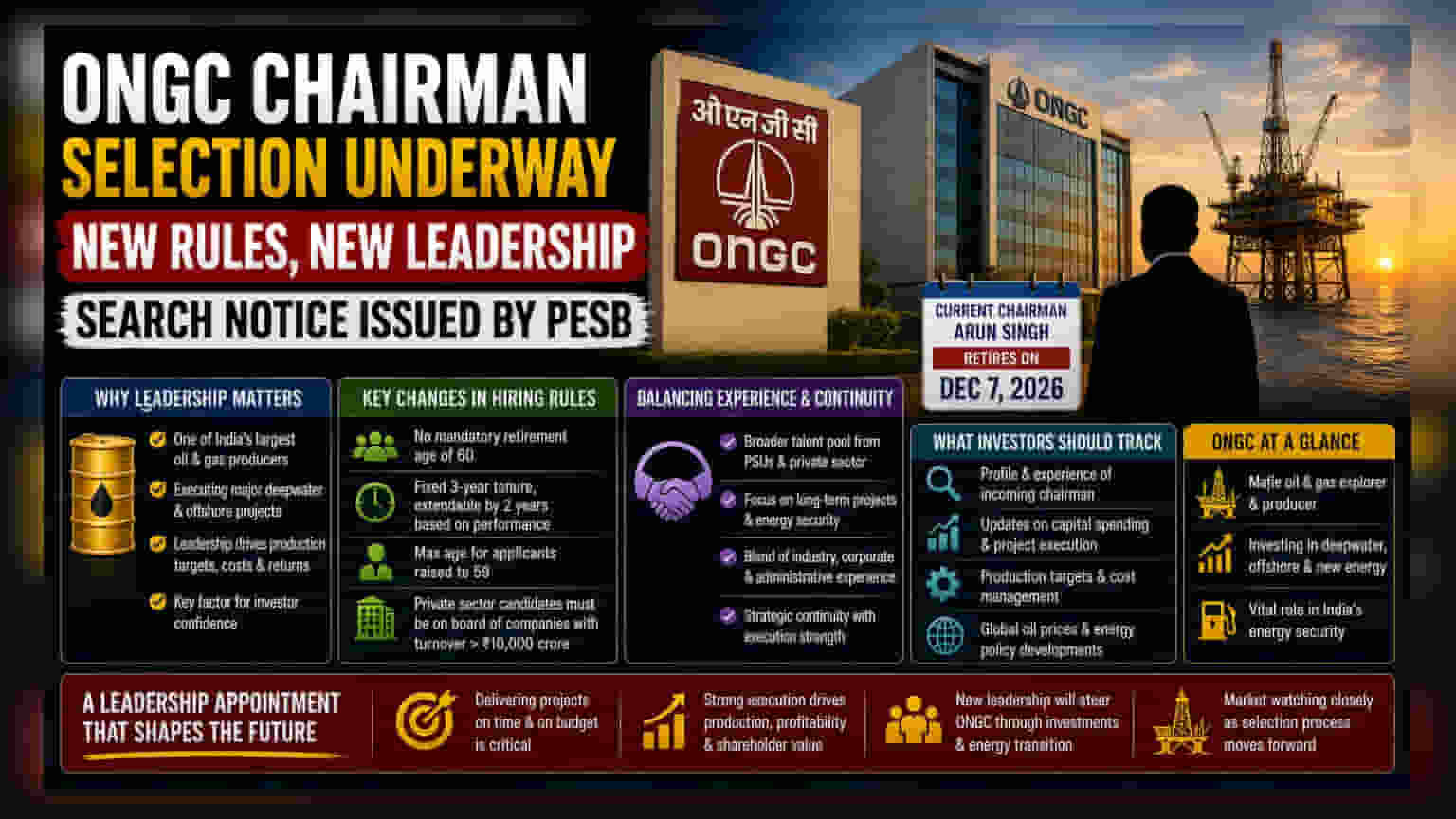
The government has opened applications for a new ONGC chairman to succeed Arun Singh, who retires in December 2026. New guidelines introduce a fixed three-year tenure and higher age limits to attract experienced candidates from both the public and private sectors. This change aims to ensure leadership stability as the state-owned energy giant pursues its production and expansion goals.
What Happened
The government has initiated the process to select the next chairman for Oil and Natural Gas Corporation (ONGC). This follows the upcoming retirement of the current chairman, Arun Singh, who is set to step down on December 7, 2026. The Public Enterprises Selection Board (PESB) has released a search notice with revised eligibility criteria, marking a shift in how the state-owned energy company approaches its top-level appointments.
Why Leadership Matters for Investors
For shareholders, the leadership of a large company like ONGC is a key factor. As one of the country's largest oil and gas producers, ONGC is currently balancing significant capital spending on deepwater and offshore fields with the need to maintain or increase production levels. Investors look for leadership that can execute these large projects without delays or cost overruns. A change in leadership always brings questions about strategic continuity, so the market often watches whether the new management will stick to the existing production targets or introduce new goals.
Key Changes to Hiring Rules
To attract a broader pool of talent, the government has updated its recruitment requirements. Previously, candidates had to adhere to a mandatory retirement age of 60. The new guidelines remove this age limit as a barrier for the chairman role, instead offering a fixed three-year tenure, which can be extended by an additional two years based on performance.
Additionally, the maximum age for applicants has been raised to 59. The criteria for private sector candidates have also been clarified; those applying must be serving on the board of a company with an annual turnover exceeding ₹10,000 crore. This move suggests an intent to bring in top-tier industry experience, whether from government bodies or large private firms.
Balancing Experience and Continuity
The appointment of the ONGC chairman is a strategic move, as the company operates in a sector where global oil prices and domestic energy security play a major role. By allowing for a fixed, extendable tenure, the government aims to provide the new leader enough time to oversee long-term projects rather than dealing with the uncertainty of short-term tenures. The inclusion of private sector executives also reflects a growing trend in state-owned enterprises to invite leaders with a mix of corporate and administrative experience.
What Investors Should Track
As the search progresses, the key monitorable for investors will be the experience and background of the incoming candidate. While the announcement of the new chairman is expected later this year, investors may watch for any updates on ONGC's ongoing capital spending programs and production targets. The ability of the new leadership to navigate the company's ambitious investment plans and manage operating costs will be critical in the coming quarters.