

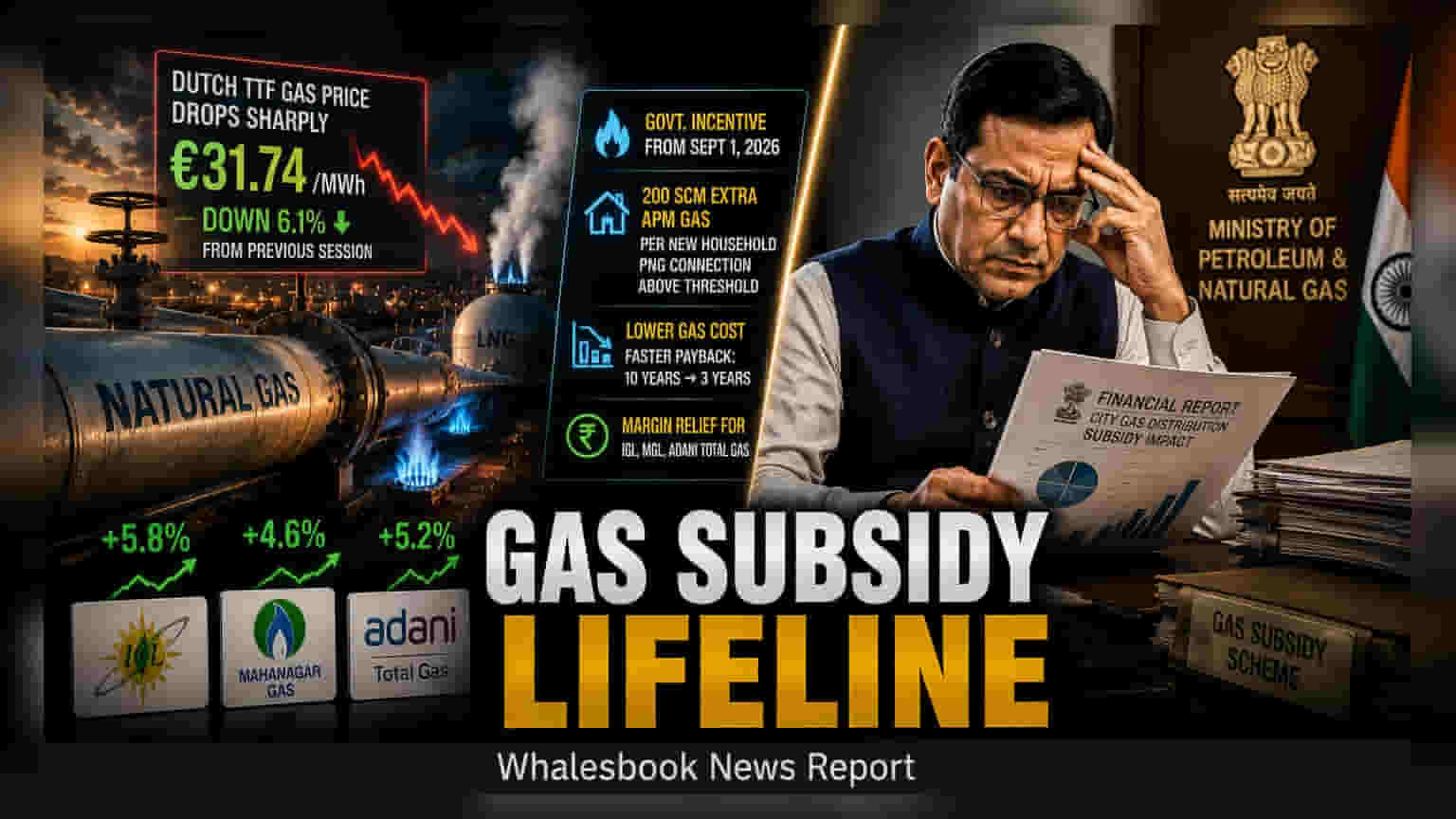
Starting September 1, 2026, the government will provide City Gas Distribution firms like Indraprastha Gas and Mahanagar Gas with additional lower-cost APM gas for every new household connection. This initiative aims to help companies lower procurement costs and improve margins, which faced significant pressure in the June quarter. While the policy provides a short-term breather, investors should note the one-time nature of this benefit amidst ongoing sector headwinds.
Starting September 1, 2026, the central government is launching an incentive scheme for City Gas Distribution (CGD) companies in India. The policy offers an additional allocation of 200 standard cubic metres (SCM) of gas under the Administered Price Mechanism (APM) for every new billed household Piped Natural Gas (PNG) connection added above a specific threshold. This move is designed to support companies like Indraprastha Gas (IGL), Mahanagar Gas (MGL), and Adani Total Gas by allowing them to substitute a portion of their more expensive market-linked gas with cheaper, state-allocated supplies.
Impact on Margins and Infrastructure
For CGD companies, the primary cost challenge has been the reliance on high-cost imported Liquefied Natural Gas (LNG) to meet demand once their cheaper APM gas quota is exhausted. By increasing the allocation of low-cost APM gas, this scheme helps lower the overall average cost of gas procurement. Industry estimates suggest this could significantly reduce the payback period for new household connections—the time required for a new customer's gas usage to recover the cost of the initial infrastructure investment—potentially bringing it down from roughly 10 years to approximately 3 years.
Following the announcement on August 19, 2026, stocks of major CGD players, including IGL, MGL, and Adani Total Gas, saw a temporary rally of between 4% and 6%. This positive market response reflects investor hope for margin recovery following a difficult June quarter (Q1FY27), where IGL and MGL reported significant year-on-year declines in their EBITDA of 42% and 12%, respectively. These results highlighted the margin pressure companies have been facing due to elevated gas prices.
Caution Amidst Short-Term Relief
While the scheme provides a financial cushion, it is important to consider its limitations. The program is structured as a one-time, six-month incentive. Because it is not a permanent structural change, it may not resolve the long-term volatility that these companies face regarding global gas prices and policy changes. Furthermore, the actual benefit for shareholders will depend on how quickly these companies can add new, active connections and whether they choose to pass on some of these cost savings to consumers to spur adoption, which could reduce the net benefit to their own profit margins.
Investors should closely track the pace of new household customer additions and future management commentary on gas procurement costs. The key monitorable will be whether this additional APM allocation leads to a sustained improvement in profit margins in the coming quarters, or if the benefit remains limited due to high operating costs and slowing expansion in certain regions.